
Last updated: 8 November 2026
In short: Probably, yes. Two large molecular studies have found that the body does not age at a steady pace but in waves, with the sharpest changes clustering around the mid forties and around sixty, in men as well as women. The findings are about molecules in blood, not wrinkles, and the studies have real limits, but they fit what I see in clinic and what the skin research has shown for decades: faces tend to change in steps, after long plateaus. That has practical consequences for when to protect, when to assess and when to treat.
Almost everyone who sits down in my consultation room in Hale says a version of the same thing: "I looked the same for years and then, in about eighteen months, everything changed." Patients in their mid forties say it. Patients around sixty say it. For a long time medicine treated this as a trick of perception, on the grounds that ageing is a slow, steady slope and people simply stop noticing until something tips them into noticing. Recent research suggests the patients were right and the slope was wrong.
This article looks at the evidence that we age in bursts rather than in a straight line, what the two most cited studies actually measured and how much weight they can bear, why the face in particular seems to change in steps, and what, if anything, you should do differently at the ages the data points to.
In this article:
- Do we age in bursts? What the Stanford study found
- The earlier evidence: three waves in the blood
- How much can these studies tell us? The caveats
- Why the face in particular ages in steps
- The two ages that matter most for your face, and what happens at each
- What to do at the mid forties checkpoint
- What to do at the sixty checkpoint
- Does this mean the years in between do not matter?
- What happens at my clinic in Hale
- Frequently asked questions
Do we age in bursts? What the Stanford study found
In August 2024 a team at Stanford led by Professor Michael Snyder published a study in the journal Nature Aging that followed 108 adults aged 25 to 75 for several years, taking regular blood, stool, skin, nasal and oral samples and measuring more than 135,000 different molecules and microbes in them, nearly 250 billion data points in all. The question was simple: do these molecules change steadily with age, or not?
They did not. For most of the molecules measured, levels stayed fairly stable for years and then shifted sharply, and the shifts clustered at two ages.
"We're not just changing gradually over time; there are some really dramatic changes." Professor Michael Snyder, Stanford Medicine, senior author of Nonlinear dynamics of multi-omics profiles during human aging, Nature Aging, 2024.
The detail that matters most for this article is a small one: skin and muscle pathways were among those that shifted at both 44 and 60. The study did not photograph faces or measure wrinkles, but the molecular machinery that maintains skin was changing at exactly the ages my patients point to.
The earlier evidence: three waves in the blood
The Stanford paper was not the first to find waves. In 2019 a different Stanford group, led by Tony Wyss-Coray, published a study in Nature Medicine of nearly 3,000 proteins in the blood of more than 4,000 people aged 18 to 95. Protein levels did not drift steadily with age; they changed in three waves, peaking at around 34, 60 and 78. Roughly a third of all the proteins measured changed markedly across the lifespan, and the pattern was undulating rather than linear.
The two studies disagree on the earlier wave, 34 in one and 44 in the other, which is a reminder that the exact ages are less important than the shape. Two independent groups using different methods both found that the body ages in steps, and both found one of those steps at around sixty.
How much can these studies tell us? The caveats
As a GP I would not be doing my job if I passed these findings on without their limits, which the authors themselves are careful about.
With those limits in mind, the findings still earn their place, because they agree with something the skin literature has shown for forty years without anyone calling it a burst.
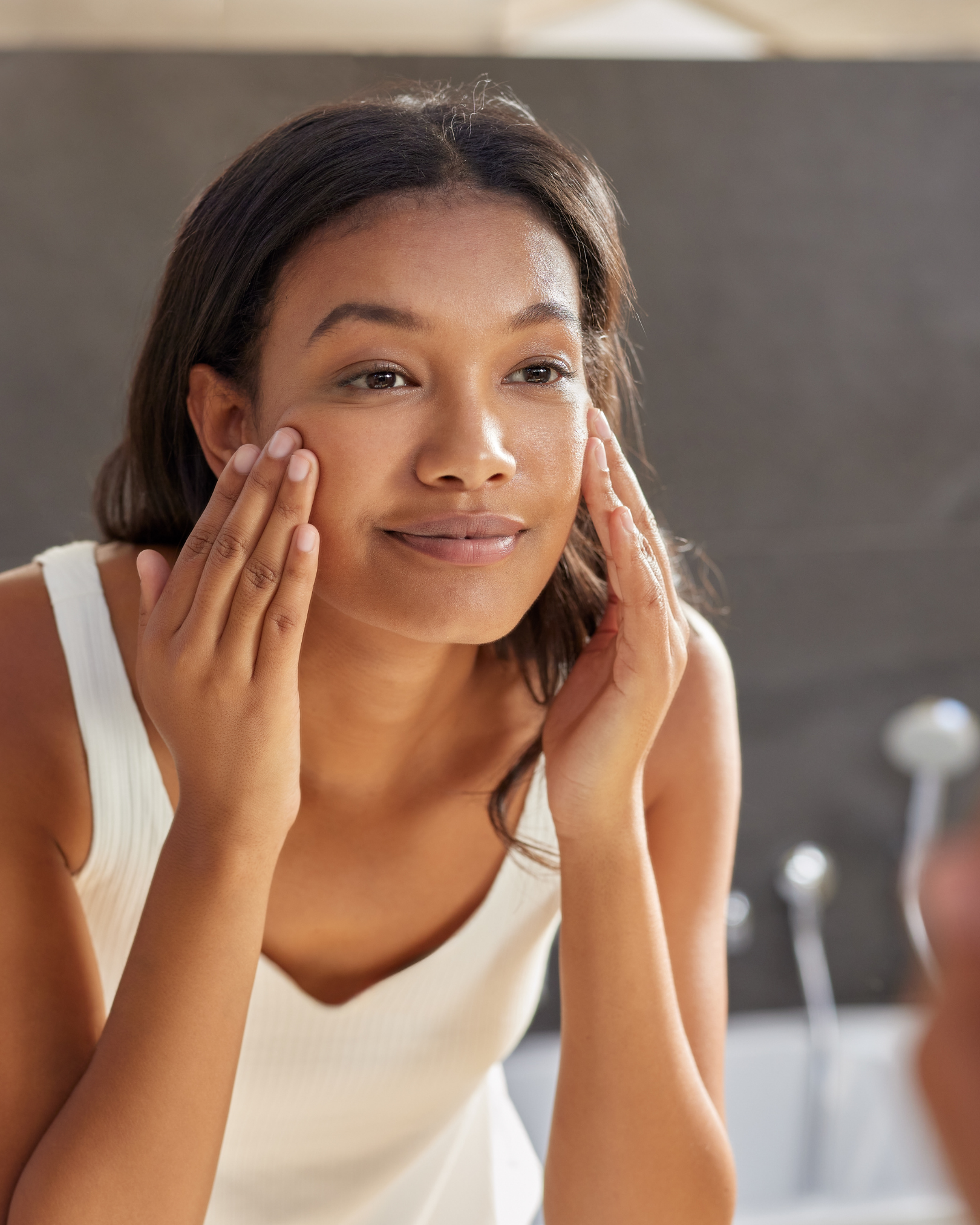
Why the face in particular ages in steps
Long before anyone measured 135,000 molecules, dermatologists had found that the skin does not age smoothly. Skin collagen declines by about one per cent a year through adult life, and then, in women, by up to 30 per cent in the five years after the menopause before settling to a slower rate. That is a step by any definition, and it lands squarely in the first burst for women. The facial skeleton also changes in a non uniform way, with the eye sockets widening and the upper jaw receding at rates that accelerate in later life, and the mid face fat compartments shift and thin in a pattern that CT studies show is concentrated in particular decades rather than spread evenly.
On top of the biology, the face has a property that makes steps inevitable even if the underlying decline were smooth: thresholds.
So the face would look as though it aged in steps even if the body did not, and the body, it turns out, does too. The two effects stack, which is why the mid forties and around sixty are the two moments when patients most often tell me they no longer recognise themselves.
The two ages that matter most for your face, and what happens at each
What to do at the mid forties checkpoint
If the body is going to change in a burst, the useful response is to arrive at the burst in good order and to reassess on the far side of it, rather than to panic in the middle. For the mid forties that means three things.
What I would not do in the mid forties is reach for volume. The flattening cheek and deepening fold at 45 are early, the structure is mostly intact, and filler added now is the volume women most often regret at 55. Skin quality and prevention in the mid forties; structure, if needed, in the fifties. For the fuller picture of this decade see why your face changes in your forties.

What to do at the sixty checkpoint
Does this mean the years in between do not matter?
No, and this is the misreading I most want to head off. The plateaus between bursts are when the reserve is built or spent. A face that arrives at 44 with twenty years of daily sunscreen, a decade of retinoid and no cigarettes has more collagen for the burst to take a percentage of, and crosses its thresholds later and more gently. A face that arrives at 60 with a well maintained mid face and a strong neck has less structure to lose. The bursts decide when the change shows. The plateaus decide how much there is to show.
What happens at my clinic in Hale
Patients come to the clinic from Hale, Altrincham, Bowdon, Hale Barns, Timperley, Sale, Wilmslow, Alderley Edge, Knutsford and Didsbury, and the two commonest ages on my consultation list are, unsurprisingly, the mid forties and around sixty. Arriving a year or two before the burst, with a baseline and a plan, is the quiet advantage the research offers.
Takeaway: The body appears to age in waves rather than a straight line, with bursts of molecular change around the mid forties and sixty, and the face, which works on thresholds, changes in steps for reasons of its own. The two effects stack, which is why so many people feel they aged overnight at 45 or 60. Build reserve in the plateaus, protect and photograph through the bursts, rebuild afterwards, and treat the face in front of you rather than the age on the form.

Frequently asked questions about ageing in bursts
Do humans really age in bursts rather than gradually?
The best current evidence says yes. A 2024 Stanford study of more than 135,000 molecules in 108 people found that most changed little for years and then shifted sharply at around 44 and 60. An earlier study of blood proteins in more than 4,000 people found waves at 34, 60 and 78. Both are about molecules rather than appearance, and both have limits, but both find steps, not a slope.
At what ages do you age the fastest?
According to the 2024 study, the mid forties and around sixty. The 2019 protein study found peaks at 34, 60 and 78. The exact ages vary between studies and between people; the agreement is on the shape and on a burst around sixty.
Why do I look older suddenly at 45?
Three things coincide. The body's molecular ageing accelerates in the mid forties, including pathways that maintain skin and muscle. For women, the menopause collagen cliff often begins. And the face works on thresholds: years of slow collagen and fat loss cross the point where a line stays at rest or a cheek stops holding up a fold, so changes that were decades in the making become visible in months.
Is the mid forties burst just the menopause?
No. The Stanford researchers expected it to be and found the same changes in men. For women the menopause adds its own, steeper, collagen loss on top of the shared burst, which is one reason women often notice the mid forties change more sharply than men do.
Why do I suddenly look like my mother at 60?
Because the second burst falls on structure. By sixty the facial skeleton has receded, the deep fat has thinned and shifted, and the skin is thinner and less elastic; the sixty burst in metabolism, immunity and muscle coincides with those thresholds being crossed. Family resemblance shows most when the underlying frame is what is on display.
Can you slow or prevent an ageing burst?
You can change how much it has to take. Daily SPF, a retinoid, not smoking, sleep, strength training and moderate alcohol build the reserve that a burst then takes a percentage of. The authors of the 2024 study also note that some of the mid forties change in alcohol and caffeine metabolism may reflect behaviour, which is within your control.
Should I have aesthetic treatments before or after a burst?
Protect and build skin quality before and during, with SPF, a retinoid and collagen stimulating treatments such as polynucleotides or microneedling. Rebuild structure after, once the face has settled, with Sculptra, Radiesse or carefully placed filler as needed. Treating structure in the middle of a change means treating a face that will not exist in a year.
What is the best age to start anti ageing treatment?
Prevention starts in the twenties with sunscreen. Skin quality treatment makes sense from the late thirties or early forties. Structural treatment makes sense when structure has been lost, which for most people is the fifties. The research on bursts supports getting a baseline assessment in the early to mid forties, before the first big change.
Does everyone age at 44 and 60?
No. These are averages from relatively small studies. Genetics, sun exposure, smoking, weight change, illness and the timing of the menopause move the steps earlier or later, and some people change more gradually. The consultation assesses your face, not your date of birth.
Are these studies reliable?
They are good studies with clear limits: the 2024 one followed only 108 people, neither measured appearance directly, the earlier one compared different people at one moment rather than following individuals, and behaviour may explain part of the pattern. They should be read as a plausible explanation for something patients have described for years, not as a timetable.
Next steps
If you are approaching your mid forties or sixty, or feel you have just come through a change you did not see coming, book a consultation at the clinic in Hale. We will take a baseline, work out which phase your face is in and what is still moving, and build a plan that fits it, including, where it is the right answer, waiting.
Learn more about Dr Caroline Warden Clinic
Learn more about other treatments offered
Further reading
- The Best Aesthetic Treatments for Your 30s, 40s, 50s and Beyond
- Why Your Face Changes in Your 40s and What Actually Helps
- Why Some Women Feel They Have Aged Overnight
- Does Menopause Make You Look Older?
- Why Collagen Declines and the Treatments That Actually Stimulate It
- Has My Face Fallen? Cheek Filler, Sculptra and Radiesse Compared
- Polynucleotides in Hale and Altrincham (for skin quality before and during a burst)
- Sculptra in Hale and Altrincham (for rebuilding structure afterwards)
Dr Caroline Warden (GMC 6157708) is an NHS GP with over 19 years of clinical experience, an independent prescriber, and holds a Level 7 postgraduate diploma in cosmetic injectables. She has practised aesthetic medicine since 2017 and is the sole practitioner at Dr Caroline Warden Skin & Aesthetic Clinic, which she runs with her sister Louise at 2 Crown Passages, Hale, Cheshire, WA15 9GN, serving patients from Hale, Altrincham, Bowdon, Hale Barns, Timperley, Sale, Alderley Edge, Wilmslow, Knutsford, Didsbury and across Cheshire and South Manchester. The clinic was named Best Doctor Led Aesthetic Clinic in Cheshire 2026 by GHP. The clinic is an authorised Obagi stockist and sells skincare products; this is a commercial interest and is declared here. The clinic does not diagnose or treat medical conditions; blood pressure, blood sugar, the menopause and other health matters raised in this article are for your own GP, and prescription only medicines are prescribed following a face to face consultation and are not promoted here. This article provides general educational information and does not replace an individual consultation.
References
- Shen X, Wang C, Zhou X, et al. Nonlinear dynamics of multi-omics profiles during human aging. Nature Aging 2024;4: pages 1619 to 1634. Read the study
- Stanford Medicine. Stanford Medicine researchers find that aging is not linear, with bursts of change around 44 and 60. News release, August 2024, reported by Longevity Technology. Read the report
- Lehallier B, Gate D, Schaum N, et al. Undulating changes in human plasma proteome profiles across the lifespan. Nature Medicine 2019;25(12): pages 1843 to 1850. Read the abstract
- National Institutes of Health. Blood protein signatures change across lifespan. NIH Research Matters, December 2019. Read the summary
- Brincat M, Kabalan S, Studd JW, et al. A study of the decrease of skin collagen content, skin thickness, and bone mass in the postmenopausal woman. Obstetrics and Gynecology 1987;70(6): pages 840 to 845. Read the abstract
- Shuster S, Black MM, McVitie E. The influence of age and sex on skin thickness, skin collagen and density. British Journal of Dermatology 1975;93(6): pages 639 to 643. Read the abstract
- Gierloff M, Stöhring C, Buder T, et al. Aging changes of the midfacial fat compartments: a computed tomographic study. Plastic and Reconstructive Surgery 2012;129(1): pages 263 to 273. Read the abstract
- Mendelson B, Wong CH. Changes in the facial skeleton with aging: implications and clinical applications in facial rejuvenation. Aesthetic Plastic Surgery 2012;36(4): pages 753 to 760. Read the abstract