Facial Volume Loss Treatment in Hale, Altrincham and Cheshire

Last updated: 30 September 2026
Hollow cheeks, sunken temples, deeper folds and a face that looks tired or gaunt
Patients rarely come in saying "I have facial volume loss". They say their face looks flatter, hollower, more tired or older than they feel. Cheeks that used to be full have dropped. Temples have sunk. Folds around the mouth have deepened. The jawline has softened. Sometimes it has happened slowly over a decade; sometimes it has happened in six months after significant weight loss.
Volume loss is the single biggest reason a face changes shape with age, and it is also the most commonly mistreated. The reflex answer in many clinics is filler in the cheeks. At my clinic in Hale, near Altrincham, I start somewhere else: which layer of the face has changed, and what will restore it without making you look filled.
In this article:
- What does facial volume loss look like?
- Why does the face lose volume?
- Where does volume loss show first?
- Why is filler not always the answer?
- Which treatments restore facial volume?
- Facial volume loss after weight loss and Mounjaro
- When injectables are not enough
- How much does treatment cost in Hale and Altrincham?
- Frequently asked questions
What does facial volume loss look like?
Most people notice the effect before they understand the cause. The table below matches what you see in the mirror to what has actually changed underneath.
The face does not simply sag. It deflates, and then it drapes. Treat the deflation and much of the draping resolves on its own.
Why does the face lose volume?
A youthful face is a set of smooth convex curves: full cheeks, rounded temples, a continuous line from lower eyelid to cheek. Those curves are built from four layers, and every one of them changes with age. Plastic surgeons Sydney Coleman and Rajiv Grover described facial ageing in the Aesthetic Surgery Journal as
"a complex synergy of skin textural changes and loss of facial volume."
Coleman SR, Grover R. Aesthetic Surgery Journal, 2006
On top of the normal timeline sit the accelerators: menopause, which removes oestrogen's support for collagen and fat distribution; significant or rapid weight loss, which strips facial fat from every compartment at once; genetics; smoking; and lifelong sun exposure. I explain the anatomy in more detail in the Triangle of Youth: why your face changes shape, and the hormonal side in menopause and facial ageing explained.
Where does volume loss show first?
Temples
The temples hollow early and are rarely the first thing a patient mentions, yet they sit at the junction of forehead, brow, eye and cheek, so restoring them changes the balance of the whole upper face. Read Sculptra for hollow temples.
Cheeks and midface
The cheek is the keystone. When the deep cheek fat shrinks, everything below it descends: the under-eye shadows deepen, the nasolabial fold sharpens, the corner of the mouth turns down. This is why I nearly always assess the cheek before treating anything lower. Read has my face fallen? Restoring midface support without overfilling.
Under the eyes
Most under-eye hollowing is really cheek volume loss viewed from above. I do not routinely fill the tear trough; I look at the cheek first. Read my under-eye treatment guide.
Around the mouth and lower face
Folds beside the mouth and marionette lines are usually the result of volume loss higher up, not a problem in their own right. Filling them directly tends to look heavy. Jawline softening and jowls belong here too; read what actually works for jowls and why Radiesse is so effective for jawline definition.
In front of the ears
The preauricular area hollows quietly with age and after weight loss, and restoring it is one of the least noticed, most effective ways of lifting the lateral face. It is one of the zones I treat in the Sculptra lifting protocol.

Why is filler not always the answer?
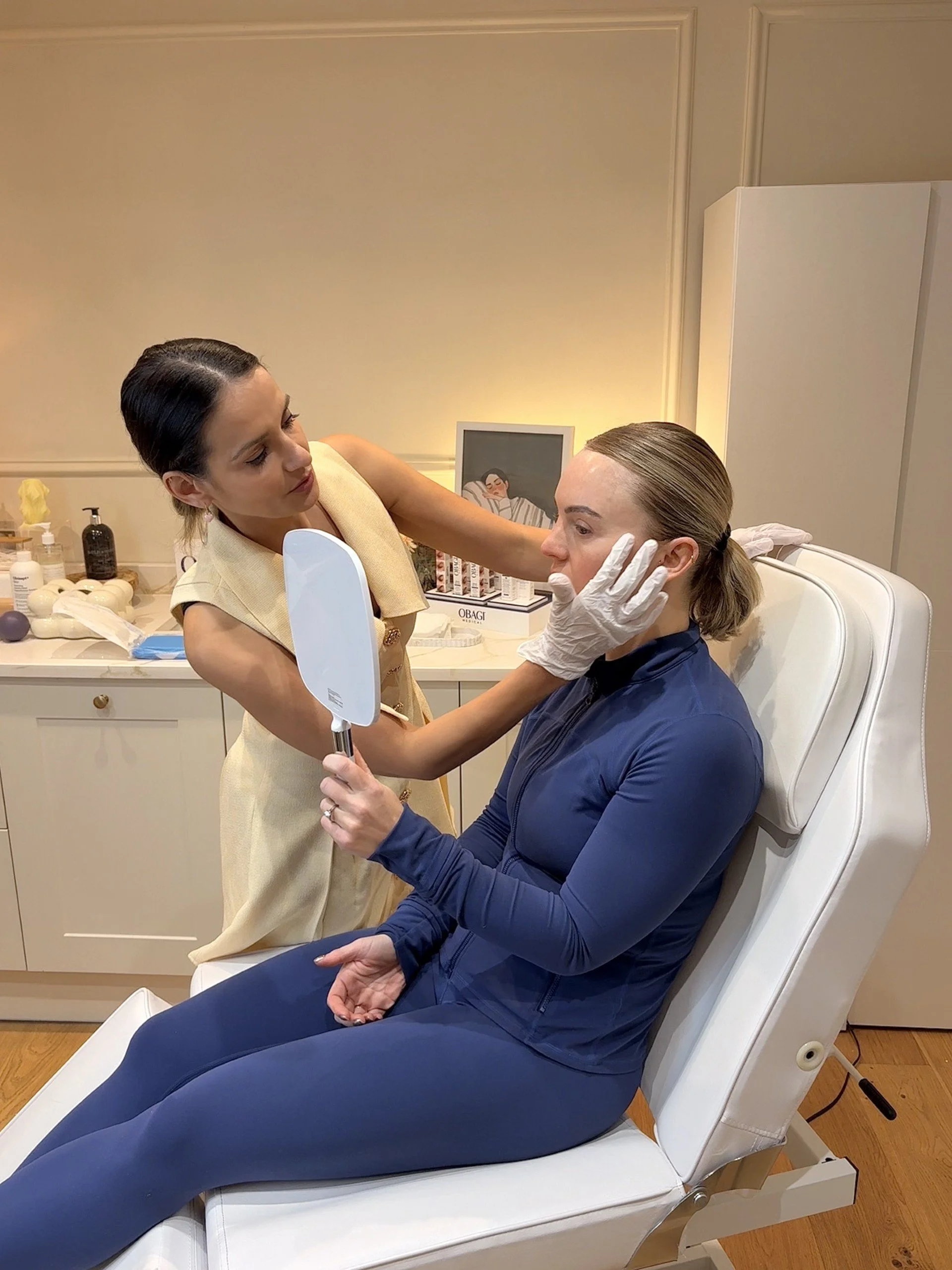
Hyaluronic acid filler is precise, immediate and reversible, and in the right place it is excellent. But it replaces volume in one spot. When a face has lost volume everywhere, chasing that loss with syringe after syringe of filler produces the look everyone recognises and nobody wants: the pillowy cheek, the heavy midface, the face that has clearly "had something done". The aesthetics industry now has a name for what patients are feeling about this, and I wrote about it in filler fatigue: why less filler, more structure is the biggest shift in aesthetics.
My approach is structure first:
Filler replaces what you have lost. Biostimulators rebuild it. For most faces over 45 with volume loss, rebuilding is the more natural, more durable and ultimately cheaper route.
Which treatments restore facial volume?
For a direct comparison of the two collagen stimulators, read Sculptra vs Radiesse: which is right for you?
Facial volume loss after weight loss and Mounjaro
Losing a significant amount of weight, however you do it, removes fat from the face as well as the body, and the face usually shows it first. Cheeks flatten, temples sink, skin that was stretched over fullness now drapes, and the result can be a face that looks five to ten years older than it did at the start.
What is Mounjaro face?
"Mounjaro face" or "Ozempic face" is not the medicine ageing the face. It is rapid fat loss revealing volume depletion that was already underway, at a pace the skin cannot keep up with. The treatment logic is the same as for any volume loss, with one addition: timing. I usually advise waiting until weight has been stable for around three months before structural treatment, so that we are restoring a face that has stopped changing. Sculptra is my usual first choice here because it rebuilds broadly and gradually, and its collagen response also helps the skin recover. Read why Sculptra may be one of the best treatments for Mounjaro face and what Mounjaro face is and what you can do about it.
When injectables are not enough
Injectables restore volume and improve skin. They do not remove skin. If the dominant problem is loose, excess skin rather than deflation, particularly along the jaw and neck, the honest answer is a surgical opinion, and I would rather give you that at consultation than take you through a course of treatment that cannot deliver what you want. Most patients from Hale, Bowdon, Altrincham, Wilmslow and Alderley Edge who come to me with volume loss are well within what biostimulators and skin treatments can achieve. Some are not, and I will tell you which you are.
How much does facial volume loss treatment cost in Hale and Altrincham?
A new-patient consultation is £75, redeemable against treatment. Sculptra is priced per vial rather than per area, and a typical course for broad volume loss is two to three sessions; I set out the full course cost and how it compares with filler over two years in Sculptra cost in Hale and Altrincham. Radiesse, filler, polynucleotide and skin booster prices are on the price list. Because volume loss is usually treated over a few months, I will give you a total plan cost at consultation rather than a single-session figure.
Your consultation
I assess your face in three dimensions, at rest and moving: bone support, deep and superficial fat, ligament laxity, skin quality, and how the upper, mid and lower face relate to one another. I take a medical history, ask about weight change and hormones, and look at any previous treatment. Then I tell you which layer is driving what you see, what will help, what will not, and in what order. Every consultation and every treatment at the clinic is carried out by me personally. There is no pressure to proceed, and if what you need is not something I offer, I will say so.
Book a consultation for facial volume loss
Frequently asked questions
How do I know if I have facial volume loss?
Compare a photograph from ten years ago, taken in similar light. If the cheeks are flatter, the temples more concave, the folds beside the mouth deeper and the face generally narrower or more tired, that is volume loss. A consultation confirms which layer is responsible.
What is the best treatment for facial volume loss?
For broad, diffuse loss, a collagen stimulator such as Sculptra. For one precise deficit, hyaluronic acid filler. For jawline definition, Radiesse. For thin skin over reasonable volume, skin-quality treatment. Most people over 45 need a combination, staged over a few months.
Is Sculptra better than filler for volume loss?
For widespread deflation, usually yes: it rebuilds your own collagen gradually, looks natural and lasts longer. For a single focal correction, filler is more precise. They are different tools rather than competitors.
Can facial volume loss be reversed?
Substantially, yes. Bone loss cannot be reversed, but the fat and collagen layers can be rebuilt and the skin improved, which restores most of what people notice.
Does menopause cause facial volume loss?
It accelerates it. Falling oestrogen speeds collagen loss and changes fat distribution, which is why many women describe their face changing within a few years either side of menopause.
What causes hollow cheeks?
Loss of the deep cheek fat pads, receding cheekbone support, and sometimes weight loss or genetics. Restoring the deep support usually lifts the whole midface.
What is Mounjaro face?
Rapid facial fat loss during weight loss with GLP-1 medication, revealing volume depletion faster than the skin can adapt. It is treated like any volume loss, once weight is stable.
Should I wait until my weight is stable before treatment?
Ideally yes, for structural treatment: around three months of stable weight. Skin-quality treatment and skincare can start sooner.
Can you treat hollow temples?
Yes, and it is one of the most rewarding areas. Sculptra is my usual choice.
Will restoring volume make my face look puffy?
Not if the right layer is treated in the right amount. Puffiness comes from filler placed superficially or in excess. Collagen stimulation placed deep rebuilds rather than inflates.
How many treatments will I need?
Typically two to three Sculptra sessions for broad loss, with results developing over three to six months and a maintenance session every eighteen months to two years. Filler and Radiesse are usually single sessions with annual review.
Can facial volume loss cause jowls?
Yes. As the cheek deflates, lower-face fat descends over the jaw and the jowl forms. Restoring cheek support is often the first step in treating jowls.
Related reading
- Why Sculptra may be one of the best treatments for Mounjaro face
- The Triangle of Youth: why your face changes shape with age
- Sculptra vs Radiesse: which collagen stimulator is right for you?
- Filler fatigue: why less filler, more structure is the biggest shift in aesthetics
- Sculptra for hollow temples
- What actually works for jowls?
Next steps
Learn more about Dr Caroline Warden Clinic
Learn more about other treatments offered
References
- Coleman SR, Grover R. The anatomy of the aging face: volume loss and changes in 3-dimensional topography. Aesthet Surg J. 2006;26(1 Suppl):S4-S9.
- Mendelson B, Wong CH. Changes in the facial skeleton with aging: implications and clinical applications in facial rejuvenation. Aesthetic Plast Surg. 2012;36(4):753-760.
Written by Dr Caroline Warden, NHS GP with over 19 years of clinical experience, independent prescriber and Level 7 qualified aesthetic doctor. GMC 6157708. Dr Caroline Warden Skin & Aesthetic Clinic, 2 Crown Passages, Hale, Altrincham, Cheshire WA15 9GN.