Lip Lines and Lines Around the Mouth: Treatment in Hale, Altrincham and Cheshire
Last updated: 30 September 2026
Vertical lip lines, lipstick bleed and a mouth that looks older than the rest of your face
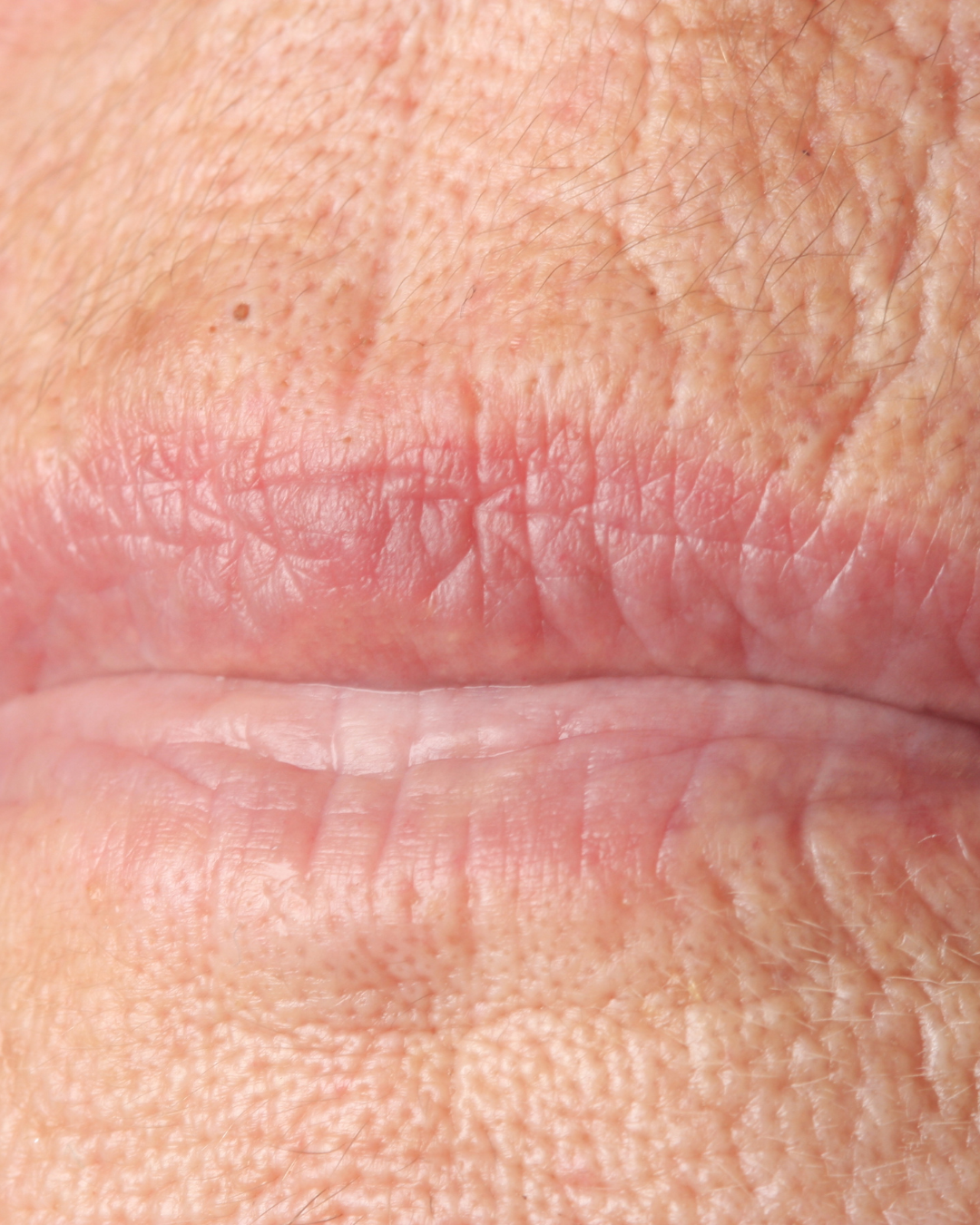
Lines around the mouth are among the most disliked signs of ageing and the most badly treated. Patients tell me their lipstick bleeds into little vertical channels above the lip, that the upper lip has thinned and lengthened, or that the corners of the mouth have started to turn down. Many are lifelong non-smokers who are offended by the phrase "smoker's lines". The medical term is perioral rhytids, and they happen to almost everyone.
The mouth is also the area where overtreatment shows most. Everyone has seen the overfilled lip, the flat upper lip that no longer moves, the lines filled one by one so the skin sits in ridges. At my clinic in Hale, near Altrincham, my approach to the mouth is deliberately conservative: work out why the lines are there, treat the cause, and never fill a line just because you can see it.
In this article:
- Why do lines form around the mouth?
- What are the different types of line around the mouth?
- Which treatments actually work for lip lines?
- What I avoid around the mouth, and why
- What results can you realistically expect?
- How much does lip line treatment cost in Hale and Altrincham?
- Frequently asked questions
Why do lines form around the mouth?
The lips are surrounded by a ring of muscle, the orbicularis oris, that contracts thousands of times a day when you speak, sip, kiss, purse and whistle. Over decades that movement folds the skin above the lip into vertical creases. On its own that would be manageable. The problem is that the skin around the mouth also ages faster than almost anywhere else on the face, for reasons set out in the table below. The authors of the largest trial of lip line treatment put it plainly: the area is
"highly mobile and subject to multifactorial changes during aging."
Sundaram H et al., Dermatologic Surgery, 2022

What are the different types of line around the mouth?
Patients say "lines around my mouth" and mean four different things. Each has a different cause and a different fix.
Vertical lip lines are a skin and muscle problem. Marionette lines are a support problem. They sit an inch apart and need opposite treatments.
Which treatments actually work for lip lines?
Anti-wrinkle injections around the mouth
Tiny doses placed into the ring muscle above the lip reduce the pursing that folds the skin, so lines soften and stop deepening. Done well, the lip moves normally and nobody can tell. Done badly, the upper lip goes weak, straws become difficult and speech feels odd, so dose and placement matter more here than anywhere else on the face. I use micro-doses and I always start conservatively. The same medicine, in a slightly different place, can also relax the muscle that pulls the corners of the mouth down. Anti-wrinkle injections use a prescription-only medicine, so whether they are suitable for you is decided at consultation, and I will discuss risks including temporary weakness, asymmetry and bruising. Read my anti-wrinkle injections page.
Soft hyaluronic acid filler for lip lines
Ordinary lip filler is the wrong product for lip lines: it is too firm, it adds bulk and it leaves ridges. What works is a very soft, flexible hyaluronic acid designed for mobile areas, placed superficially in tiny amounts, with the aim of hydrating and smoothing the skin rather than plumping it. This is where the best evidence sits. In a 202-patient randomised, evaluator-blinded trial published in Dermatologic Surgery, 80.7% of patients treated with a resilient hyaluronic acid for moderate to severe lip lines had a clinically meaningful improvement at 8 weeks, against 7.8% of untreated controls, and 66% were still improved a year later, with 88% satisfied at 12 months.
I use the RHA range for lips at my clinic because it is built for movement; I wrote about that choice, and how I minimise migration and the filled look, in natural-looking lip fillers in Hale. Where the upper lip has thinned and lengthened, a small amount of support at the lip border often does more for the lines above it than treating the lines directly. Read my dermal fillers page.
Skin boosters and polynucleotides
Where the skin above the lip is thin, dry and crinkled rather than deeply creased, improving the skin itself is the priority. Skin boosters rehydrate and plump the dermis; polynucleotides support the skin's own repair and thicken it gradually over a course. Both suit the perioral area because they add no volume and cannot migrate. Read my skin boosters page and polynucleotides page.
Prescription retinoids and daily SPF
The upper lip is one of the most sun-damaged sites on the face and almost nobody protects it. A prescription retinoid applied nightly to the upper lip, built up slowly because the skin here is sensitive, remodels collagen and softens fine lines over three to six months, and SPF every morning stops them coming back. This is the treatment I recommend to everyone with lip lines, whatever else we do. Read my medical-grade skincare page and retinol vs prescription retinoids.
Chemical peels and microneedling
For sun-damaged, crepey skin around the mouth, a course of medical peels or microneedling with exosomes improves texture and fine lines by resurfacing and stimulating collagen. They work best combined with the retinoid above and are a good option for people who want to avoid injectables entirely. Read my Perfect Peel page and microneedling page.
Which treatment for which problem?
What I avoid around the mouth, and why
Volumising lip filler for lip lines. A bigger lip does not smooth the skin above it; it usually makes the lines more visible and the mouth heavier. Lip volume and lip lines are separate questions.
Filling lines one by one. Threading firm filler into each vertical line creates ridges that are worse than the lines, and the product tends to migrate upward over time into the "filler moustache" everyone recognises.
Heavy anti-wrinkle doses. The ring muscle around the mouth is needed for eating, drinking and speaking. Overtreating it produces a stiff, flat upper lip and dribbling with a cup. Micro-doses only, and a review at two weeks.
Laser resurfacing. Ablative laser is effective for deep lip lines but I do not have lasers at the clinic, and the risk of pigment change in olive and darker skin is real. Where I think it is the right answer for you I will say so and point you to a colleague.
The mouth should keep moving. A softer line on a face that speaks and smiles normally beats a smooth one on a face that cannot.
What results can you realistically expect?
With the combination approach, expect lines that are visibly softer within two to three months, lipstick that stays put, and a mouth that looks in keeping with the rest of your face. Fine and moderate lines improve considerably. Deep, decades-old sun-etched creases soften but rarely vanish, and I would rather tell you that at consultation than after a course of treatment. Patients from Hale, Bowdon, Altrincham, Wilmslow and Alderley Edge who are happiest with this area are the ones who wanted to look less tired and less lined, not the ones who wanted a different mouth.
How much does lip line treatment cost in Hale and Altrincham?
A new-patient consultation is £75, redeemable against treatment. Because lip lines usually need a small amount of two or three things rather than a lot of one, I will give you a plan cost at consultation. Anti-wrinkle treatment around the mouth is usually a small area added to an upper-face treatment; soft filler for lip lines typically needs half to one syringe; skin boosters and polynucleotides are priced per course. Current prices are on the price list, and I explain how anti-wrinkle pricing works in what you are actually paying for.
Your consultation
I look at the mouth at rest and in movement, at the length and volume of the upper lip, the support behind it from the teeth and chin, the quality of the skin above it, and the wider face. I ask about smoking, vaping, straws, sun exposure and any previous lip treatment, and take a medical history. Then I tell you which of the four types of line you have, what will help, and what I would leave alone. Every consultation and treatment is carried out by me personally, an NHS GP and aesthetic doctor, and there is no pressure to proceed.
Frequently asked questions
What is the best treatment for lip lines?
Usually a combination: micro-dose anti-wrinkle injections for the muscle, a prescription retinoid and SPF for the skin, and where lines are etched at rest, a very soft filler placed superficially. Which mix depends on the type of line.
Why do I have smoker's lines when I have never smoked?
Because the main causes are pursing movement, sun damage and collagen loss, not smoking. Smoking accelerates them but is not required.
Can anti-wrinkle injections get rid of lip lines?
They soften lines caused by movement and stop them deepening. Lines etched into the skin at rest also need skin treatment or a soft filler.
Does lip filler get rid of lip lines?
Ordinary volumising lip filler does not, and often makes them more visible. A soft, flexible hyaluronic acid placed in the skin above the lip is a different treatment with good trial evidence.
Will treatment make my lips look bigger?
Not if that is not the goal. Lip line treatment adds little or no volume. If the upper lip has thinned, a small amount of border support may be suggested, and I will show you exactly what that means before anything is done.
Can lip lines be treated without injections?
Yes. Retinoids, medical peels and microneedling improve fine and moderate lines over a few months, and are a good route for people who want to avoid injectables.
Does menopause make lip lines worse?
Yes. Falling oestrogen accelerates collagen loss in the thin skin above the lip, which is why many women notice lines appearing within a few years of menopause.
Why does my lipstick bleed?
Because vertical lines act as channels. Softening the lines, and hydrating the skin so the channels are shallower, stops it.
How long do results last?
Anti-wrinkle effects last three to four months. Soft filler for lip lines lasted a year in two thirds of trial patients. Skin-quality treatments last as long as you maintain them with retinoid and SPF.
Can you treat marionette lines with filler?
Filling the line itself usually looks heavy. Marionette lines respond better to restoring support in the cheek and chin; see the volume loss and jawline guides.
Will people be able to tell?
Not if it is done conservatively. The aim is a mouth that looks rested and in keeping with your face, and that still moves normally.
Who is not suitable?
Anyone pregnant or breastfeeding, with an active cold sore or infection near the mouth, a history of keloid scarring, or certain neuromuscular conditions for anti-wrinkle treatment. Cold sore history is not a bar, but we plan around it.
Related reading
- Natural-looking lip fillers in Hale: why I choose the RHA range and how I minimise migration
- Lines and wrinkles: which type do you have?
- Retinol vs prescription retinoids: what the evidence shows
- Why your wrinkles are still there after anti-wrinkle injections
- Facial volume loss: why your face looks hollow and what helps
- Menopause and facial ageing explained
Next steps
Learn more about Dr Caroline Warden Clinic
Learn more about other treatments offered
References
- Sundaram H, et al. Efficacy and safety of a new resilient hyaluronic acid filler in the correction of moderate-to-severe dynamic perioral rhytides: a 52-week prospective, multicenter, controlled, randomized, evaluator-blinded study. Dermatol Surg. 2022;48(1):87-93.
- Ganceviciene R, Liakou AI, Theodoridis A, Makrantonaki E, Zouboulis CC. Skin anti-aging strategies. Dermato-Endocrinology. 2012;4(3):308-319.
Written by Dr Caroline Warden, NHS GP with over 19 years of clinical experience, independent prescriber and Level 7 qualified aesthetic doctor. GMC 6157708. Dr Caroline Warden Skin & Aesthetic Clinic, 2 Crown Passages, Hale, Altrincham, Cheshire WA15 9GN.