Loose, Sagging Skin and Loss of Firmness: Skin Laxity Treatment in Hale, Altrincham and Cheshire
Perhaps your skin simply does not feel as firm as it used to. Your cheeks may look a little softer, the jawline may be losing definition, or the skin beside the mouth may seem looser than it once did. When you pinch the skin on your face or neck it may feel thinner and less resilient. Patients in Hale, Altrincham and across Cheshire often describe this to me in one sentence: "My face is starting to sag."
But that does not always mean the skin itself is the whole problem.
What we see as facial sagging is usually caused by several changes happening at the same time: declining collagen and elastin within the skin, loss of facial volume, changes in the fat pads, reduced structural support and remodelling of the underlying bone. Working out which layer has changed is the most important part of treating it properly, because loose skin, volume loss and jowling are not the same problem and do not need the same treatment.
At my doctor-led aesthetic clinic in Hale, near Altrincham, I take a structure-first, skin-first approach to facial ageing. The aim is not to pull, fill or freeze everything. It is to work out why your face has changed and what, if anything, is genuinely worth treating.
Dr Caroline's note
I am an NHS GP, independent prescriber and Level 7 qualified aesthetic doctor, and I assess every patient personally before any treatment is discussed. For skin laxity in particular, the assessment is the treatment plan. Once we know whether the change is in your skin, your facial support or both, the right option usually becomes obvious. Sometimes that is a collagen stimulator, sometimes it is rebuilding structure, and sometimes it is excellent skincare and nothing more for now.
Skin Laxity at a Glance: What You Notice and What May Be Happening
The important point is that there is no single "skin tightening treatment" that is right for everybody.
What Is Skin Laxity?
Skin laxity means the skin has lost some of its firmness, elasticity and ability to spring back into position.
When we are younger, the dermis contains a strong network of collagen and elastin. Collagen provides strength and structure. Elastin helps the skin stretch and recoil. As we age, collagen production declines and the existing collagen network becomes increasingly fragmented. Changes also occur within elastin and the other components of the skin's supporting matrix.
The skin gradually becomes thinner, less elastic, less resilient, more crepey and less able to resist the effects of gravity and movement.
But facial ageing does not occur in the skin alone. The tissues beneath it are changing too, which is why treating the surface on its own may not correct what somebody describes as "sagging".
Loose skin, volume loss and jowling are three different problems. The first job is working out which one you actually have.

Why Does Skin Become Looser As We Age?
There is no single cause. Several processes overlap, and the balance between them is different for every face.
Is It Loose Skin or Is It Volume Loss?
This distinction matters enormously.
Imagine a cushion inside a slightly loose cover. If the cushion loses volume, the cover suddenly looks loose. You could spend a lot of time trying to tighten the fabric, when part of the actual problem is that the support underneath it has disappeared.
Faces behave in a similar way. With age we lose volume from the temples, cheeks and lateral face, the deeper fat compartments change and the facial skeleton itself remodels. As support decreases, the tissues begin to descend. This can contribute to:
- flattening of the cheeks
- deeper folds
- early jowling
- loss of jawline definition
- hollow temples
- an overall impression that the face has "dropped"
In somebody like this, repeated superficial skin treatments are unlikely to address the whole problem. Sometimes the better approach is to rebuild support, which is where treatments such as Sculptra, Radiesse or carefully placed dermal filler come in. You can read more on my facial volume loss page.
What Causes Jowls and Can They Be Tightened?
Jowls are a perfect example of why facial ageing needs proper assessment. A jowl is not simply a patch of loose skin. It can result from a combination of tissue descent, changes within the fat compartments, loss of cheek and lateral facial support, reduced jawline definition, changes to the jawbone, skin laxity and the anatomy around the ligaments of the lower face.
So when somebody asks me, "Can you tighten my jowls?", the first question is always: what is actually creating them?
One patient may benefit from improved jawline support with Radiesse. Another may benefit more from Sculptra to rebuild broader facial support. A third has excellent underlying structure but declining skin quality. And somebody with significant tissue descent will get the most honest answer from a surgical opinion. There is more on this on my jawline definition page.
Good to know
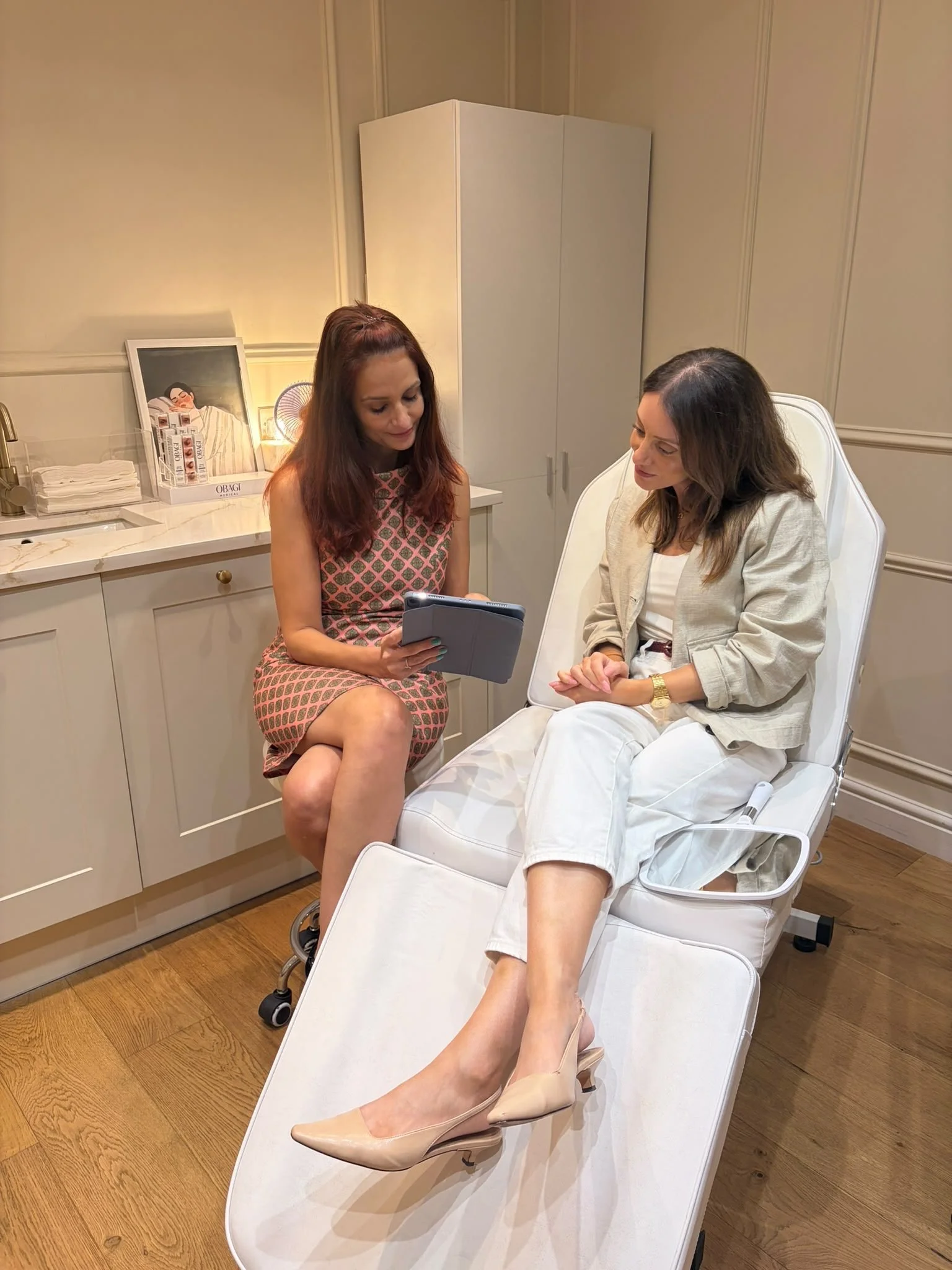
You do not need to know which treatment you want before you book. Consultations are currently £75, fully redeemable against a completed treatment, and there is no obligation to go ahead with anything. For skin laxity, arriving without a fixed idea is often the best starting point.
Which Treatments Can Improve Skin Laxity?
There is no one treatment I use for everybody. Instead, I divide the problem into three layers: structure, skin quality and surface, and choose from the options below according to which layer needs help.
Structure: Rebuilding Collagen and Facial Support
Skin Quality and Surface: When the Skin Itself Is the Problem
Sometimes the underlying facial volume is actually quite good and the problem is the skin sitting over it: thin, crepey, dehydrated, finely lined or simply less healthy than it once was. These treatments work within the skin and are chosen for quality rather than lift.
Which Treatment Is Best for Sagging Skin?
There is no universal winner. The best treatment depends on which layer is responsible.
Often the best result does not come from choosing one treatment and asking it to solve everything. It comes from identifying the different components and treating each appropriately.
Can You Tighten Sagging Skin Without Surgery?
Mild to moderate laxity can often be improved without surgery, although "tighten" is a word I use carefully.
Collagen-stimulating treatments improve the quality, thickness and firmness of skin. Structural treatments replace some of the support lost beneath it. Together these can make a face look noticeably firmer and better supported. What no injectable does is remove excess skin or produce the anatomical change of a surgical facelift or neck lift.
If significant loose skin or tissue descent means surgery is the only route to the result you are asking for, I will say so at your consultation, and I am happy to point you towards an appropriate surgical opinion.
The priority is always one of four things: improving the skin, rebuilding support, restoring a specific area, or leaving things alone.
Can Skin Laxity Be Prevented?
We cannot stop skin ageing, and I do not think we need to. Ageing is normal. But we can influence the factors that accelerate it, and the things I would prioritise are remarkably unexciting: protect your skin from UV, do not smoke, look after your general health, avoid large repeated swings in weight where possible, use evidence-based skincare, and treat the skin when there is a genuine reason to rather than constantly chasing perfection.
The aim is healthy ageing, not pretending ageing is not happening.
Skin Laxity During Perimenopause and Menopause
Many of the women I see in Hale, Altrincham and Alderley Edge in their forties and fifties tell me the same thing: "My face seems to have changed really quickly." They are not imagining it.
Hormonal changes around menopause affect skin hydration, collagen, thickness and elasticity at exactly the same time that age-related changes are taking place in the deeper facial structures. The result can be a relatively rapid change in firmness, texture, dryness, fine lines, lower-face heaviness and overall facial support.
That does not mean every menopausal woman needs injectable treatment. It does mean a proper assessment of skin quality, volume, structure, muscle movement and bone support before deciding whether anything needs treating, rather than adding filler to every area that looks different.
Skin Laxity After Weight Loss
Weight loss can be transformative for health and confidence, and it can also change the face. When facial fat reduces, the skin envelope no longer has the same support. Cheeks can flatten, temples can hollow and the lower face may appear looser.
This has been labelled "Ozempic face" in the press, but the underlying issue is the loss of volume associated with significant weight reduction rather than the medication itself. For these patients I usually assess whether we need structural restoration first and skin-quality improvement second. Treating only the skin when the face underneath has deflated is unlikely to give the best result.
When Should I Start Treating Skin Laxity?
There is no correct age. Some people develop visible changes in their thirties; others keep excellent firmness well into their fifties and beyond. I do not recommend treatment based on a birthday. I recommend it when there is:
- a genuine concern
- an identifiable cause
- a treatment capable of improving it
- a realistic expectation of worthwhile benefit
Sometimes the right recommendation is skincare. Sometimes it is a collagen-stimulating treatment. Sometimes it is restoring lost structure. And sometimes it is nothing at all yet.
Frequently Asked Questions About Loose and Sagging Skin
What is the best treatment for loose facial skin?
It depends on what is causing the looseness. Sculptra may be useful where collagen and deeper support have declined; Radiesse provides structural support; hyperdilute Radiesse can improve skin firmness; and polynucleotides, skin boosters and microneedling improve skin quality. Significant excess skin may need a surgical assessment.
Can Sculptra tighten loose skin?
Sculptra stimulates collagen formation and can gradually improve facial support, firmness and skin quality. I particularly consider it where laxity sits alongside broader volume loss or deflation. It cannot physically remove excess skin.
Is Radiesse good for sagging skin?
Radiesse can be used in two ways. Standard Radiesse improves facial structure and definition, for example along the jawline. Diluted or hyperdiluted, it works predominantly as a collagen biostimulator to improve skin quality and firmness.
Does Profhilo tighten sagging skin?
Profhilo improves hydration and aspects of skin quality. Where there is genuine tissue descent or significant excess skin, it works best alongside structural treatment rather than instead of it.
Do polynucleotides tighten skin?
Polynucleotides may improve elasticity, fine lines and skin quality, and the evidence base is still developing. I use them for thin, crepey or declining skin rather than as a lifting treatment.
Can microneedling help loose skin?
Microneedling stimulates collagen remodelling and can improve texture and early loss of firmness. It will not restore significant lost volume or correct major tissue descent.
What age does skin start to sag?
There is no fixed age. Genetics, hormonal changes, sun exposure, smoking, weight changes and individual facial anatomy all influence when visible laxity develops.
Why has my face suddenly started sagging in my 40s?
Several processes converge in the forties: gradual collagen loss, early structural change in the face and the hormonal shifts of perimenopause. Weight loss can also make existing laxity more obvious.
Can skincare tighten loose skin?
Skincare cannot replace lost structural support, but daily SPF and evidence-based ingredients such as retinoids play an important role in preserving and improving the quality of the skin itself.
Can sagging skin be treated without filler?
Absolutely. Filler is only one tool and is often not the right one for laxity. Depending on the cause, I may consider collagen stimulators such as Sculptra or Radiesse, polynucleotides, microneedling, skin boosters, medical-grade skincare, or no injectable treatment at all.
Is loose neck skin treated differently from the face?
Often, yes. The neck and décolletage usually need collagen-focused treatment within the skin, such as hyperdilute Radiesse or polynucleotides, rather than volume. There is more on my neck and décolletage page.
Doctor-Led Treatment for Skin Laxity in Hale, Altrincham and Cheshire
You do not need to know which treatment you need before you come to see me. In fact, I would rather you did not arrive having already decided.
At your consultation I assess your skin quality, facial anatomy, distribution of volume, bone and structural support, muscle movement, areas of true laxity, previous treatment, medical history and what you actually want to change. From there we decide whether the priority is improving the skin, rebuilding support, restoring a specific area, or leaving things alone.
I am an NHS GP, independent prescriber and Level 7 qualified aesthetic doctor, and every consultation and injectable treatment at our Hale clinic is carried out personally by me. The approach is deliberately natural and evidence-led. The goal is not to make you look younger at any cost. It is to help you look healthy, rested and like yourself as your face changes with time.
Book a Skin Laxity Consultation in Hale
If you are noticing loose skin, facial sagging or loss of firmness and are unsure which treatment, if any, you need, the best place to start is a consultation. Our doctor-led clinic is based in Hale, Cheshire, close to Altrincham, and welcomes patients from Bowdon, Hale Barns, Wilmslow, Knutsford, Sale, Timperley, Alderley Edge, Stockport, Manchester and the wider Cheshire area.
The consultation is about understanding why your face or skin has changed first. Treatment comes second.
Written by Dr Caroline Warden, NHS GP and aesthetic doctor, Dr Caroline Warden Skin & Aesthetic Clinic, 2 Crown Passages, Hale. Last reviewed: 7 October 2026.