Last updated: 1 November 2026
Most of us have one: a thread vein on the side of the nose that foundation never quite covers, a stubborn milia bump under the eye, a skin tag on the neck that catches on a necklace, or a cluster of little red dots on the chest that seems to multiply every summer. They are harmless. They are also, for a lot of people, the one thing their eye goes to in the mirror every morning.
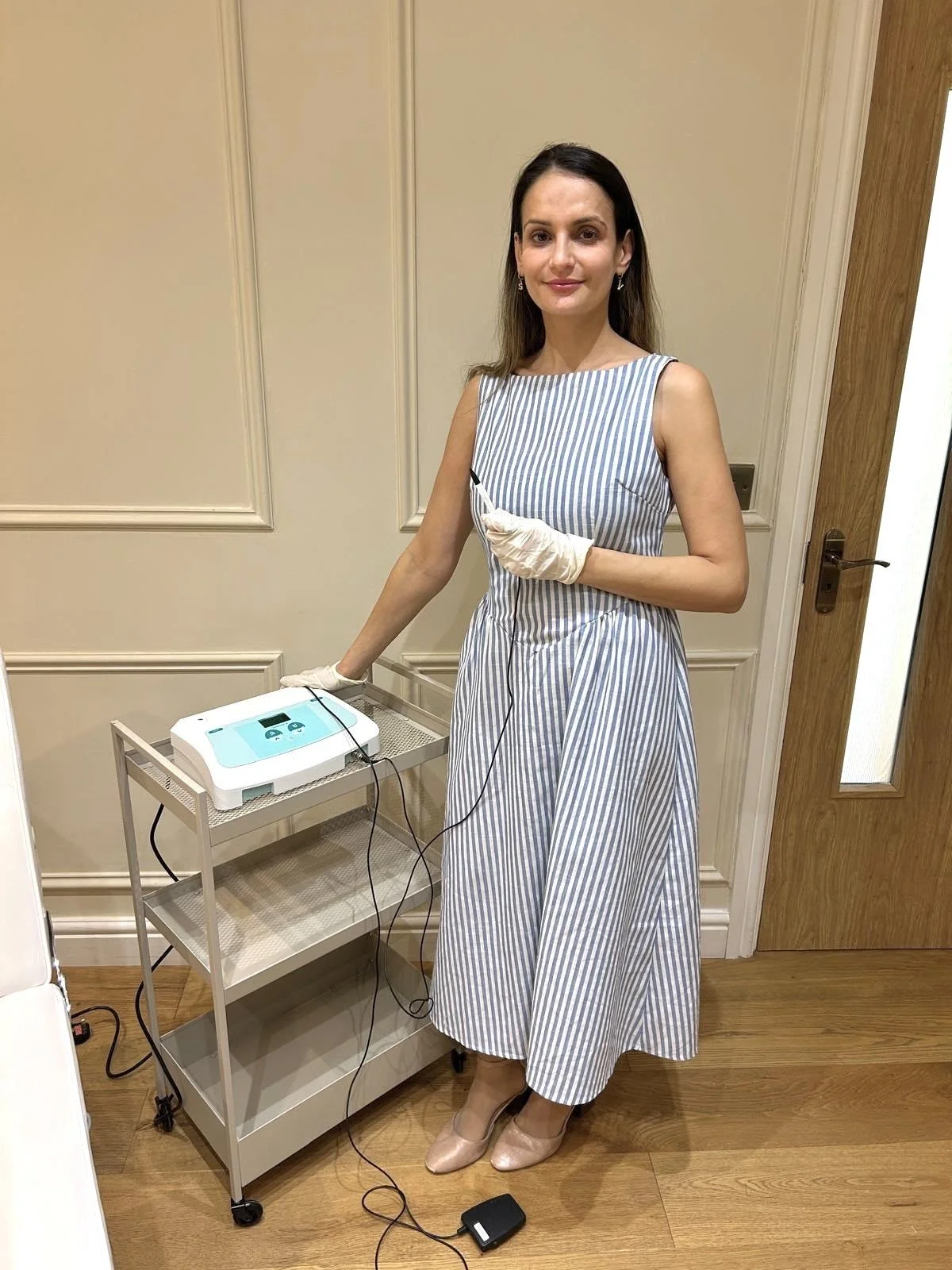
Advanced electrocautery is the quick, precise, doctor led treatment I use at my clinic in Hale to remove these small blemishes, usually in a single short appointment, with minimal downtime and no lasers. This guide explains what it is, what it can and cannot treat, what the appointment feels like, and how to tell the difference between a blemish that is suitable for removal and one that needs your GP first. It is written for patients across Hale, Altrincham, Bowdon, Wilmslow, Knutsford and Cheshire who have been putting up with something small for far too long.
In this article:
- What is electrocautery, and is it the same as advanced electrolysis?
- Which skin blemishes can electrocautery remove?
- What electrocautery is not used for, and why
- Why choose electrocautery over lasers, IPL or home remedies?
- What to expect at your appointment
- Aftercare and healing
- Why a doctor led clinic matters for blemish removal
- Frequently asked questions
What is electrocautery, and is it the same as advanced electrolysis?
Electrocautery uses a very fine probe carrying a controlled electrical current to deliver a tiny, precise pulse of heat to a blemish. That heat either seals a small blood vessel shut or gently removes unwanted tissue, while the skin a millimetre away is left untouched. You may also see it called advanced electrolysis, diathermy, thermolysis or advanced cosmetic procedures (ACP); these are different names for closely related techniques using the same principle. Because the energy is delivered by direct contact rather than by light, it is suitable for very small targets on delicate areas such as the eyelids, nose, neck and chest, where precision matters more than power.
Which skin blemishes can electrocautery remove?
Electrocautery is designed for small, clearly benign, non pigmented blemishes. These are the four I treat most often.
"Skin tags are soft, skin-coloured growths on the skin. They are very common and are usually small and harmless." NHS, Skin tags.
The NHS also notes that skin tag removal is considered cosmetic and is not available on the NHS, and advises against trying to remove one yourself, because of the risk of bleeding, infection and scarring. That combination, harmless but not treated by the NHS and not safe to do at home, is exactly where a doctor led cosmetic clinic fits.

What is electrocautery not used for, and why?
This section matters as much as the one before it. I will only treat a blemish with electrocautery when I am confident it is benign and not pigmented. That is a deliberate clinical rule, not an excess of caution.
The clinic treats cosmetic concerns. It is not a skin lesion diagnosis service, and the most useful thing I can sometimes do at a blemish appointment is tell you that this particular spot should be looked at by your GP before anyone touches it.
Why choose electrocautery over lasers, IPL or home remedies?
One correction to something you may read elsewhere: no heat based treatment is entirely free of pigmentation risk. Electrocautery carries a lower risk than light based devices because it does not depend on melanin absorption, but in deeper skin tones I still use conservative settings, treat a test area where sensible, and insist on SPF during healing.
Takeaway: electrocautery is the right tool for a small number of specific, benign blemishes, treated precisely, usually once. It is not a tool for moles, pigment or widespread redness, and a doctor should be the one deciding which is which.

What happens at your electrocautery appointment in Hale?
Blemish removal is one of the few treatments at the clinic that does not need a separate consultation first; the assessment happens at the start of the same appointment.
Aftercare and healing: what to expect in the days afterwards
Contact me if a treated area becomes increasingly red, hot, painful or weepy after the first couple of days, which is uncommon but worth checking.
Why does a doctor led clinic matter for blemish removal?
Blemish removal is widely available on the high street, and much of it is done well. The reason I think a doctor should do it comes down to what happens before the probe is switched on. Every blemish removal involves a judgement about what the lesion is, and that judgement is the part that matters: recognising the skin tag that is really something else, the "cherry angioma" that is not, or the mole that has changed. As an NHS GP with over 19 years of clinical experience I make that assessment every working day, and when something needs a medical opinion I will send you to your own GP rather than treat it.
Beyond that, you get the same things that apply to every treatment at the clinic: a full medical history, sterile single use probe tips, careful settings for your skin tone, written aftercare, and the same doctor assessing, treating and reviewing you. Details, prices and booking are on the advanced electrocautery treatment page.
Takeaway: it is a small treatment with a big effect on how you feel about your skin, and the part that deserves a doctor is not the fifteen minutes of treatment, it is the two minutes of looking first.

Frequently asked questions about electrocautery skin treatments
Does electrocautery hurt?
Most people describe a brief warm sting lasting a second or two per blemish, similar to a small elastic band flick. Anaesthetic is not usually needed, and because each pulse is so short the appointment is over quickly. If you are very needle or treatment anxious, tell me when you book and we will take it slowly.
How many sessions will I need?
Skin tags, cherry angiomas and most milia are usually cleared in one appointment. Larger or more numerous thread veins, and a face with many milia, sometimes need a second visit four to six weeks later.
Will the blemishes come back?
A treated blemish does not return. You can, however, develop new ones over time, particularly skin tags in friction areas and cherry angiomas, which increase naturally with age. Many patients book a short tidy up every year or two.
Will it leave a scar?
When the right blemish is treated with the right settings and aftercare is followed, scarring is rare; the usual result is a faint pink mark that fades over a few weeks. Picking scabs and sun exposure during healing are the two things most likely to leave a mark, which is why daily SPF is non negotiable afterwards.
Is electrocautery safe for darker skin tones?
Yes, with care. Because it does not rely on light being absorbed by melanin, it avoids the main pigmentation risk of lasers and IPL, but any heat can cause temporary darkening in deeper skin tones. I use conservative settings, sometimes a test spot, and strict sun protection during healing.
Can you remove moles with electrocautery?
No. I do not treat moles or any pigmented lesion with electrocautery, because heat destroys the tissue and removes the chance of examining it properly. Moles should be assessed by your GP, who can refer you to a dermatologist if needed.
Can you treat freckles, sun spots or age spots?
Not with electrocautery, because heat on pigment risks post inflammatory hyperpigmentation and the pigment tends to return. For sun damage and uneven tone I use prescription skincare programmes following consultation, which address the whole area rather than individual spots.
Can I have skin tags removed on the NHS?
Generally no. The NHS classes skin tag removal as cosmetic, so it is not usually available, and NHS advice is not to attempt removal yourself. Private doctor led removal is the usual route.
Do I need a consultation before electrocautery?
No separate consultation is needed. Assessment takes place at the start of your 30 minute appointment. If I find something that is not suitable, I will explain why and point you to your GP, and we will only treat what is appropriate.
How much does electrocautery cost in Hale?
Pricing depends on the number and type of blemishes treated and is listed on the price list. Several blemishes can usually be treated within a single appointment fee.
Can I combine blemish removal with other treatments?
Often, yes. Electrocautery can be done at the same visit as many skincare and injectable appointments, although I prefer to keep it separate from microneedling and peels in the same area so each can heal cleanly.
Next steps
If there is a skin tag, milia, thread vein or blood spot you have been meaning to deal with for years, it is usually a fifteen minute job. Book an electrocautery appointment at the clinic in Hale and bring the full list; I would rather look at everything once.
Learn more about Dr Caroline Warden Clinic
Learn more about other treatments offered
Further reading
- Advanced Electrocautery Skin Treatments in Hale: The Full Guide
- Skin Tag Removal in Hale and Altrincham
- Facial and Chest Thread Veins: Causes and Safe Treatment
- Cherry Angiomas (Blood Spots): Causes and When to Worry
- Why Is My Face Always Red?
- Advanced Electrocautery for Skin Blemishes in Hale (treatment page and prices)
Dr Caroline Warden (GMC 6157708) is an NHS GP with over 19 years of clinical experience, an independent prescriber, and holds a Level 7 postgraduate diploma in cosmetic injectables. She has practised aesthetic medicine since 2017 and runs Dr Caroline Warden Skin & Aesthetic Clinic with her sister Louise at 2 Crown Passages, Hale, Cheshire, WA15 9GN, serving patients from Hale, Altrincham, Bowdon, Hale Barns, Timperley, Sale, Alderley Edge, Wilmslow, Knutsford, Didsbury and across Cheshire and South Manchester. You will only ever be seen and treated by Dr Warden. The clinic treats cosmetic skin concerns only; any new, changing or pigmented lesion should be assessed by your own GP. This article provides general educational information and does not replace an individual assessment. Information correct as of November 2026.
References
- NHS. Skin tags. Read the NHS page
- Anatomic distribution of cherry angiomas in the general population. Dermatology 2022;238(1): pages 18 to 26 (counts rise by about 4% per year of age; prevalence reported from 22% at age 20 to 30 to 40 to 78% over 70). Read the study
- British Association of Dermatologists. Patient information: milia. Read the leaflet
- NHS. Sunscreen and sun safety. Read the NHS guidance
- NHS. Moles: when to see a GP. Read the NHS page
