Why Is Radiesse So Effective for Jawline Definition?
Last updated: September 2026
In this article:
- What makes Radiesse different from other dermal fillers?
- Why rheology matters more than you'd think for jawline definition
- Is Radiesse actually approved for jawline contour?
- How does Radiesse create definition without looking "filled"?
- What does the evidence actually show?
- What should you know before treatment?
- A real patient's jawline journey
- Is this available near me in Hale, Altrincham or Cheshire?
- Frequently asked questions
Not every filler is suited to the jawline, and the reason comes down to physics as much as anatomy. A soft, hydrating product that's excellent for lips or cheeks can behave completely differently when asked to hold a crisp, defined angle along the mandible. Radiesse happens to be built for exactly that job, and the science behind why is genuinely interesting rather than just marketing language.
What Makes Radiesse Different From Other Dermal Fillers?
Radiesse is composed of calcium hydroxylapatite (CaHA) microspheres, the same mineral that makes up bone and teeth, suspended in a carboxymethylcellulose gel carrier. On injection, the gel provides immediate structural volume. Over the following months, as the gel is gradually absorbed, the CaHA microspheres act as a scaffold that genuinely stimulates your own collagen, elastin and new blood vessel formation. It's both an immediate structural filler and a biostimulator, which is part of why it behaves so differently from a standard hyaluronic acid product.
Why Rheology Matters More Than You'd Think for Jawline Definition
Rheology is the science of how a material flows and deforms under stress, and it's the real answer to "why this filler and not another." Two properties matter most:
Radiesse has one of the highest viscosities of any dermal filler, and a high G-prime that specifically suits "mimicking bony morphologies, such as chin and jawline," in the words of one recent clinical review. That's the actual mechanism behind a defined jaw, not just a marketing claim.
Is Radiesse Actually Approved for Jawline Contour?
Yes, and this is a genuinely notable point. Radiesse+ became the first FDA-approved injectable filler specifically indicated for subdermal and supraperiosteal injection to improve moderate-to-severe loss of jawline contour, not just approved generally and used off-label, as is the case for many fillers in this area.
"CaHA(+) is an ideal filler for jawline augmentation due to its rheologic properties (high G′) and ability to achieve defined contours and angles."
A 2024 systematic review concluded that calcium hydroxylapatite may be considered a safe and effective treatment option specifically for the jawline, alongside cheeks and nasolabial folds, giving this indication a genuinely solid evidence base rather than just popular use.
How Does Radiesse Create Definition Without Looking "Filled"?
Placed correctly, usually deep, along the bone itself rather than superficially, Radiesse supports and projects the jawline the way the underlying bone structure would if it hadn't softened with age or was never particularly defined to begin with. Because the effect comes from structural support plus genuine collagen stimulation, rather than simply adding a soft pillow of volume near the surface, results tend to look like definition rather than "filler," provided the technique and placement are right.
There's also a genuinely interesting safety-relevant property worth knowing: CaHA microspheres are smooth and defect-free, which laboratory studies show leads to near-zero bacterial adherence, and the material drives tissue regeneration with minimal inflammatory response, unlike some other biostimulators that rely more heavily on triggering inflammation to work.
What Does the Evidence Actually Show?
Beyond the FDA approval itself, several clinical studies have specifically examined jawline outcomes. A prospective observational study restoring jawline contour with calcium hydroxylapatite reported high patient satisfaction, and a randomised study evaluating its effectiveness and safety for jawline contour found consistent, reproducible results. This isn't a treatment being repurposed for the jawline on a hunch, it's one with a body of jawline-specific research behind it.
What Should You Know Before Treatment?
In the interest of giving you the full picture, not just the favourable parts, there are a couple of honest limitations worth knowing. Unlike hyaluronic acid fillers, there's no reversal agent for Radiesse. If you're ever unhappy with a result, there's no equivalent to the hyaluronidase "undo" option, which makes proper consultation and a conservative approach on the first treatment particularly important. There can also be a transient dip in visible effect around the three-month mark, as the gel carrier is absorbed faster than your own collagen has fully replaced it, before the longer-term biostimulated result settles in. Neither of these is a reason to avoid treatment, but both are worth knowing before you start, not discovering afterwards.
A Real Patient's Jawline Journey
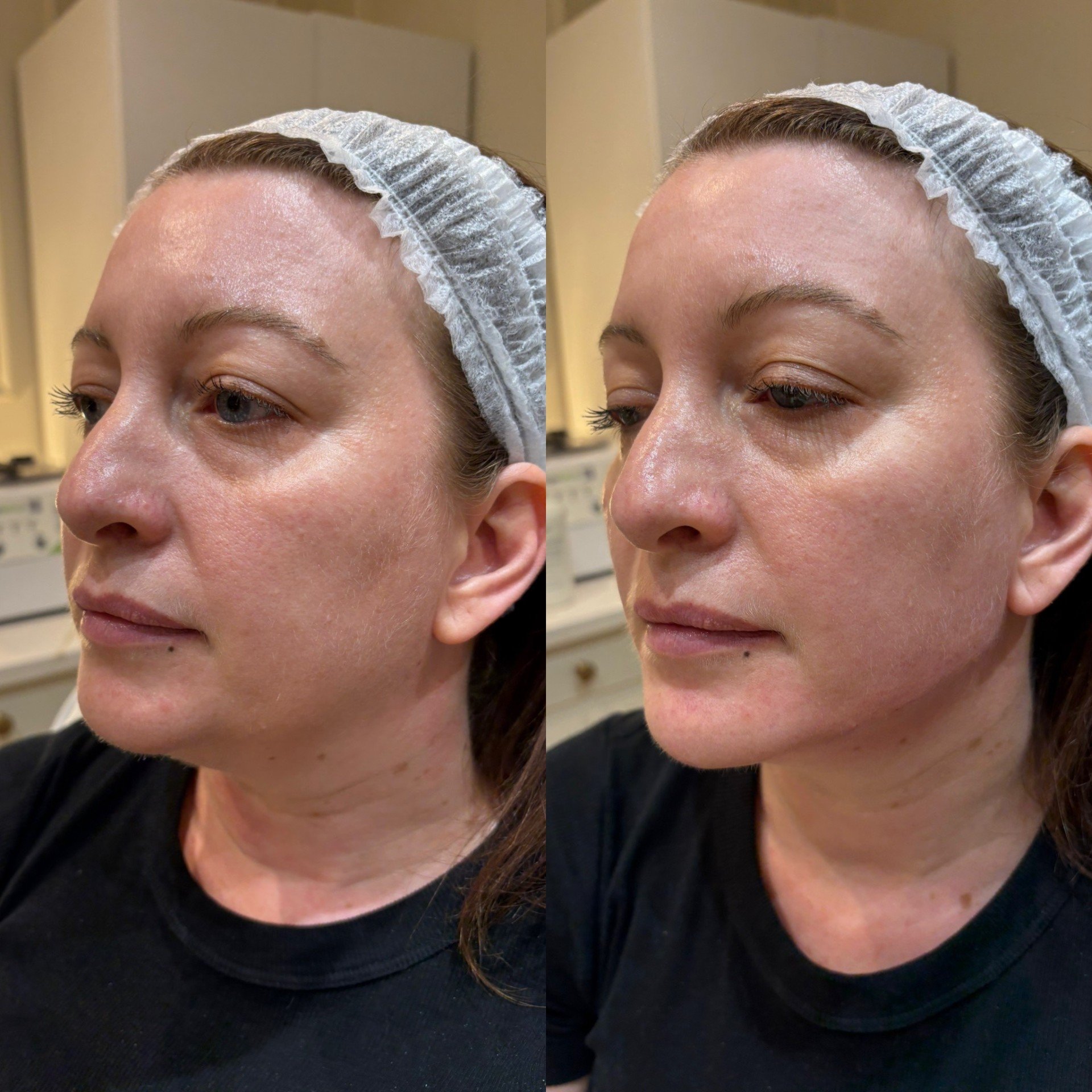
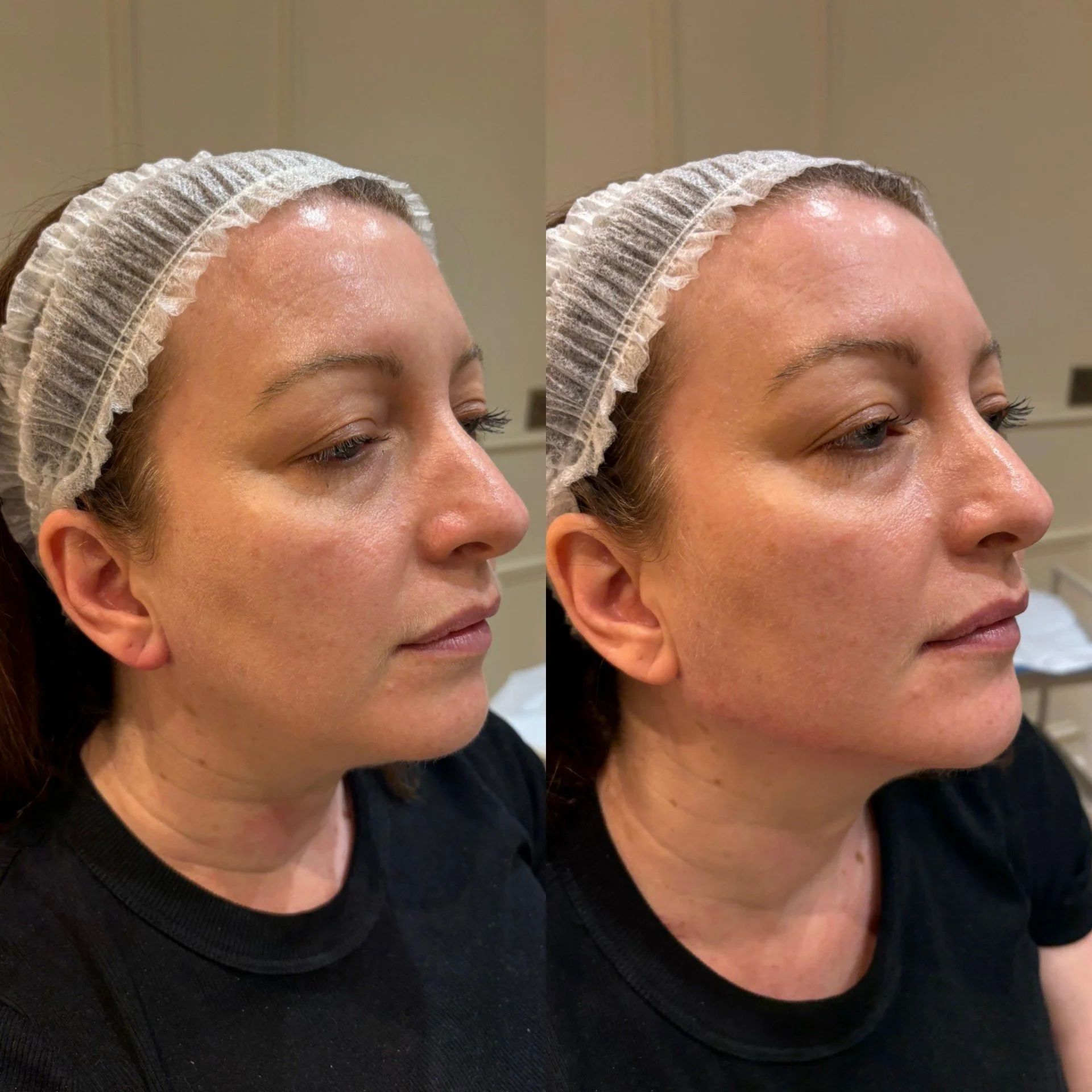
Patient: Female in her 40s, concerned about a softened jawline and loss of definition along the mandible, no previous filler experience in this area.
Treatment plan: 1 session of 2 syringes of Radiesse, placed along the jawline using cannula.
Results: improved angle definition, reduced jowling appearance, improved confidence. As with any aesthetic treatment, individual results vary, and this reflects one patient's experience rather than a guaranteed outcome.
[Before and after photos, same lighting, angle and expression, patient consent confirmed for marketing use]
Is This Available Near Me in Hale, Altrincham or Cheshire?
Yes. Radiesse for jawline definition is one of the treatments I offer at my clinic in Hale, for patients from Altrincham, Bowdon, Alderley Edge, Wilmslow and across Cheshire. Because placement and technique matter as much as the product itself here, a proper consultation to assess your anatomy is the right starting point rather than requesting a specific treatment by name.
Book a Consultation
If you're considering Radiesse for jawline definition and want an honest assessment of whether it suits your face, I'd be glad to talk it through at a consultation in Hale.

Frequently Asked Questions About Radiesse for Jawline Definition
Is Radiesse better than other fillers for the jawline?
For this specific area, its rheology genuinely suits the job, high stiffness and viscosity that resist deformation and migration, which is exactly what defining a bony contour like the jawline needs. That's different from saying it's universally "better," other fillers suit other areas and goals.
How long does Radiesse last in the jawline?
Often 12 to 18 months or longer, depending on the individual and the area treated.
Does Radiesse for the jawline hurt?
Most patients describe mild discomfort during injection, typically manageable with topical or local anaesthetic as part of the product itself.
Can Radiesse be dissolved if I don't like the result?
No, unlike hyaluronic acid fillers, there's no reversal agent available. This makes a conservative first treatment and a proper consultation particularly important.
Is Radiesse for jawline definition suitable for everyone?
Not necessarily, suitability depends on your anatomy, goals and medical history, which is exactly what a consultation is for.
Can Radiesse be combined with other treatments?
Often, yes, though as with any combination plan, each treatment needs its own appropriate assessment and timing.
References
- Moradi A, Green JB, Kwok GP, Nichols K, Rivkin A. Guidelines for optimal patient outcomes using calcium hydroxylapatite for jawline contour. Aesthet Surg J Open Forum. 2023. ncbi.nlm.nih.gov/pmc/articles/PMC10120162
- Guida S, et al. A systematic review of Radiesse/calcium hydroxylapatite and carboxymethylcellulose: evidence and recommendations for treatment of the face. Int J Dermatol. 2024. onlinelibrary.wiley.com
- The role of calcium hydroxylapatite (Radiesse) as a regenerative aesthetic treatment: a narrative review. Aesthet Surg J. pmc.ncbi.nlm.nih.gov/articles/PMC11025388
Further Reading
- Filler Fatigue Is Real: Why "Less Filler, More Structure" Is the Biggest Shift in Aesthetics
- What Are Polynucleotides, and How Do They Compare to Profhilo and Sculptra?
- Explore Radiesse at the Clinic
- Explore Sculptra at the Clinic
Next Steps
Learn more about Dr Caroline Warden Clinic
Learn more about other treatments offered
Dr Caroline Warden is an NHS GP with over 19 years of clinical experience and a special interest in cosmetic dermatology, an independent prescriber, and holds a Level 7 postgraduate diploma in cosmetic injectables. She is the sole practitioner at Dr Caroline Warden Skin & Aesthetic Clinic, a female-led, family-run clinic at 2 Crown Passages, Hale, Altrincham, awarded Best Doctor Led Aesthetic Clinic in Cheshire 2026 by GHP. GMC number 6157708. This article is for information only and does not constitute individual medical advice.