Sculptra for Hollow Temples: Why This Small Area Can Change the Whole Face

Last updated: September 2026
In this article:
- Why do our temples become hollow?
- Why can hollow temples change the whole face?
- Where does Sculptra fit in?
- Can Sculptra improve hollow temples?
- Sculptra does not give an instant final result
- Why I would not automatically treat every hollow temple
- Sculptra or temple filler?
- Why the temple is an advanced area to treat
- What does a natural temple result look like?
- Who might be suitable?
- Sculptra for hollow temples in Hale, Altrincham and Cheshire
- Frequently asked questions
When patients talk to me about facial ageing, the temples are rarely the first thing they mention. They might tell me their face looks thinner. Their cheekbones suddenly seem more prominent. Their eyes look more tired. Or they feel that the upper part of their face has become slightly harder or more angular.
Quite often, they cannot identify exactly what has changed.
Sometimes, part of the answer is sitting in a relatively small and frequently overlooked area of the face: the temples. Temporal hollowing can be subtle, but because the temples form the transition between the forehead, brow, eye and cheek, losing volume here can alter the overall proportions of the face. This is also why treating the temples appropriately can sometimes make more difference than patients expect.
Why Do Our Temples Become Hollow?
Some people naturally have more hollow temples than others. Facial shape, genetics and body composition all play a part, and a degree of concavity through this area can be completely normal.
However, the temples can also become noticeably more hollow with age. As we get older, changes take place throughout the different layers of the face. We lose and redistribute facial fat, collagen declines, and there are changes within the underlying muscles and bony skeleton. The temple is no exception.
Significant weight loss can make this particularly noticeable. Patients who have lost a substantial amount of weight, including some people following treatment with GLP-1 medications such as Mounjaro or Wegovy, can find that the temples become much more visibly hollow alongside changes through the cheeks and midface.
The result isn't necessarily that someone suddenly looks "old". More commonly, the face simply begins to look slightly more depleted.
Why Can Hollow Temples Change the Whole Face?
The temple sits in an interesting position anatomically. It connects the forehead to the side of the face and forms part of the framework surrounding the eyes and cheekbones. When volume is lost here, structures such as the lateral orbital rim and cheekbone can become more visible. The transition from forehead to cheek can appear less smooth, and the upper face may start to look narrower or more angular.
Research into temporal anatomy describes increased visibility of the temporal crest, vessels, lateral orbital rim and upper zygomatic arch as some of the changes associated with temporal ageing. This is why treating a temple is not simply about "filling a hollow". The aim should be to restore balance and continuity between different areas of the face.
In the right patient, softening a hollow temple can make the eye area appear less skeletal, reduce the prominence of the cheekbone and create a smoother transition through the upper face. It is a good example of why I prefer to assess the face as a whole rather than looking at isolated lines or individual features.
Where Does Sculptra Fit In?
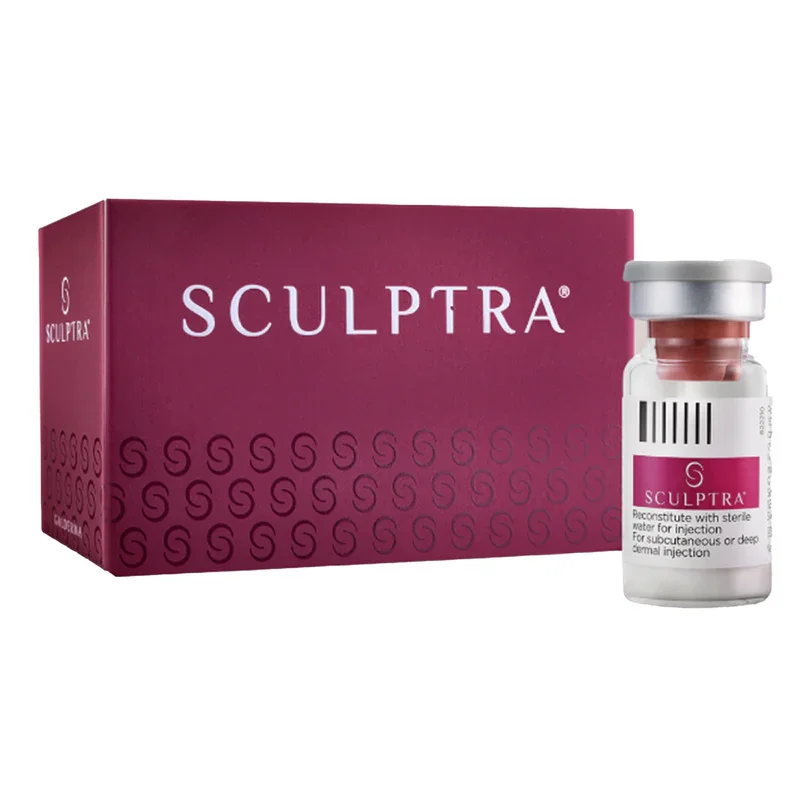
Sculptra is an injectable treatment containing poly-L-lactic acid, or PLLA. Unlike a traditional hyaluronic acid filler, it does not create its final result by simply leaving a fixed volume of gel in the tissues. Instead, Sculptra acts as a collagen biostimulator, encouraging a gradual tissue response and new collagen production over the weeks and months following treatment.
This makes it particularly interesting for patients who are not necessarily looking for an obvious change in facial shape, but who have developed broader facial depletion and loss of support. At my clinic, temples may form part of a wider Sculptra treatment plan alongside areas such as the lateral cheek, midface or jawline, depending entirely on the patient's anatomy. I rarely think about Sculptra in terms of simply treating one isolated "area". I am much more interested in the relationship between those areas.
Can Sculptra Improve Hollow Temples?
For appropriately selected patients, PLLA can improve temporal hollowing gradually, and there is increasingly good clinical evidence specifically looking at treatment of the temple.
That last point, from the second study, is particularly interesting to me. We are not really treating a pair of isolated hollows. We are treating part of the architecture of the face.
Sculptra Does Not Give an Instant Final Result
This is important. Immediately after Sculptra treatment, the area usually looks fuller because the product is mixed with fluid before it is injected. That initial fullness is not the final result. Much of it settles over the following days. The collagen response then develops gradually over the following weeks and months.
This can initially feel slightly strange to patients because the treatment can appear to have "disappeared" before the biological effect has really begun. Sculptra therefore suits patients who are comfortable with slow, progressive improvement rather than an immediate transformation. Personally, I think that gradual change is one of its advantages. You continue to look like yourself.
Why I Would Not Automatically Treat Every Hollow Temple
One of the most important parts of aesthetic medicine is knowing when not to treat something. Not every hollow temple is a problem. Some people naturally have a leaner, more sculpted facial shape. In others, treating the temples too aggressively could make the upper face appear wider or heavier and actually reduce the individual character of the face.
I also would not look at the temples in isolation. If somebody is concerned about looking tired or hollow, I want to understand what is happening through the entire lateral face, cheeks and eye area before deciding where treatment should go. Sometimes the temple is important. Sometimes it isn't. And sometimes another treatment altogether is more appropriate.
Sculptra or Temple Filler?
This is not really a question with one universal answer. Hyaluronic acid filler and Sculptra behave very differently, and the correct choice depends on the anatomy, the degree of hollowing, the quality of the tissues, the patient's treatment history and what we are actually trying to achieve.
That difference in reversibility is exactly why careful patient selection and treatment planning matter so much here.
Why the Temple Is an Advanced Area to Treat
The temple looks like a relatively simple hollow on the surface. Underneath, it is anything but simple. The temporal region contains multiple layers of fascia, muscle and fat alongside important arteries, veins and nerves. Anatomical studies specifically highlight structures including the superficial temporal artery, the temporal branch of the facial nerve, and the sentinel vein as the key structures to understand when considering injectable treatment in this area.
This is one reason I consider temple treatment an advanced anatomical area. The correct injection approach depends on understanding not simply where the hollow is visible, but what lies underneath it and which tissue plane is appropriate for the treatment being used. Although serious vascular complications from aesthetic injections are rare, they can be significant. The temporal region has complex vascular anatomy, so this is not an area in which I believe treatment should ever be approached casually.
What Does a Natural Temple Result Look Like?
A good temple result should not make you look as though your temples have been "filled". In fact, ideally nobody should notice the temples at all. The aim is a smoother transition from the forehead through the side of the face into the cheek. The upper face may look a little softer. The eye area may look less skeletal. The cheekbone may appear less stark. And the face as a whole can sometimes look healthier and less depleted without anyone being able to pinpoint exactly what has changed.
That, to me, is a much more interesting outcome than simply chasing volume.
What About Very Hollow Temples?
More significant temporal hollowing needs particularly careful assessment. It may require a staged approach rather than attempting to create a complete correction in one appointment. This is especially important with collagen-stimulating treatments because the result continues to evolve after treatment. Trying to achieve complete correction immediately can lead to overtreatment.
I would much rather treat conservatively, allow the collagen response to develop and then reassess. More product is not automatically a better result.
Can Sculptra Lift the Face by Treating the Temples?
I am cautious with the word "lift". Sculptra is not a surgical facelift and it cannot reposition significant excess skin. However, restoring support through appropriate areas of the lateral face can alter the way the facial contours relate to one another. In some patients, improving volume and collagen support around the temples and lateral cheek can contribute to a more balanced appearance through the mid and lower face.
But this should not be interpreted as meaning that injecting the temples will somehow mechanically lift every face. Facial ageing is far more complicated than that. Skin laxity, bone structure, fat distribution, ligamentous support and the degree of underlying volume loss all matter.

Who Might Be Suitable for Sculptra in the Temples?
I might consider Sculptra as part of a treatment plan for somebody who has:
- developed increasing temporal hollowing with age
- broader facial volume loss rather than one isolated indentation
- become noticeably more hollow following significant weight loss
- reduced support through the lateral face and cheeks
- a preference for gradual rather than immediate change
- realistic expectations about what collagen stimulation can achieve
But the decision is always made after examining the face properly. The treatment needs to fit the patient, rather than the patient being made to fit the treatment.
A Small Area, But Not an Insignificant One
I think the temples are a perfect example of how facial ageing is often misunderstood. Patients understandably focus on the things they can easily see: a nasolabial fold, a jowl, a line beside the mouth. But the face does not age one line at a time. It changes in three dimensions.
Sometimes what is bothering somebody lower down the face is partly related to changes happening elsewhere. And sometimes restoring a little support in an area they had never even considered can improve the balance of the face far more elegantly than directly treating the feature they first noticed. That is why, in my clinic, the starting point is always anatomy rather than a treatment menu.
Sculptra for Hollow Temples in Hale, Altrincham and Cheshire
At my clinic, all Sculptra consultations and treatments are carried out personally by me. I take an anatomy-led, deliberately conservative approach to facial rejuvenation, with a focus on natural results and long-term facial and skin health. If you are noticing hollowing through the temples, cheeks or wider face, you do not need to decide before your appointment whether Sculptra, dermal filler or another treatment is right for you. That is what the consultation is for.
Patients visit the clinic from Hale, Altrincham, Bowdon, Alderley Edge, Wilmslow, Hale Barns, Bramhall, Knutsford, Mobberley, Sale, Timperley, Urmston, Handforth, Poynton, Cheadle, Didsbury, Manchester, Warrington, Stockport and across Cheshire.
Book a Consultation
There is no obligation to proceed with treatment following your consultation. If you'd like an honest assessment of what's actually changed in your face, I'd be glad to see you at the clinic in Hale.
Frequently Asked Questions About Sculptra for Temple Hollowing
How many sessions of Sculptra do the temples need?
This varies by individual, but the strongest evidence to date comes from a protocol of two to three sessions, with results developing over the following months and lasting through at least 12 months of follow-up.
Will Sculptra in my temples make my face look wider?
Not when appropriately dosed and planned. This is exactly why I wouldn't treat every hollow temple automatically, and why conservative, staged treatment matters in this area.
How soon will I see results in my temples?
The area often looks fuller immediately due to the fluid the product is mixed with, but this settles within days. The genuine, lasting result from collagen stimulation develops gradually over the following weeks and months.
Is temple treatment risky?
Serious complications are rare, but the temporal region has complex vascular and nerve anatomy, which is exactly why I consider it an advanced area requiring proper anatomical assessment rather than a standardised approach.
Can Sculptra in the temples be combined with other areas?
Often, yes. Temples frequently form part of a wider plan alongside the lateral cheek, midface or jawline, depending on your individual anatomy.
Is Sculptra reversible if I don't like the result?
No, unlike hyaluronic acid filler, Sculptra cannot simply be dissolved. This makes careful, conservative treatment planning particularly important from the outset.
References
- Efficacy and safety of a poly-L-lactic acid filler for temporal augmentation: a randomised, no-treatment control, evaluator-blinded, multicenter study. Aesthet Surg J. 2026. pubmed.ncbi.nlm.nih.gov/41637104
- Arruda S, et al. Prospective single-site open-label study assessing safety and efficacy of poly-L-lactic acid for temple volume loss. J Drugs Dermatol. 2026;25(1):43. jddonline.com
- Hong GW, Wan J, Choi W, Yi KH. An expert guide to anatomy-based filler injection for the temple: techniques and clinical insights. Life. 2025;15(2):266. ncbi.nlm.nih.gov/pmc/articles/PMC11856534
Further Reading
- Why Mounjaro Face May Be One of the Best Reasons to Consider Sculptra
- Why Collagen Declines and the Treatments That Actually Stimulate It
- Explore Sculptra at the Clinic
Next Steps
Learn more about Dr Caroline Warden Clinic
Learn more about other treatments offered
Dr Caroline Warden is an NHS GP with over 19 years of clinical experience and a special interest in cosmetic dermatology, an independent prescriber, and holds a Level 7 postgraduate diploma in cosmetic injectables. She is the sole practitioner at Dr Caroline Warden Skin & Aesthetic Clinic, a female-led, family-run clinic at 2 Crown Passages, Hale, Altrincham, awarded Best Doctor Led Aesthetic Clinic in Cheshire 2026 by GHP. GMC number 6157708. This article is for information only and does not constitute individual medical advice.
