
Last updated: 16 November 2026
In short: Sculptra is an injectable collagen stimulator made from poly L lactic acid. Rather than filling a line, it prompts your own skin to rebuild collagen over three to six months, restoring the soft structure that faces lose from the early forties onwards, and the results have been shown to last two years or more. It suits people with hollowing at the temples and cheeks, early jowls, loss of definition after weight loss, and the general "deflated" look that filler cannot fix without looking filled. At my clinic in Hale I carry out every Sculptra consultation, treatment and review myself, using a cannula with local anaesthetic, a maximum of two vials at the first visit and sessions six to eight weeks apart. One vial is £495 and two are £950; most people need two to three sessions in the first year and one or two vials a year after that.
Local to Hale, Altrincham or Cheshire? I am an NHS GP and aesthetic doctor and run a GP led skin clinic in Hale village where every consultation, treatment and review is carried out by me personally, with evening appointments until 7pm on Tuesdays and Wednesdays and until 9pm on Fridays. You can book a consultation or see the price list.
Sculptra has quietly become the treatment I am asked about most by patients in their forties and fifties from Hale, Altrincham, Bowdon and Wilmslow, usually with the same opening line: "I don't want filler, but my face has dropped." This guide is everything I would want you to know before you book it anywhere: what Sculptra is, what the evidence actually shows, who it suits, how I do it, what it costs locally, and the questions to ask whoever treats you.
In this article:
- What is Sculptra and how does it work?
- What does the evidence say about Sculptra?
- Who is Sculptra for, and who is it not for?
- Sculptra vs dermal filler vs Radiesse: which is right for your face?
- How I perform Sculptra at my clinic in Hale
- What to expect: the Sculptra timeline
- How much does Sculptra cost in Hale and Altrincham?
- Risks and side effects
- Choosing a Sculptra clinic near you
- Frequently asked questions
What is Sculptra and how does it work?
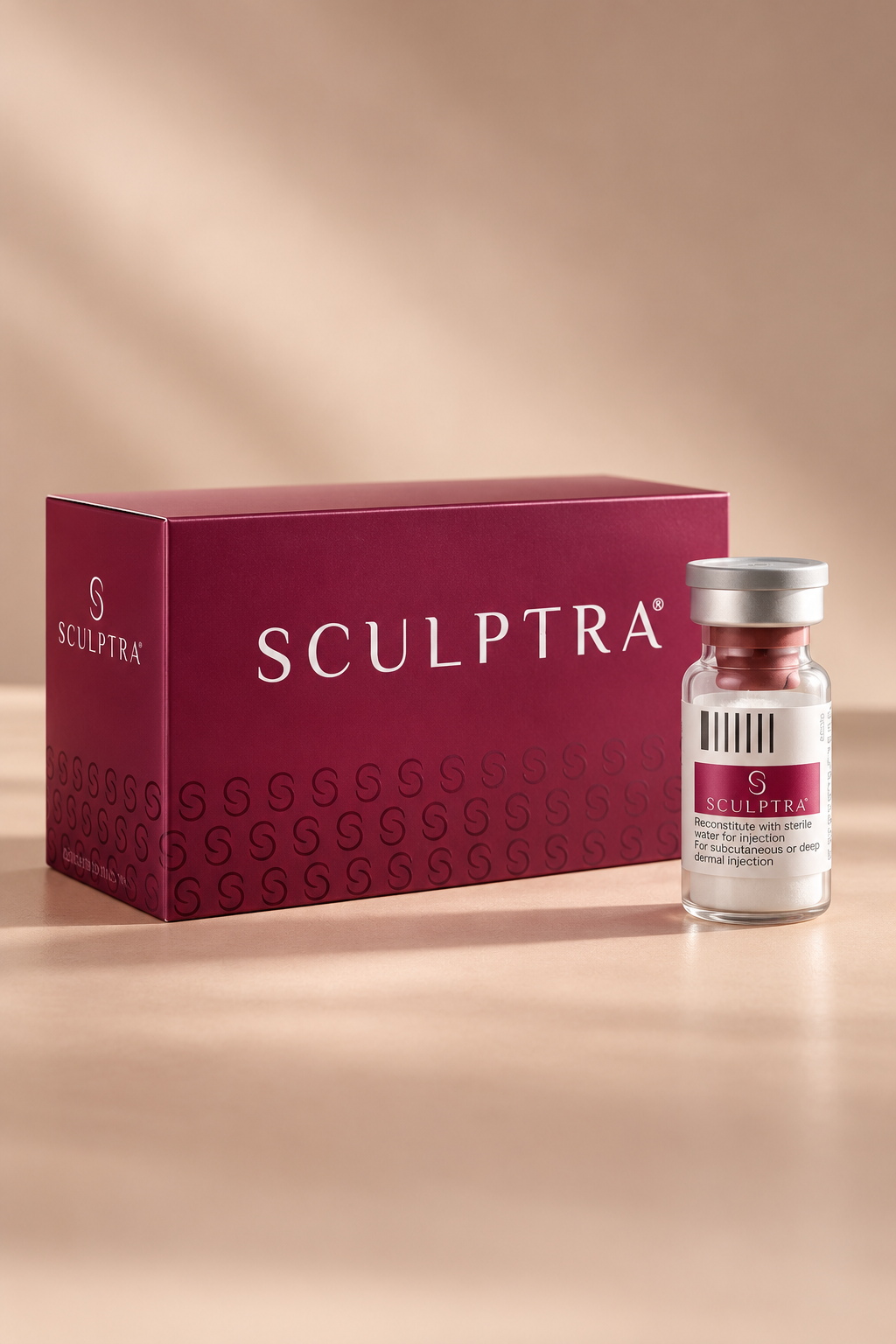
Sculptra is a sterile suspension of poly L lactic acid microparticles, a biodegradable material that has been used in dissolvable stitches for decades. Injected under the skin, the particles themselves do very little; what matters is the response they provoke. Your fibroblasts treat the particles as a scaffold and lay down new type I collagen around them over the following months, and as the particles slowly dissolve, the collagen remains. Biopsy studies show measurable increases in collagen by three months after treatment (Goldberg et al, 2013).
The practical consequence is that Sculptra does not give an instant result. The water it is mixed with produces a short lived fullness that settles in a day or two, and the real change builds gradually, which is why it looks like your own face rather than an addition to it. It was first licensed in 2004 for facial volume loss in HIV, approved for cosmetic use in 2009, and in April 2023 the FDA added a specific approval for fine lines and wrinkles of the cheeks after a two year trial.
What does the evidence say about Sculptra?
"Injectable poly-l-lactic acid-treated subjects maintained improvements for up to 25 months after treatment." Brown SA, Rohrich RJ, Baumann L et al, Plastic and Reconstructive Surgery, 2011.
The limits of the evidence are worth stating too. Most trials treated the nasolabial folds or cheeks because those are easy to measure; the temple, jawline and lower face work I do most often rests on the same mechanism and on extensive clinical experience rather than on a dedicated randomised trial for each area. And every trial used more than one session, which is why a single vial is a start rather than a result.
Who is Sculptra for, and who is it not for?
Two areas I do not treat with Sculptra are the lips and the area directly under the eyes, where the risk of nodules is higher and where the product is not designed to go. I have written about why I approach the under eye area differently in why I do not offer tear trough filler.
Sculptra vs dermal filler vs Radiesse: which is right for your face?
Many of my patients have a combination: Sculptra for the broad restoration, and later a small amount of filler or Radiesse where a precise edge is wanted, such as the chin or jawline. I have compared the two collagen stimulators in more detail in why I brought biostimulators to my clinic.
How I perform Sculptra at my clinic in Hale
Every Sculptra patient sees me, and only me, from the first consultation to the last maintenance vial. That matters more for Sculptra than for most treatments, because the result is built over several sessions and the judgement about where the next vial goes depends on seeing how the last one responded. I photograph you at each visit, record exactly where and how much was placed, and plan the following session from that record rather than from a template.
What to expect: the Sculptra timeline
Day 1 to 3: mild swelling from the water the product is mixed in, which gives a preview of fullness and then settles; some bruising and tenderness is common. Week 1 to 4: the face looks much as it did before; this is normal and the point at which first timers worry. Week 6 to 8: the first subtle change in how light sits on the cheeks and temples, and the second session. Month 3 to 6: the result builds visibly; friends say you look well. Month 6 to 12: peak result after the final session of the course. Year 2 and beyond: maintained with one or two vials a year, timed to your own ageing rather than a calendar.
How much does Sculptra cost in Hale and Altrincham?
Spread over two years, a full Sculptra course costs less per month than many people spend on skincare, and considerably less than the equivalent volume of filler repeated at the same intervals. Prices are correct at the time of writing and confirmed at consultation; a full breakdown is in my Sculptra lifting protocol and on the price list.
Risks and side effects
Sculptra has a long safety record, but it is not risk free and anyone who tells you otherwise should be asked why. In the FDA cheek trial, 21 per cent of treated patients had a product or procedure related adverse event, almost all minor: bruising was the most common, with short lived tenderness and swelling reported by most people in the days after treatment. The complication specific to Sculptra is the small nodule, a firm lump under the skin that occurs when particles cluster; it is uncommon with correct dilution, placement and massage, and when it happens it is usually not visible and resolves over months. Rarer still are inflammatory nodules, which need medical management. Because the result is your own collagen it cannot be dissolved, which is the strongest argument for conservative dosing by one experienced clinician who sees you at every stage.
Choosing a Sculptra clinic near you
Sculptra is a medical device rather than a prescription medicine, which means it is less tightly regulated than anti wrinkle injections and can legally be offered by non medical injectors. It is also one of the least forgiving products to inject badly. The questions I would ask any clinic in Hale, Altrincham or Wilmslow before booking are: who exactly will inject me and what is their registration; how many Sculptra treatments do they carry out; what dilution and hydration time do they use; do they use a cannula; how many vials will they place at the first visit; will I see the same person at every session; and what happens if I develop a nodule. At my clinic the answers are: me, GMC 6157708; Sculptra and Radiesse are the treatments I perform most; standard dilution hydrated in advance; always a cannula with local anaesthetic; one or two vials; yes, always; and you call me directly. For the wider checklist, see how to choose an aesthetic clinic safely.
Takeaway: Sculptra rebuilds your own collagen gradually across the whole face, with randomised trial evidence of results lasting two years or more, and it suits the deflated, dropped look of the forties and fifties better than filler does. It needs two or three sessions in the first year, patience for three to six months, and a clinician who places it conservatively and sees you at every stage. At my clinic in Hale that clinician is always me, one vial is £495, two are £950, and the first step is a consultation to decide whether it is the right treatment for your face at all.
Frequently asked questions about Sculptra in Hale and Altrincham
Is there a doctor who does Sculptra near Hale or Altrincham?
Yes. I perform Sculptra personally at my clinic at 2 Crown Passages in Hale village, two minutes from Hale station and one stop from Altrincham, with parking opposite in Cecil Road car park.
How much is Sculptra in Cheshire?
At my clinic one vial is £495 and two vials at the same visit are £950. A typical first year is £950 to £1,445 over two to three sessions, then one or two vials a year.
How many vials of Sculptra do I need?
Most people in their forties and fifties need three to five vials across the first year, placed over two or three sessions. I never use more than two at the first visit, because collagen cannot be removed and building in stages gives a better result.
How long does Sculptra take to work?
The first subtle change is at six to eight weeks, the result builds over three to six months and peaks about six months after the final session. It is not a treatment for an event next month.
How long does Sculptra last?
Trials show results maintained at two years and beyond after a full course. In practice I see most patients once or twice a year for a maintenance vial.
Is Sculptra better than filler?
Different rather than better. Sculptra restores diffuse support gradually and lasts longer; filler corrects a specific area immediately and can be dissolved. For a face that looks deflated rather than lined, Sculptra is usually the better first choice.
Does Sculptra hurt?
Not much. The product is mixed with local anaesthetic, I numb each cannula entry point, and most people describe pressure rather than pain. Tenderness for a few days afterwards is normal.
Is there downtime after Sculptra?
Expect some swelling for one to three days and possible bruising for up to a week. Most people go back to work the next day; I would avoid a big occasion in the first week.
Can Sculptra go wrong?
The main risk is a small nodule under the skin, which is uncommon with correct technique and usually resolves. Bruising and swelling are common and short lived. Sculptra cannot be dissolved, which is why experience and conservative dosing matter.
Is Sculptra good for Mounjaro face?
It is one of the best options, because weight loss removes support across the whole face and Sculptra restores it gradually without an overfilled look. I usually wait until weight has been stable for two to three months.
Can men have Sculptra?
Yes, and increasingly do. It restores structure at the temples, cheeks and jawline without the softening fullness that filler can give a male face.
Am I too old for Sculptra?
No. Patients in their sixties and seventies respond well, provided the main issue is volume loss rather than loose skin. If the honest answer is that surgery would serve you better, I will say so at consultation.
Can I combine Sculptra with other treatments?
Yes. Common combinations are anti wrinkle injections for the upper face, Radiesse or a small amount of filler for the jawline or chin once the Sculptra result has built, and polynucleotides or microneedling for skin quality.
Who will treat me at your clinic?
Me, at every visit. I am the only practitioner, so the person who plans your Sculptra is the person who injects it, reviews it and places your maintenance vial the following year.
How do I book a Sculptra consultation in Hale?
Use the booking page or contact the clinic. The consultation is £75, redeemable against treatment, and if you are suitable and keen, your first session can usually follow at the same appointment.
Next steps
If your face has started to look tired or dropped and you want to know whether Sculptra is the right answer, book a consultation. We will assess your face zone by zone, agree a plan with the number of vials and the full cost before anything is injected, and you will see me, and only me, at every session. The consultation fee is redeemable against treatment.
Learn more about Dr Caroline Warden Clinic
Learn more about other treatments offered
Further reading
- Sculptra Treatment in Hale, Altrincham and Cheshire
- Why Sculptra May Be One of the Best Treatments for Mounjaro Face
- My Sculptra Lifting Protocol: Sessions, Vials and Costs
- Sculptra for Hollow Temples
- What Is Sculptra and How Does It Work?
- Why Your Face Changes in Your 40s, and What Actually Helps
- Radiesse for Jawline and Structural Lift
- Before and After Results
Dr Caroline Warden (GMC 6157708) is an NHS GP with over 19 years of clinical experience, an independent prescriber, and holds a Level 7 postgraduate diploma in cosmetic injectables. She has practised aesthetic medicine since 2017 and is the sole practitioner at Dr Caroline Warden Skin & Aesthetic Clinic, 2 Crown Passages, Hale, Cheshire, WA15 9GN, where every consultation, treatment and review is carried out by her personally. Patients travel from Hale, Altrincham, Bowdon, Hale Barns, Timperley, Sale, Wilmslow, Alderley Edge, Knutsford, Didsbury and across Cheshire. The clinic was named Best Doctor Led Aesthetic Clinic in Cheshire 2026 by GHP. Sculptra is a CE marked medical device; suitability, dose and the number of sessions are decided at consultation. The clinic does not diagnose or treat medical conditions; if you have a medical concern, please see your GP. Results vary between individuals. This article is for information only and does not constitute individual medical advice.
References
- Brown SA, Rohrich RJ, Baumann L, et al. Subject global evaluation and subject satisfaction using injectable poly-L-lactic acid versus human collagen for the correction of nasolabial fold wrinkles. Plast Reconstr Surg 2011;127(4): pages 1684 to 1692. Read the abstract
- US Food and Drug Administration. Sculptra (injectable poly-L-lactic acid) summary of safety and effectiveness data, cheek wrinkles, P030050/S039, 2023. Read the FDA summary
- Galderma. Galderma receives FDA approval for Sculptra for cheek wrinkles. Press release, 26 April 2023. Read the release
- Goldberg D, Guana A, Volk A, Daro-Kaftan E. Single-arm study for the characterization of human tissue response to injectable poly-L-lactic acid. Dermatol Surg 2013;39(6): pages 915 to 922. Read the abstract
- Valantin MA, Aubron-Olivier C, Ghosn J, et al. Polylactic acid implants (New-Fill) to correct facial lipoatrophy in HIV-infected patients: results of the open-label study VEGA. AIDS 2003;17(17): pages 2471 to 2477. Read a summary
