Last updated: 31 October 2026
Every few weeks a patient in my clinic in Hale says something like: "That side was fine, but this side really stung" or "It never used to hurt this much, is it me?" The honest answer is that it is partly you, partly me, partly the product, and partly a quirk of how your brain is wired that researchers only measured properly in 2017.
Pain during aesthetic injections is not random, and it is not something you have to put up with. This article explains why injections hurt, why the left side of the face hurts more for most people, what the research actually says about your menstrual cycle, how vibration tricks the nervous system, and exactly what I do about all of it, so that patients from Hale, Altrincham, Bowdon and Wilmslow leave my clinic surprised by how little they felt.
In this article:
- Why do aesthetic injections hurt at all?
- Which areas of the face are most sensitive?
- Why does the left side of the face hurt more?
- Are injections more painful before your period?
- How does vibration reduce injection pain?
- What else changes how much an injection hurts?
- How I minimise discomfort at my clinic in Hale
- Frequently asked questions
Why do aesthetic injections hurt at all?
Three things happen when a needle enters the skin. The needle tip activates pain receptors (nociceptors) in the skin; the product stretches the tissue as it is delivered; and your brain interprets the signal in light of how anxious, tired and prepared you are. Only the first is fixed. The other two can be changed, which is why the same injection can feel like nothing on one day and sharp on another.
Which areas of the face are most sensitive to injections?
The face is supplied by the trigeminal nerve, which has three branches: the forehead and upper eyelid (V1), the cheek, nose and upper lip (V2) and the jaw and lower lip (V3). Nerve ending density is not even. The upper lip, the sides of the nose and the skin around the eyes are richly supplied and feel sharp; the forehead and outer cheek are comparatively forgiving. This is why a frown line treatment is usually described as "a few scratches" while a lip treatment without numbing would not be.

Why does the left side of the face hurt more?
This is the finding that surprises people most, and it is real. In 2017 a Dutch team led by Jacques Fouché published a multicentre study of 302 patients in Aesthetic Surgery Journal. Each patient had the same treatment on both sides of the face and scored the pain of each side separately. The left side was rated consistently and significantly more painful, whether the treatment was anti-wrinkle injections, filler or both.
Pain was "rated as worse on the L side of the face." Fouché JJ, Van Loghem JAJ, Thuis J, De Heer LM, van Oijen MGH. Left/Right Pain Asymmetry With Injectable Cosmetic Treatments for the Face. Aesthetic Surgery Journal, 2017.
The difference is small, around a third to half a point, but it held across 302 people and every treatment type, which is not chance. Why is less certain, and I want to be precise about that. The study measured the effect; it did not prove the mechanism. The leading explanation is that the right hemisphere of the brain, which processes sensation from the left side of the body, is also more involved in the emotional and attentional aspects of pain, so the same signal from the left may simply be given more weight. Laboratory studies in other settings have found similar left sided bias. It is a plausible, well supported idea rather than a settled fact.
Two practical findings from the same study matter more than the mechanism. Patients who were injected on the left side first reported a less painful experience overall, probably because the more sensitive side is treated before fatigue and anticipation build. And anti-wrinkle injections given with a 29 gauge needle were significantly more painful than with a 33 gauge, which is about as fine as a needle can be. I use the finest needle practical for the product, and I ask most patients which side they would like me to start with; if they have no preference, I start on the left.
Are injections more painful before your period?
Plenty of women tell me they are, and I take that seriously. The research, though, is less supportive than the folk wisdom. Older studies suggested pain sensitivity rose in the days before a period; more recent and better controlled studies have not found a consistent pattern. The most thorough review, published in the European Journal of Pain in 2015, concluded:
"Menstrual cycle phase has no effect on the perception of pain in healthy, pain-free women." Iacovides S, Avidon I, Baker FC. Does pain vary across the menstrual cycle? A review. European Journal of Pain, 2015.
The same authors note there is still no consensus, and women who experience painful periods may be an exception, since they show heightened sensitivity to some kinds of pain throughout the cycle. My honest reading is this: the cycle itself probably matters less than what travels with it. The days before a period often bring poorer sleep, lower mood, bloating that makes you feel less like yourself, and more fluid in the tissues, all of which can make an injection feel worse and a bruise more likely. If you know you feel fragile at that time, book mid cycle. If you do not, there is no reason to plan around it.
What else changes how much an injection hurts?

How does vibration reduce injection pain?
You already know the principle. When you bang your knee, you rub it, and rubbing makes it hurt less. That is not superstition; it is the Gate Control Theory of Pain, proposed by Ronald Melzack and Patrick Wall in 1965 and still the foundation of how we understand pain. Touch and vibration travel to the spinal cord along fast, thick nerve fibres; pain travels along slower, thinner ones. When both arrive together, the fast signal partly "closes the gate" on the slow one, so less pain reaches the brain. Vibration also gives your attention somewhere else to go, which matters as much.
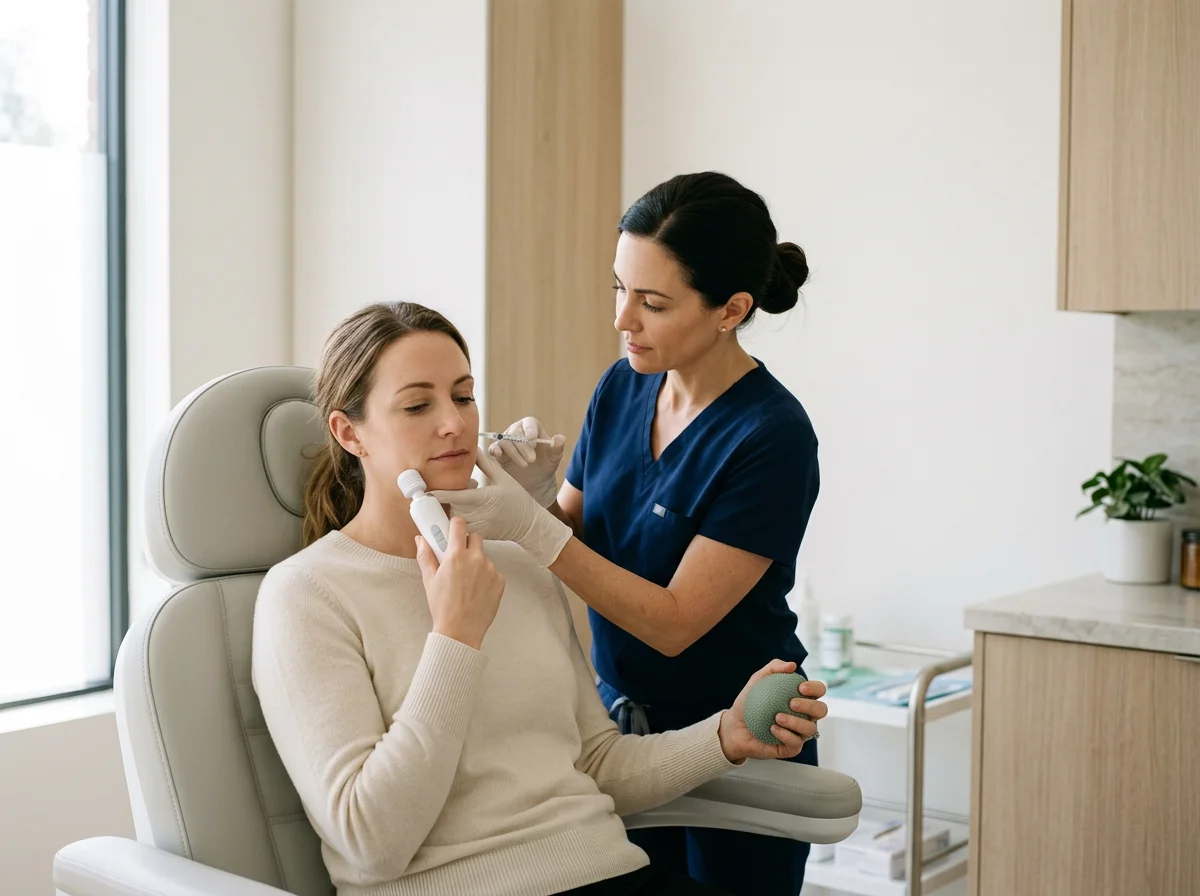
In clinic I hold a small vibration wand against the skin a short distance from where I am injecting, something I first learnt in paediatric emergency medicine in Australia, where we used it to help children through blood tests. The best evidence for it in facial aesthetics is a 2016 study in which 32 women had one side of the face injected with vibration and the other without:
"The Gate Control Theory of Pain explains why vibration reduces pain." Kuwahara H, Ogawa R. Using a vibration device to ease pain during facial needling and injection. ePlasty, 2016.
The Kuwahara study also noted that vibration is best avoided for very precise, smooth contour work such as the under eye, where any movement is unhelpful, so I do not use it everywhere. Taken together, the evidence says what experience says: vibration helps most people a good deal, a few not at all, and it works best as part of a layered approach.
How I minimise discomfort at my clinic in Hale
None of these is dramatic on its own. Together they are the reason the most common thing I hear at the end of a first appointment is "was that it?"
Takeaway: injection pain is a signal your brain assembles from anatomy, technique and expectation. The anatomy is fixed. The other two are mine and yours to change, and between us we usually can.

Frequently asked questions about pain during aesthetic injections
Do anti-wrinkle injections hurt?
Usually very little. In the 302 patient study the average score was around 3.5 out of 10 without any special measures, and the needles used are among the finest in medicine. With numbing, cooling and vibration most of my patients describe a brief scratch, over in a second or two, and a full treatment takes minutes.
Does filler hurt more than anti-wrinkle injections?
Slightly, because a thicker product stretches tissue and more of it is delivered: 4.22 versus 3.60 out of 10 on the left side in the same study. In practice the difference largely disappears with a cannula, local anaesthetic at the entry point and a filler containing lidocaine, which most modern fillers do.
Why did it hurt more this time than last time?
Almost always something other than the injection: a worse night's sleep, more stress, more caffeine, a different area, or a needle that was not changed often enough. If a treatment hurts more than you expect, say so during it rather than afterwards, because there is usually something I can adjust straight away.
Why does the left side of my face hurt more?
Because for most people it does. A 302 patient study found the left side consistently a third to half a point more painful across all treatments, most likely because the right side of the brain, which processes the left side of the body, is more involved in the emotional weighting of pain. It is not a sign that anything was done differently.
Are injections more painful before your period?
The best review of the evidence found no consistent effect of cycle phase on pain in healthy women, although women with painful periods may be more sensitive generally. What does change in the days before a period is sleep, mood and fluid retention, all of which can make the experience feel worse. If you know you feel fragile then, book mid cycle.
Can I take painkillers before my appointment?
Paracetamol an hour beforehand is fine if you want it. I would avoid ibuprofen and aspirin for a few days before injectables unless they have been prescribed for you, because they increase bruising, and bruising is a bigger nuisance than the moment of injection.
Does needle size make a difference?
Yes, measurably. Anti-wrinkle injections with a 29 gauge needle were significantly more painful than with a 33 gauge in the 2017 study. Finer needles and frequent needle changes are among the simplest ways an injector can reduce pain, and you are entitled to ask what is being used.
Is pain during an injection a sign something has gone wrong?
A brief scratch or pressure is normal. Sudden severe pain, pain that spreads, or pain with blanching or a change in skin colour is not, and is one of the reasons I watch the skin constantly and ask you to tell me immediately if anything feels different. In a medical clinic those signs are recognised and acted on at once.
How long does the discomfort last afterwards?
For anti-wrinkle injections, minutes. For filler or collagen stimulators, mild tenderness and swelling for a day or two is normal and settles with cooling. Anything that worsens after 48 hours, or pain out of proportion to what you can see, should be reported to the clinic the same day.
I am very nervous of needles. Is there a gentler way to start?
Yes. Prescription skincare and superficial peels involve no needles at all, and many nervous patients begin there. When you are ready for injectables, we start with one small area and every comfort measure available. I have written a separate guide to how I support nervous patients.
Next steps
If a previous treatment hurt more than you think it should have, or you have been putting off a first appointment because of it, come and talk to me in Hale. Comfort is planned at my clinic, not improvised, and the plan is built around you.
Learn more about Dr Caroline Warden Clinic
Learn more about other treatments offered
Further reading
- How to Choose an Aesthetic Clinic Safely
- Treatment Anxiety Is Real: How I Support Nervous Patients
- Your First Anti-Wrinkle Appointment: What to Expect
- What Happens During an Aesthetic Consultation
- Anti-Wrinkle Injections in Hale, Altrincham and Cheshire
- Dermal Fillers in Hale, Altrincham and Cheshire
Dr Caroline Warden (GMC 6157708) is an NHS GP with over 19 years of clinical experience, an independent prescriber, and holds a Level 7 postgraduate diploma in cosmetic injectables. She has practised aesthetic medicine since 2017 and runs Dr Caroline Warden Skin & Aesthetic Clinic at 2 Crown Passages, Hale, Cheshire, WA15 9GN, serving patients from Hale, Altrincham, Bowdon, Hale Barns, Timperley, Sale, Alderley Edge, Wilmslow, Knutsford, Didsbury and across Cheshire and South Manchester. This article provides general educational information and does not replace an individual assessment. Clinical information correct as of October 2026.
References
- Fouché JJ, Van Loghem JAJ, Thuis J, De Heer LM, van Oijen MGH. Left/right pain asymmetry with injectable cosmetic treatments for the face. Aesthetic Surgery Journal 2017;37(6): pages 708 to 714. https://doi.org/10.1093/asj/sjw214
- Kuwahara H, Ogawa R. Using a vibration device to ease pain during facial needling and injection. ePlasty 2016;16:e9. Read the study
- Chorney SR, Villwock JA, Suryadevara AC. Vibration versus ice to reduce cosmetic botulinum toxin injection pain: a randomized controlled trial. Ear, Nose and Throat Journal 2019;98(6): pages 351 to 355. Read the study
- Iacovides S, Avidon I, Baker FC. Does pain vary across the menstrual cycle? A review. European Journal of Pain 2015;19(10): pages 1389 to 1405. https://doi.org/10.1002/ejp.714
- Melzack R, Wall PD. Pain mechanisms: a new theory. Science 1965;150(3699): pages 971 to 979. https://doi.org/10.1126/science.150.3699.971
- McLenon J, Rogers MAM. The fear of needles: a systematic review and meta-analysis. Journal of Advanced Nursing 2019;75(1): pages 30 to 42. Read the abstract
