What Makes Anti-Wrinkle Injections Look Natural? The Five Decisions That Decide Your Result

Last updated: 28 October 2026. This was the first article I wrote for this journal in May 2025, and it has been rewritten in full.
Most people who ask me about anti-wrinkle injections in Hale or Altrincham start with the same worry: will it be obvious? They have seen the foreheads that do not move, the eyebrows that sit too high at the outer edge, the eyes that look surprised in every photograph, and they would rather keep their lines than risk that. It is a reasonable fear, and the reassuring answer is that none of those results are accidents. Each one comes from a decision that was made badly, or not made at all, before the treatment started. This article explains those decisions, so you can judge any practitioner by them, including me.
In this article:
- Why do anti-wrinkle injections sometimes look unnatural?
- The UK picture: who is injecting, and why it matters
- Decision one: reading your face before treating it
- Decision two: balancing the muscles that lift and the muscles that pull
- Decision three: how much, and why less first is not a compromise
- Decision four: where exactly the product goes
- Decision five: when to treat and when to wait
- What a consultation with me involves
- What a natural result looks like at two weeks
- Frequently asked questions
Why do anti-wrinkle injections sometimes look unnatural?
Anti-wrinkle injections work by temporarily relaxing the small muscles whose repeated contraction creases the skin above them. That is the whole mechanism. The product does not know which muscle it is in, how strong that muscle is, or what the muscle next to it is doing. Every unnatural result is a mismatch between where and how much was injected and what that particular face needed.
The UK picture: who is injecting, and why it matters
Around 900,000 anti-wrinkle procedures are carried out in the UK every year, and the UK remains one of the few high-income countries where someone with no healthcare qualification can legally inject them. Research in 2025 identified almost 20,000 practitioners across more than 5,500 UK clinics, a quarter of them non-medical aestheticians, and a survey of 919 patients found nearly half had been treated in beauty clinics. Save Face, the government-approved register, received almost 3,000 complaints in a single year, close to a quarter of them about anti-wrinkle injections.
I include those figures not to alarm you but because they explain the results you have seen. The product is the same in every syringe. The variable is the assessment, the anatomical knowledge and the judgement of the person holding it, and in the UK the law does not guarantee any of those three. A face-to-face consultation with a prescriber is a legal requirement before treatment; a consultation with the doctor who will actually treat you, who will also see you for the review, is what I offer in Hale. The rest of this article is what happens in that consultation.

Decision one: reading your face before treating it
No two frowns are the same. Anatomical studies describe at least five distinct patterns in the way the muscles between the eyebrows contract, and each needs a different injection map. A practitioner who uses the same five points on every patient will get it right by chance on some faces and wrong on the rest.
So the first ten minutes of your appointment are spent watching you frown, raise your eyebrows, squint and smile, while I note where the muscles are strongest, how your brows sit at rest, and whether your lines are there only when you move or etched in when you do not. Lines that are etched in at rest will soften with treatment but not vanish, and you should be told that before you pay for anything.
Decision two: balancing the muscles that lift and the muscles that pull
This is the decision that separates a natural forehead from a heavy one. One large muscle, the frontalis, lifts your eyebrows and creates horizontal forehead lines. A group of smaller muscles between and around the brows pulls them down and creates frown lines. Your brow position at any moment is the balance between them.
Treat the forehead alone and you weaken the only muscle holding the brows up while the pulling muscles carry on at full strength: the brows drop, the eyelids feel heavy, and the face looks more tired than before. Published guidance is explicit that the forehead should never be treated in isolation, and that this matters even more over fifty, when many people rely on the frontalis to hold up brows that have begun to descend. In the large forehead-line trials, treating the frown and the forehead together kept brow droop to around 2% and, by relaxing the pulling muscles, often produced a subtle lift. If your brows already sit low, the right answer may be to treat only the frown lines and leave the forehead alone, and I will say so.
Decision three: how much, and why less first is not a compromise
The licensed doses used in the clinical trials are a starting point, not a target. Your result depends on your muscle mass, your sex, your age and what you want to keep. A man with a strong frown may need considerably more than a woman with fine lines; someone who acts, presents or simply likes an expressive face needs less than someone who wants their frown gone entirely.
My rule is to treat to the point that softens, not the point that stops, and then review at two weeks, when the full effect is visible. If the lines need more, a small top-up takes two minutes and costs nothing extra. If I had used the larger dose on the day, there is no taking it back for three months. The two-week review is also when any asymmetry is corrected and the outer brow adjusted if needed. I would be wary of any clinic that does not build it in.
You can always add. You cannot subtract. Every natural result I have ever produced was built in two steps, not one.
Decision four: where exactly the product goes
Placement is measured in millimetres. The consensus guidance for the forehead is to inject at least two centimetres above the brow, and higher still in older patients, so that the lower forehead keeps its lift and the product cannot travel towards the eye. Frown injections sit above the bony rim of the eye socket, never on or below it, because that is how product reaches the muscle that lifts the eyelid. Crow's feet are treated outside the orbital rim in small, superficial points so the smile stays in the eyes. None of this is secret; it is in the published consensus papers, and it is why an injector who understands the anatomy under the skin gets consistent results while one working from a diagram does not.
Decision five: when to treat and when to wait
Results last roughly three to four months. Treating earlier than that, chasing the first flicker of movement, keeps the muscle permanently switched off, which over years can thin it and flatten the forehead in a way that looks more done, not less. It also increases the small risk of the treatment becoming less effective over time, which I explain in Why Has My Anti-Wrinkle Treatment Stopped Working?. I ask patients to wait until movement has clearly returned, usually twelve to sixteen weeks, and I will tell you if you have come back too soon.
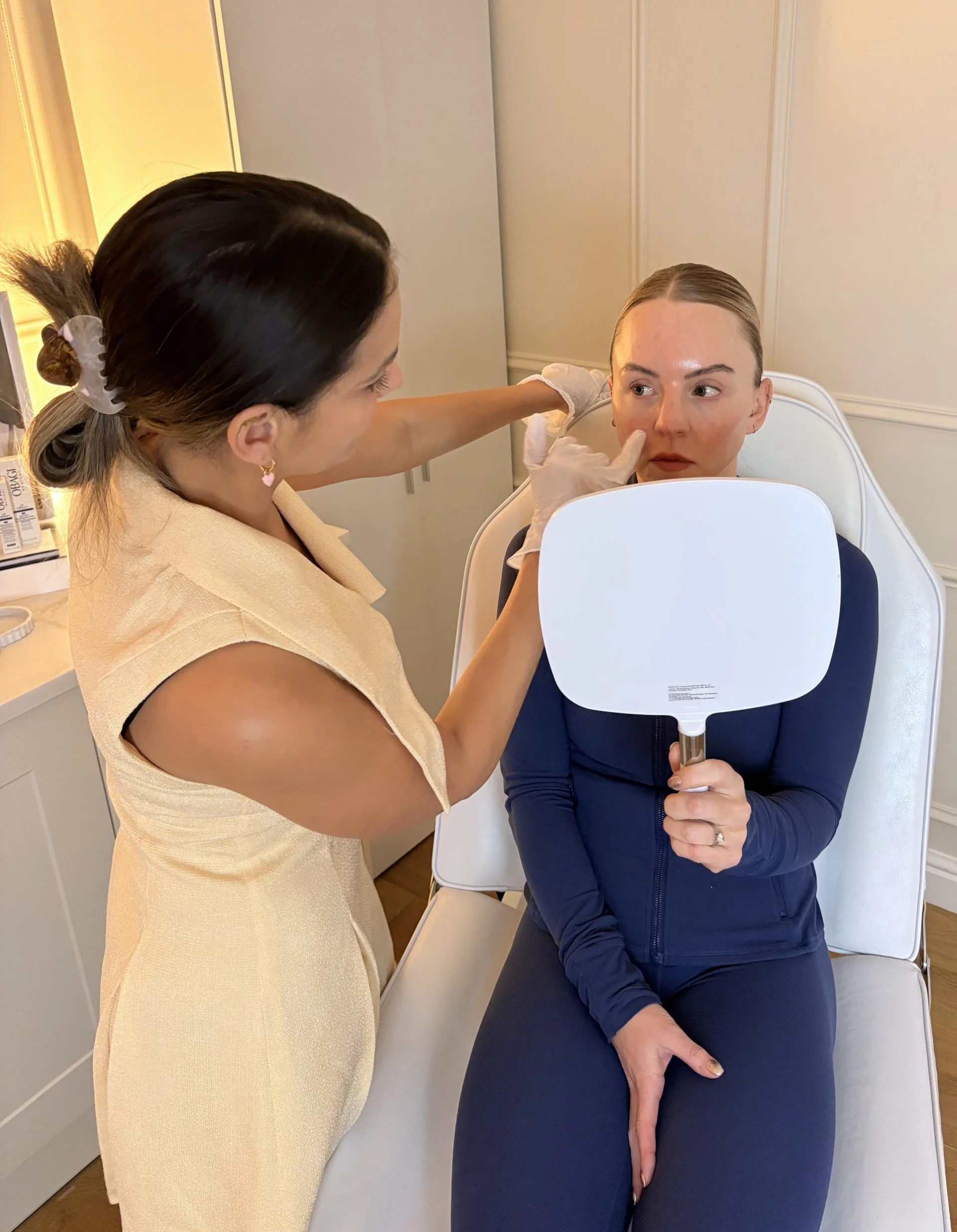
What a consultation with me involves
The General Medical Council publishes specific guidance for doctors who offer cosmetic interventions, and it sets the standard I work to in Hale. When the guidance was announced, the GMC put the principle in one sentence:
"Doctors must not pressure patients to make rushed decisions they may end up regretting."
General Medical Council, announcing its guidance on cosmetic interventions
The consultation fee is fully redeemable against treatment, and current prices are on the price list.
What a natural result looks like at two weeks
A good result passes a simple test: people say you look well and cannot say why. In practice that means the following.
Who it suits, and who I will ask to wait
Anti-wrinkle injections suit most adults with lines that appear on movement, from the late twenties onward, and they are the right first step for frown lines, forehead lines and crow's feet. They are not the answer for lines caused by volume loss or skin laxity, which need a different conversation, and I will not treat anyone under 18, anyone pregnant or breastfeeding, anyone with certain neuromuscular conditions, or anyone whose expectations I cannot meet. Saying no is part of getting natural results; the practitioner who treats everyone produces the faces this article began with.

What to expect, from appointment to review
Aftercare is simpler than the internet suggests; I have set out what actually matters in the aftercare myths post.
My verdict
A natural result is not a style; it is the sum of five decisions made correctly: reading your face, balancing the lifting and pulling muscles, dosing to soften rather than stop, placing the product precisely, and treating only when movement has returned. The product in the syringe is identical wherever you go in Cheshire. What you are choosing is the judgement that decides those five things, and it is worth choosing carefully, because the forehead you have seen that does not move was once someone's first appointment too.
Frequently asked questions
Why do some people look frozen after anti-wrinkle injections?
Too much product in the forehead, aimed at erasing every line rather than softening them. A conservative first dose with a two-week review avoids it.
Why do eyebrows droop after anti-wrinkle injections?
Usually because the forehead was treated without the frown muscles, or injected too close to the brow, weakening the lifting muscle while the pulling muscles keep working. Treating both together keeps brow droop to around 2% in trials.
What causes a "Spock brow"?
Frown injections placed too far inward, leaving the outer forehead fibres to pull the outer brow up unopposed. It is easily corrected with a small top-up at the two-week review.
Can anti-wrinkle injections cause a droopy eyelid?
Rarely. Eyelid droop happens when product reaches the eyelid-lifting muscle from injections placed too low or too deep. It affected over 5% of patients in the original licensing trial and is under 1% in experienced hands; it is temporary and can be eased with prescription eye drops.
Why is a two-week review important?
The full effect takes about fourteen days. Reviewing then allows a small top-up or an asymmetry correction while a larger first dose cannot be undone for three months.
How often should I have anti-wrinkle injections?
When movement has clearly returned, usually every twelve to sixteen weeks. Treating earlier risks a flattened forehead over time and may reduce effectiveness.
Will anti-wrinkle injections get rid of lines that are there at rest?
They soften them but rarely remove them. Etched lines need time, skincare and sometimes other treatments; a good consultation tells you this before you pay.
Is it legal for a beautician to give anti-wrinkle injections in the UK?
Currently yes, provided a prescriber has seen you face to face first, which is often not happening. The product is a prescription medicine; who assesses you and who injects you is your choice, and it is the choice that determines the result.
Do you treat anyone who asks?
No. If your brows are already low, your lines are etched in, you are under 18, pregnant or breastfeeding, or I do not think treatment will help, I will say so. Declining is part of producing natural results.
Further reading
- Anti-Wrinkle Injections in Hale and Altrincham: The Complete Guide
- How Anti-Wrinkle Injections Can Make You Look Refreshed, Not Frozen
- Your First Anti-Wrinkle Appointment, Step by Step
- Aesthetic Doctor vs Aesthetic Practitioner: Why It Matters for Your Face
- Lines and wrinkles: every treatment option explained
- Anti-wrinkle injections in Hale: the treatment page
Next steps
Learn more about Dr Caroline Warden Clinic
Learn more about other treatments offered
About the author
Dr Caroline Warden is an NHS GP with nearly twenty years in medicine, an independent prescriber, and holds a Level 7 postgraduate diploma in cosmetic injectables. She is the sole treating practitioner at Dr Caroline Warden Skin & Aesthetic Clinic, 2 Crown Passages, Hale, Altrincham, Cheshire, and personally carries out every consultation, treatment and review. GMC number 6157708.
References
- General Medical Council. Guidance for doctors who offer cosmetic interventions: key points. Read the guidance.
- General Medical Council. Explaining risks and seeking informed consent in cosmetic practice. Read the learning material.
- Anglia Ruskin University. UK cosmetic injection survey finds safety gaps (919 participants; around 900,000 procedures a year). 2025. Read the summary.
- BMJ. Delayed regulation of non-surgical cosmetic procedures threatens patient safety (practitioner and clinic numbers). 2025. Read the article.
- Save Face, reported in The Times. Complaints about non-surgical cosmetic treatments continue to rise (2,824 complaints). Read the report.
- King M, et al. Management of ptosis. Journal of Clinical and Aesthetic Dermatology (Aesthetic Complications Expert Group guideline). Read the guideline.
- Aesthetic Complications Expert Group. Ptosis following botulinum toxin treatment: prevention and management (PMC). Read the article.
- De Boulle K, Carruthers A, Solish N, Carruthers J, et al. OnabotulinumtoxinA treatment for moderate to severe forehead lines: a review. Plastic and Reconstructive Surgery Global Open. 2020. Read the abstract.
- Understanding the functional anatomy of the frontalis and glabellar complex for optimal aesthetic botulinum toxin type A therapy. Aesthetic Plastic Surgery. 2013;37(5), pages 975 to 983. Read the abstract.
- Borba A, Matayoshi S, Rodrigues M. Avoiding complications on the upper face treatment with botulinum toxin: a practical guide (summary). MedEsthetics. Read the summary.
- Neurotoxin update and review, part 2: best practices in aesthetic dermatology (Spock brow, frontalis dosing). Cosmetic Dermatology. 2017. Read the review.
