Microneedling with Exosomes: Does It Actually Work? A Doctor’s Guide to Purasomes in Hale and Altrincham

Last updated: 28 October 2026
If you have searched for microneedling in Hale or Altrincham recently, you will have seen the word exosomes attached to it, usually with a claim about regeneration and a higher price. Some of the enthusiasm is justified. Some of it is marketing running ahead of the evidence, and some of what is being used in UK clinics is not even legal. As a GP who has offered microneedling with exosomes since 2025, I want to set out what they are, what the trials show, what the law says, and why I chose the product I use, so you can decide whether it is worth it for your skin.
In this article:
- What are exosomes and what do they do in the skin?
- Where do exosomes come from, and which are legal in the UK?
- Why combine exosomes with microneedling?
- What the evidence shows: the trials
- What are Purasomes, and why I chose them
- Safety, the UK rules and what to ask any clinic
- What microneedling with exosomes can and cannot help with
- Who it suits and who should wait
- What happens at your appointment, downtime and results
- Cost in Hale and how a course works
- Frequently asked questions
What are exosomes and what do they do in the skin?
Exosomes are extracellular vesicles: tiny membrane-wrapped parcels, 30 to 200 nanometres across, that almost every cell in the body releases to communicate with its neighbours. Each one carries a cargo of proteins, growth factors, lipids and small pieces of genetic code called microRNA. When a cell takes one in, the message inside changes how that cell behaves: how much collagen it makes, how it responds to inflammation, how quickly it repairs damage.
That messenger role is why they interest aesthetic medicine. Laboratory and animal studies show that exosomes from repair-type cells can prompt fibroblasts, the collagen-making cells of the dermis, to become more active, dampen inflammatory signalling and speed wound closure. The question for patients is not whether exosomes do things in a dish; it is whether a product applied to your face after microneedling does enough to notice. I come to that evidence below.
Where do exosomes come from, and which are legal in the UK?
This is the part most clinics skip, and it matters more than any other.
In 2025 a Channel 5 News investigation found human-derived exosomes being used in clinics across the UK, often by practitioners who said they had not realised the products were illegal. The Department for Business and Trade was unambiguous in response:
"Cosmetics containing exosomes from humans are banned in the UK."
Department for Business and Trade spokesperson, quoted in Aesthetics Journal, 2025
So the first question to ask any clinic in Cheshire offering exosomes is simply: what are they derived from, and are they applied topically? If the answer is "stem cells" without further detail, or involves a needle delivering the product under the skin, walk away.
Why combine exosomes with microneedling?
Two reasons, one about the skin and one about the product.
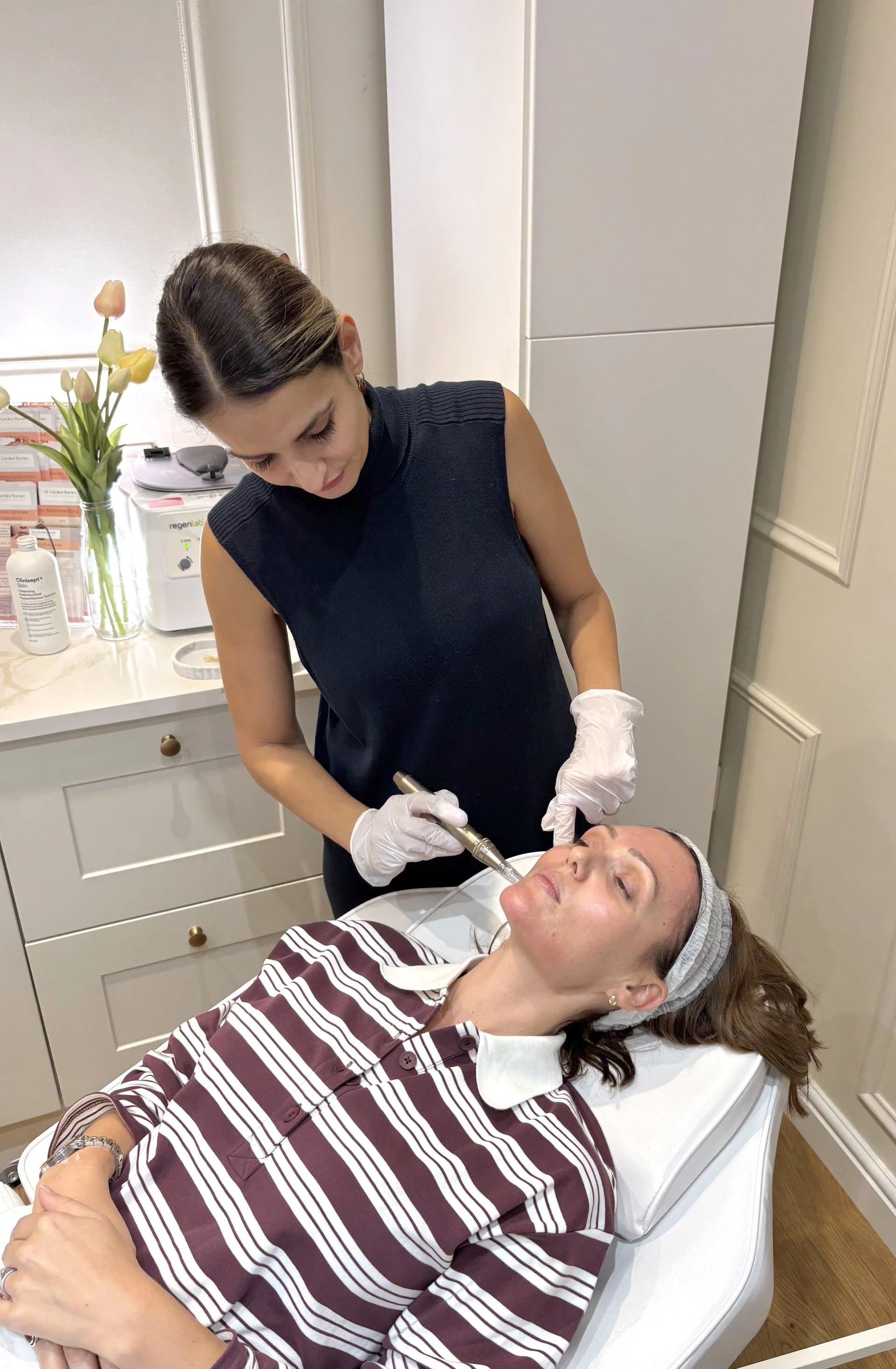
Microneedling works on its own. It is one of the better-evidenced treatments in aesthetics. A fine, sterile needle cartridge creates thousands of controlled micro-channels in the dermis, and the skin's repair response lays down new collagen in answer. In two objective studies by El-Domyati and colleagues in 2015, six sessions two weeks apart produced visible improvement in photoaged skin and in atrophic acne scars, and biopsies showed significant increases in collagen types I, III and VII and in new elastin. That is why I offer it as medical microneedling in Hale whether or not exosomes are added.
Exosomes cannot cross intact skin. At 30 to 200 nanometres they are far too large to pass the barrier, which is why an exosome moisturiser applied at home is unlikely to do much. Microneedling changes that: for a short window after treatment, the channels allow a topical product to reach the upper dermis where fibroblasts live. The combination is logical, and it is the combination, not the exosomes alone, that the better trials have tested.
What the evidence shows: the trials
I want to be exact here, because exosome marketing often is not. Here is what has actually been published in humans.
Three honest caveats sit alongside those results. The strongest trials used human stem-cell exosomes, which are not available in the UK; they prove the principle, not the specific product on any British clinic shelf. Every study is small and short; nobody has followed patients for years. And microneedling alone did well in every control arm, so exosomes are an enhancement to a treatment that already works, not the reason it works.
Exosomes make a good treatment somewhat better and the recovery somewhat kinder. That is the honest claim, and it is enough for me to offer them; it is not enough for anyone to call them miraculous.
What are Purasomes, and why I chose them
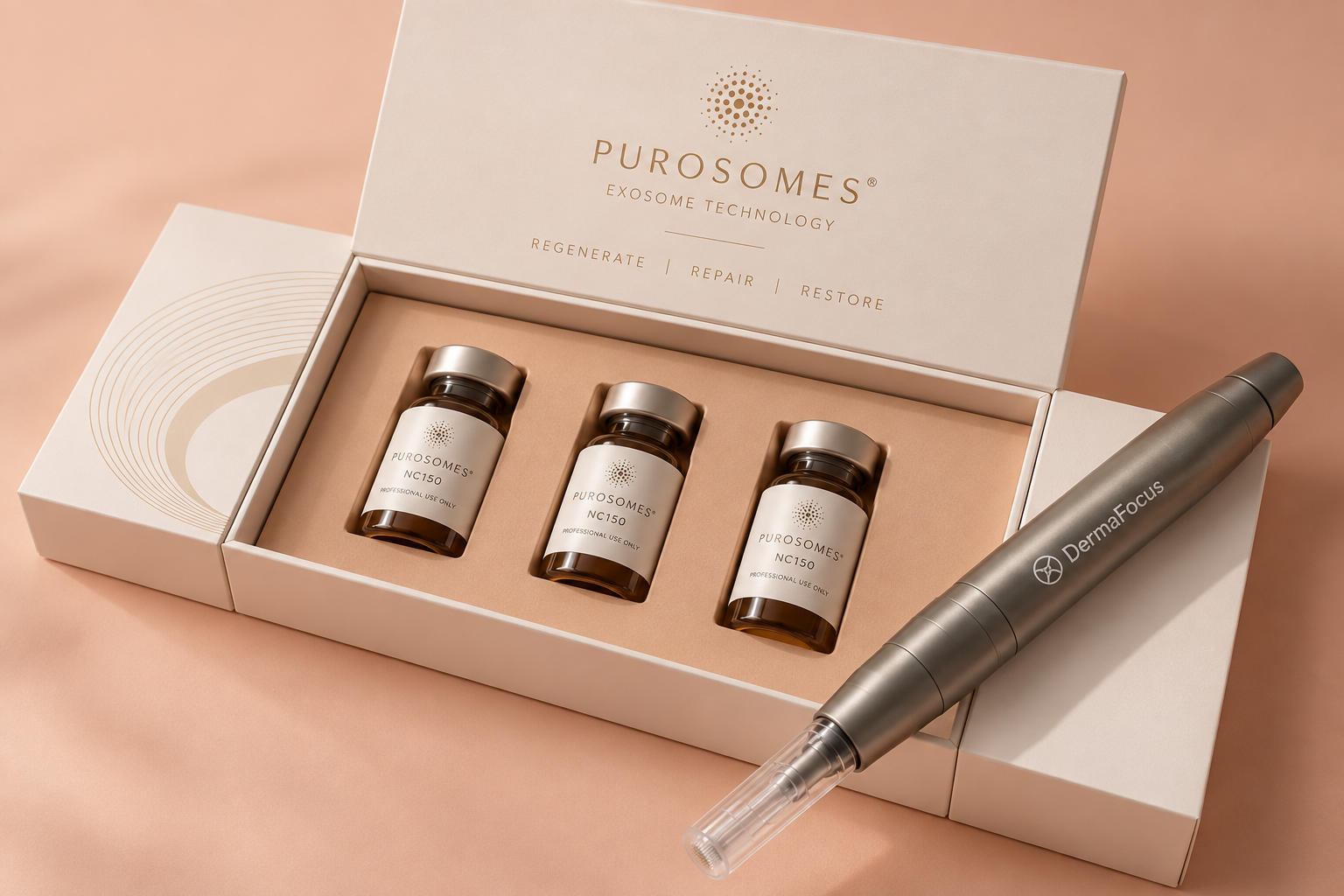
Purasomes are made by Dermoaroma, an Italian regenerative-medicine company, and are derived from certified-organic bovine colostrum, the first milk produced after calving, which is naturally rich in growth factors and extracellular vesicles. The manufacturer's AMPLEX Plus process isolates the vesicles and loads them with purified colostrum growth factors and cytokines. The skin products come as sterile single-use vials for application during and after microneedling: NC150+ Nutri Complex for tired, thin and ageing skin, and SGC100+ Skin Glow Complex for dull, damaged and uneven-toned skin. The manufacturer states that each NC150+ treatment pack contains around 20 billion exosomes and 200 mg of twenty growth factors.
I chose them for four reasons that have nothing to do with marketing.
One thing I will not do is tell you Purasomes are "clinically proven" in the way the leaflets do. The product-specific data are the manufacturer's own and have not, as far as I can find, been published in a peer-reviewed human trial. The independent evidence is for the category: exosome-containing products applied after microneedling. I think that evidence, plus the regulatory position, plus what I see in clinic, justifies offering it. You deserve to know exactly which of those three is doing the work in that sentence.
Safety, the UK rules and what to ask any clinic
Topical, non-human exosomes applied after microneedling have a reassuring short-term record: the trials above reported mild, transient redness and no serious adverse events, and several found less redness and faster settling than microneedling alone. The honest gaps are long-term data, which do not yet exist for any exosome product, and product quality, which varies enormously in an under-regulated market. Those two gaps are why the questions below matter.
What microneedling with exosomes can and cannot help with
Who it suits and who should wait
Microneedling with exosomes suits most adult skin types and tones, including darker skin where energy-based treatments carry more pigmentation risk, because microneedling itself causes very little post-inflammatory hyperpigmentation. It is particularly well matched to skin over 35 that has started to look thinner and less luminous, to anyone with acne scarring who wants a gentle, cumulative approach, and to patients who want to maintain the results of a biostimulator or polynucleotide course between treatments.
What happens at your appointment, downtime and results
Cost in Hale and how a course works
Microneedling with Purasomes exosomes is £295 per session at my clinic in Hale. I recommend a course of three sessions, four weeks apart, which matches the manufacturer's protocol and the interval used in the trials, with a maintenance session every three to six months if you want to hold the result. For acne scarring, three to six sessions is realistic. Microneedling alone is also available, and is the right choice if you have a dairy allergy or simply prefer the lower cost. Your consultation fee is fully redeemable against treatment. You can see examples of results on the Before and After page.
Exosome microneedling combines well with the rest of a regenerative plan. I often alternate it with polynucleotides for skin quality, or use it to refine texture after a course of Sculptra has rebuilt structure, keeping at least two weeks between different treatments so the skin recovers fully from each.
My verdict
Exosomes are neither the miracle the adverts describe nor the gimmick the sceptics suspect. Applied after microneedling, a well-made, legal, non-human exosome product appears to improve the result and soften the recovery, on the strength of small but consistent randomised trials. That is a worthwhile upgrade to a treatment that already works, provided you know what is being put on your skin, who is doing it and what it can realistically achieve. Those three things are the whole of my offer, and the reason I chose Purasomes.
Frequently asked questions
Do exosomes actually work with microneedling?
Small randomised split-face trials show microneedling plus exosomes outperforms microneedling plus saline on wrinkles, elasticity, hydration, pigmentation and acne scars, with milder redness. A 2026 systematic review calls the evidence promising but early, with small samples and short follow-up.
Are exosomes legal in the UK?
Human-derived exosomes are banned in UK cosmetics, and injected exosomes of any source have no UK authorisation. Animal-derived (such as bovine colostrum) and plant-derived exosomes are legal when used as topical cosmetics, which is how I use Purasomes.
What are Purasomes made from?
Certified-organic bovine colostrum, processed to isolate extracellular vesicles and load them with purified colostrum growth factors. They come in sterile single-use vials for topical application during and after microneedling.
Are exosomes safe?
Topical, non-human exosomes after microneedling have a reassuring short-term safety record in trials, with mild transient redness and no serious events. Long-term data do not yet exist for any exosome product, which is why source, sterility and a regulated practitioner matter.
How much does microneedling with exosomes cost in Hale?
£295 per session at my clinic, with a course of three sessions four weeks apart recommended.
How much downtime is there?
Redness like mild sunburn for 24 to 48 hours, then mild dryness for a few days. Most patients are back at work the next day without make-up; the trials found exosomes shorten this compared with microneedling alone.
Can microneedling with exosomes treat acne?
I treat acne scars and post-inflammatory marks, not active acne, which is a medical condition for your own GP. Microneedling is deferred until the skin is calm.
Is it better than PRP?
Both add growth factors to microneedling. PRP depends on your own blood and varies from person to person; a standardised exosome product is consistent and avoids a blood draw. I set out my reasoning in a separate article linked below.
Who should not have it?
Anyone with active infection or cold sores, recent isotretinoin, keloid tendency, pregnancy or breastfeeding, a dairy allergy (for Purasomes specifically), or uncontrolled diabetes or immunosuppression should wait or discuss first.
Further reading
- Should You Bleed During Microneedling? What a Safe Treatment Looks Like
- Why I Believe Microneedling with Exosomes Is Better Than PRP
- Why I Don't Recommend At-Home Microneedling with a Derma Roller
- The Best Treatments for Acne Scars in 2026
- Why Collagen Declines and the Treatments That Actually Stimulate It
- Medical microneedling in Hale, with or without exosomes
Next steps
Learn more about Dr Caroline Warden Clinic
Learn more about other treatments offered
About the author
Dr Caroline Warden is an NHS GP with nearly twenty years in medicine, an independent prescriber, and holds a Level 7 postgraduate diploma in cosmetic injectables. She is the sole treating practitioner at Dr Caroline Warden Skin & Aesthetic Clinic, 2 Crown Passages, Hale, Altrincham, Cheshire. GMC number 6157708. The clinic uses Purasomes exosome products purchased from the UK distributor and has no sponsorship or commercial arrangement with the manufacturer.
References
- Park KY, et al. Efficacy of combined treatment with human adipose tissue stem cell-derived exosome-containing solution and microneedling for facial skin aging: a 12-week prospective, randomized, split-face study. Journal of Cosmetic Dermatology. 2023. Read the summary.
- Kwon HH, Yang SH, Lee J, et al. Combination treatment with human adipose tissue stem cell-derived exosomes and fractional CO2 laser for acne scars: a 12-week prospective, double-blind, randomized, split-face study. Acta Dermato-Venereologica. 2020;100(18):adv00310. Read the study.
- Liang X, Li J, Yan Y, et al. Efficacy of microneedling combined with local application of human umbilical cord-derived mesenchymal stem cells conditioned media in skin brightness and rejuvenation: a randomized controlled split-face study. Frontiers in Medicine. 2022;9:837332. Read the study.
- Dhaliwal NK, Moothathamby T, Sokhal BS, Gkini MA. The use of microneedling with exosomes in dermatology: a systematic review. Journal of Cosmetic Dermatology. 2026;25(4):e70881. Read the summary.
- Stack ER, Spongberg C, Braud SC, et al. Clinical advances in exosome-based therapies for aesthetic medicine: a systematic review and meta-analysis of human clinical trials. Aesthetic Surgery Journal. 2026;46(Suppl 1). Read the abstract.
- Ash M, Zibitt M, Shauly O, et al. The innovative and evolving landscape of topical exosome and peptide therapies: a systematic review. Aesthetic Surgery Journal Open Forum. 2024. Read the review.
- El-Domyati M, Barakat M, Awad S, et al. Multiple microneedling sessions for minimally invasive facial rejuvenation: an objective assessment. International Journal of Dermatology. 2015;54(12), pages 1361 to 1369. Read the abstract.
- El-Domyati M, Barakat M, Awad S, et al. Microneedling therapy for atrophic acne scars: an objective evaluation. Journal of Clinical and Aesthetic Dermatology. 2015;8(7), pages 36 to 42. Read the study.
- Aesthetics Journal. Investigation reports human-derived exosomes in UK clinics, including the Department for Business and Trade statement. 2025. Read the report.
- Save Face. Exosome therapy: UK patient safety warning on human-derived and injectable exosomes. Read the guidance.
- Harley Academy. What are exosomes? A guide for aesthetic practitioners. 2025. Read the article.
- Aesthetics Journal. DermaFocus launches Purasomes exosome range in the UK (product range and source). Read the announcement.
