Should You Bleed During Microneedling? What the Latest Evidence Actually Shows
Written by Dr Caroline Warden, NHS GP and aesthetic doctor, Hale, Altrincham. Last reviewed July 2026.
One of the questions I am asked most often in clinic is this: if I do not bleed during microneedling, does that mean it has not worked?
The answer is no.
A small amount of pinpoint bleeding can occur during professional microneedling, particularly over thicker skin or when treating established acne scars. Heavy or widespread bleeding is not required to stimulate collagen, and a blood covered face is not a measure of treatment quality.
Modern microneedling is about creating a precise, controlled injury at the correct depth for your skin and your concern. It is not about producing as much trauma as possible.
At Dr Caroline Warden Skin & Aesthetic Clinic in Hale, near Altrincham, we adjust treatment depth across different areas of the face rather than running one aggressive setting over everything. This article explains why, using the published evidence available in 2026.
In this article
What microneedling actually does to the skin
Is pinpoint bleeding normal, and what is the correct endpoint?
Needle depth: matching the setting to the concern
Why microneedling videos on social media look so bloody
Does more inflammation produce more collagen?
Microneedling with exosomes: what the 2025 and 2026 research shows
Are exosomes legal in the UK? The point most clinics skip
What we use at our Hale clinic, and why
Risks, complications and the granuloma question
What normal recovery looks like
How many microneedling sessions will I need?
Doctor led microneedling in Hale, Altrincham and Cheshire
Frequently asked questions
References
What microneedling actually does to the skin
Microneedling, also known as collagen induction therapy, uses very fine sterile needles moving at high speed to create microscopic channels in the skin.
These controlled micro injuries switch on a repair cascade involving:
inflammatory signalling
fibroblast activation
collagen and elastin production
extracellular matrix remodelling
gradual improvement in skin texture, firmness and tone
A 2025 systematic review and meta analysis published in Aesthetic Plastic Surgery pooled 21 studies covering 723 patients treated with microneedling for facial rejuvenation. The average patient age was 48, and 72 per cent were women. The authors concluded that microneedling is associated with high patient satisfaction and a low rate of adverse events.
Crucially, the same review flagged that outcome measures, protocols and depths are still not standardised between studies. In other words, there is no published rule stating that a specific amount of visible bleeding is required for a successful result. That claim exists in marketing, not in the literature.
Is pinpoint bleeding normal, and what is the correct endpoint?
It can be normal, yes.
Published microneedling protocols typically describe the clinical endpoint as one of the following:
uniform redness (erythema)
mild erythema with warmth
erythema with occasional pinpoint bleeding
These are alternative visual endpoints, not a ranking from worst to best. Bleeding happens when the needles encounter tiny superficial vessels. It is a consequence of depth and individual skin anatomy, not the objective of the treatment.
Expected during treatmentNot required or expectedEven redness across the treated areaStreams or sheets of bloodWarmth and a sunburn like appearanceLarge areas of oozingMild swellingA completely blood covered faceScattered pinpoint bleeding in placesSevere pain requiring the treatment to stop
Needle depth: matching the setting to the concern
Depth is the single most important variable in microneedling, and it should never be a fixed number applied across the whole face.
The skin around the eyes is dramatically thinner than the skin of the cheeks or nose. Running one depth everywhere means overtreating the delicate areas and undertreating the thick ones.
Published reviews generally describe shallower settings for facial ageing and fine lines, with deeper settings reserved for atrophic scarring. As a broad guide:
ConcernTypical depth rangeUsual endpointUnder eye area, delicate skinSuperficialLight, even rednessFine lines, pores, dullness, hydrationAround 0.5 to 1.0 mmEven redness, occasional pinpoint bleedingGeneral texture and early laxityAround 1.0 mmEven redness, scattered pinpoint bleedingAtrophic acne scarring, thick cheek skinAround 1.5 to 2.0 mm, sometimes moreMore consistent pinpoint bleeding, still controlled
These are illustrative ranges from the published literature, not a protocol. Your own settings are decided at consultation based on your skin thickness, skin type and medical history.
A deeper setting reliably produces more pain, more bleeding, more inflammation, longer redness and a higher theoretical risk of pigmentation change or scarring. That does not make deeper wrong. It makes deeper a decision, not a default.
Why microneedling videos on social media look so bloody?
Social media rewards drama. A bloody treatment looks more medical, more intensive and, to a scrolling audience, more effective.
There is also a historical reason. Earlier microneedling protocols did pursue uniform pinpoint bleeding as an endpoint, particularly for established scars. Those were scar remodelling protocols. Comparing an intensive acne scar treatment with a session designed to improve hydration, pores and early ageing is comparing two different procedures that happen to share a device.
The visible severity of a procedure does not reliably predict its biological benefit.
Does more inflammation produce more collagen?
Microneedling depends on controlled inflammation to start the repair process. The goal, though, is stimulation rather than damage.
One of the reasons microneedling has a favourable recovery profile compared with fully ablative procedures is precisely that it is fractional. It leaves islands of untouched healthy tissue between the microchannels, and those reservoirs of intact skin drive faster, tidier healing.
Once sufficient stimulation has been created, additional trauma tends to add discomfort, prolonged inflammation, barrier disruption, downtime and risk, without a matching gain.
There is currently no good quality evidence that making a patient bleed heavily produces more collagen than reaching an appropriate controlled endpoint.
Microneedling with exosomes: what the 2025 and 2026 research shows
Exosomes are microscopic extracellular vesicles that carry proteins, lipids and genetic material between cells. They act as biological messengers involved in inflammation, tissue repair and matrix regulation.
They have become popular as a topical application after microneedling, because the temporary microchannels may assist delivery into the skin.
The early human data is genuinely encouraging:
A randomised split face study reported that microneedling combined with an adipose derived cell solution improved hydration, elasticity and pigmentation more than microneedling alone, with benefits apparent by around six weeks.
An investigator blinded split face trial compared exosomes with platelet rich plasma delivered alongside microneedling. Both arms improved wrinkles, pigmentation, redness and texture, and histology showed increased collagen and glycosaminoglycans. Notably, exosomes were not clearly superior to PRP.
A 2026 systematic review of human studies, covering 19 studies, found associations with improved hydration, elasticity, wrinkles, pores, pigmentation and overall appearance in the short term.
Now the caveats, which matter just as much.
A scoping review published in the Journal of Drugs in Dermatology in 2026 identified only 17 clinical studies published between 2020 and 2025 across all dermatological indications. The authors concluded that exosome based therapies show promise, but that interpretation is limited by small sample sizes, short follow up, and non randomised single arm designs.
A 2026 review in Dermatological Reviews went further on the practical side, noting substantial variability in cell sourcing, manufacturing and product characterisation, and confirming that no exosome based product holds FDA approval for dermatological use.
Products marketed as "exosomes" are not interchangeable. They differ in biological source, manufacturing process, purification, concentration, stability, added peptides or growth factors, and quality control. Two clinics offering "exosome microneedling" may be applying products with almost nothing in common.
Are exosomes legal in the UK? The point most clinics skip
This is the section I would most like patients in Hale and Altrincham to read, because it is where marketing has run ahead of the law.
In the UK, the Medicines and Healthcare products Regulatory Agency (MHRA) treats injected exosomes as medicinal products. No exosome injectable holds a UK marketing authorisation. That means:
Injecting exosomes, whether intradermally, subcutaneously or intravenously, cannot lawfully form part of a cosmetic treatment in the UK.
Human derived exosome products are not permitted for aesthetic use in the UK.
Products may be applied topically, which is how they are legitimately used alongside microneedling.
If a clinic offers to inject exosomes, or describes their product as human derived or as "stem cell exosomes from donor tissue", that is a red flag worth walking away from. Practitioners in that position may also find their indemnity insurance does not respond if something goes wrong.
Ask any clinic three questions: what is the source of your exosome product, is it applied topically or injected, and can you show me the product documentation? A good clinic will answer without hesitation.
Separately, microneedling sits within the scope of the licensing scheme for non surgical cosmetic procedures being introduced in England under the Health and Care Act 2022. The Department of Health and Social Care published its response to the consultation in August 2025 and rollout is progressing, with procedures categorised by risk. The direction of travel is clear: more formal oversight of training, premises, insurance and record keeping.
What we use at our Hale clinic, and why
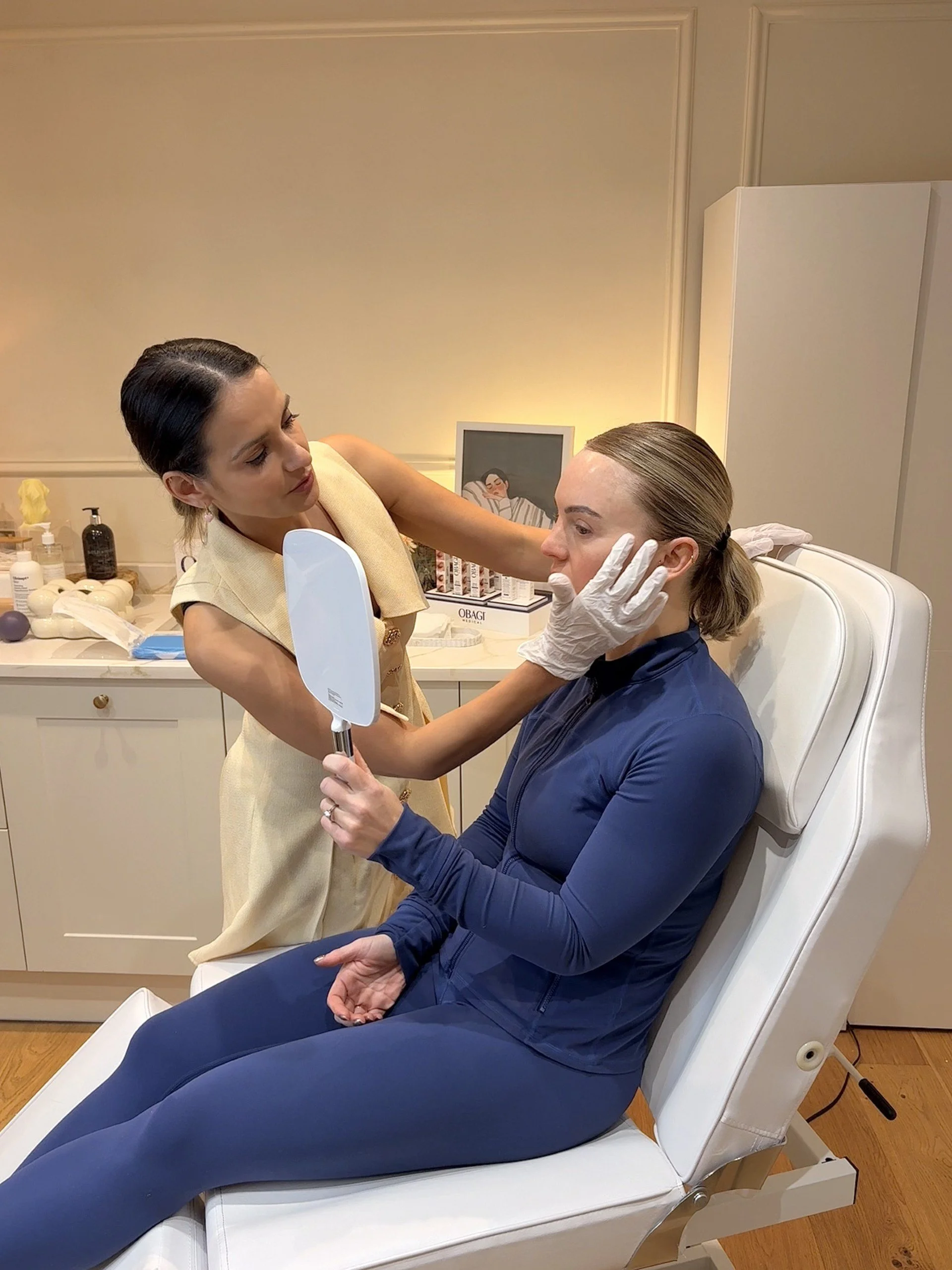
At Dr Caroline Warden Skin & Aesthetic Clinic we use the Dermafocus PNE medical microneedling device, and where clinically appropriate we combine treatment with Purasomes NC150.
To be explicit about what that is: Purasomes NC150 is a bovine derived regenerative complex, applied topically. It is not a human stem cell product and it is not injected. That is a deliberate choice, taken to stay firmly within UK regulatory boundaries while still offering a regenerative adjunct with a reasonable evidence signal behind it.
Depending on your skin, your concerns and your budget, a plan might involve:
microneedling with Purasomes NC150
microneedling with NCTF skin booster
microneedling alone
a different treatment entirely, for example [internal link: Polynucleotides] or [internal link: Skin Boosters], if that suits your skin better
Microneedling works without exosomes. The needling itself drives the collagen response. Exosomes are an optional adjunct, and any clinic presenting them as the reason the treatment works has the science the wrong way round.
Risks, complications and the granuloma question
Microneedling is regarded as safe when performed with an appropriate device, sterile technique and careful patient selection.
Common and temporary: redness, swelling, tenderness, dryness, mild flaking, occasional bruising.
Less common: post inflammatory hyperpigmentation, prolonged inflammation, acne flare, infection, tram track marks, allergic or granulomatous reactions.
The granuloma question is worth understanding properly, because it directly supports the argument of this article. A 2025 systematic review in Dermatologic Surgery searched the literature for granulomatous reactions after microneedling and found 13 studies describing 15 patients, aged 26 to 74, with non necrotising granulomatous inflammation.
The striking finding was what was implicated. Motorised microneedling pen use and topical vitamin C application featured in the majority of cases, with vitamin C involved in around 60 per cent. Reactions were sometimes treatment resistant.
The practical lesson is not to fear microneedling. It is that only products specifically selected as suitable for procedural use should ever go onto freshly microneedled skin. Your favourite vitamin C serum belongs on intact skin, not open microchannels. More product is not better, in exactly the same way that more bleeding is not better.
What normal recovery looks like
Immediately afterwards your skin will usually look pink or red and feel warm and tight. Over the following days you may notice mild swelling for 24 to 48 hours, dryness, light flaking, sensitivity to skincare and scattered pinpoint marks.
Most patients find the obvious redness settles over one to three days. Deeper acne scar treatments take longer.
Contact your treating clinic promptly if you develop worsening pain, increasing heat, pus, spreading redness, blistering or significant swelling.
How many microneedling sessions will I need?
For general skin rejuvenation we usually recommend a course of three treatments approximately four weeks apart, followed by maintenance every four to six months.
Acne scarring commonly needs more sessions, and often a combination approach rather than microneedling alone. Depending on scar type, that might include subcision, TCA CROSS, laser or a staged plan. [internal link: Acne Scarring Treatments]
Doctor led microneedling in Hale, Altrincham and Cheshire

We are a small, female led, family run clinic in the heart of Hale village, a few minutes from Altrincham town centre and the Metrolink. Patients travel to us from Bowdon, Hale Barns, Timperley, Sale, Wilmslow, Knutsford, Alderley Edge and across Cheshire and south Manchester.
Your microneedling treatment is planned around:
your skin thickness and skin type
your pigmentation risk
the specific area being treated
whether we are addressing ageing, pores, pigmentation or scarring
how much downtime you can accommodate
whether a regenerative topical is being added
Every treatment is carried out by Dr Caroline Warden personally. Nothing is delegated, and nothing runs to a fixed one size protocol.
You do not need the deepest treatment, and you do not need the bloodiest treatment. You need the right depth, performed safely, for the right indication.
Dr Caroline Warden Skin & Aesthetic Clinic, 2 Crown Passages, Hale, Altrincham, WA15 9GN
Frequently asked questions
Does no bleeding mean my microneedling has not worked?
No. Even redness without visible bleeding is a recognised and appropriate treatment endpoint, particularly for superficial and moderate depth facial rejuvenation.
Is pinpoint bleeding a good sign?
It can be a normal indication that the needles have reached the superficial dermis. It is not proof that your result will be better than someone who did not bleed.
Should my whole face bleed during microneedling?
No. Widespread or heavy bleeding is not required, and it should not be marketed as evidence of a superior treatment.
Is deeper microneedling better for acne scars?
Deeper or more targeted treatment is often necessary for certain atrophic acne scars, but the right depth depends on scar type, location and skin thickness. Some scars respond better to subcision, TCA CROSS, laser or combination therapy than to microneedling alone.
Are exosomes legal in the UK?
Topical application of a suitable non human derived exosome product is used in UK clinics. Injecting exosomes is not lawful for cosmetic purposes, because the MHRA treats injected exosomes as medicinal products and none holds a UK marketing authorisation. Human derived exosome products are not permitted for aesthetic use.
Are exosomes proven to improve microneedling results?
Early clinical trials suggest improvements in hydration, texture, elasticity and pigmentation when applied after microneedling. The studies remain small, follow up is short, and formulations vary widely. They are best described as a promising adjunct rather than a proven treatment.
Is microneedling suitable for darker skin tones?
Microneedling can be suitable across a broad range of skin tones because it does not rely on heat and does not remove the whole skin surface. All procedures that cause inflammation can potentially trigger pigmentation, so conservative settings, skin preparation and strict sun protection remain important.
Can I use my own vitamin C serum after microneedling?
Not on freshly treated skin. Topical vitamin C was implicated in the majority of published granulomatous reactions after microneedling. Only products specifically selected for procedural use should be applied to microchannelled skin.
Where can I have doctor led microneedling near Altrincham?
Dr Caroline Warden Skin & Aesthetic Clinic is based at 2 Crown Passages in Hale village, a short distance from Altrincham town centre, and treats patients from across Cheshire and south Manchester.
About the author
Dr Caroline Warden is an NHS GP with more than 19 years of clinical experience and an independent prescriber. She holds a Level 7 postgraduate diploma in cosmetic injectables and trained with Harley Academy. She founded Dr Caroline Warden Skin & Aesthetic Clinic in Hale, Altrincham, alongside her sister, with a focus on regenerative aesthetics, skin health and conservative, natural looking results. All treatments are performed by Dr Warden personally.
This article is for general information and does not replace an individual consultation. Suitability, depth and protocol are determined at assessment.

Further Reading
If you found this useful, these related articles from the clinic explore microneedling, exosomes and regenerative skin treatments in more depth.
- Why I Believe Microneedling with Exosomes Is Better Than PRP
- Microneedling with Exosomes: Why You Need It in Your Life If You Are Over 35
- Why I Don't Recommend At-Home Microneedling with a Derma Roller
- Is Microneedling Good for Menopause Skin?
- The Best Treatments for Acne Scars in 2026
Explore the treatment: Medical Microneedling in Hale, Altrincham and Cheshire
Next steps
References
Foppiani JA, Fanning JE, Beltran K, et al. Microneedling for Facial Rejuvenation: A Systematic Review. Aesthetic Plastic Surgery. 2025;49:4949 to 4960. View study
Friedmann DP, Mehta E, Verma KK, Harris R. Granulomatous Reactions From Microneedling: A Systematic Review of the Literature. Dermatologic Surgery. 2025;51(3):263 to 266. View study
Mashi A, Oraybi RA, Hakami MS, et al. Microneedling for Non Cosmetic Dermatologic Conditions: A Systematic Review of Efficacy and Safety. Cureus. 2025;17(8):e90857. View study
Exosome Based Therapies in Dermatology: A Scoping Review. Journal of Drugs in Dermatology. 2026. View study
Flores Rodríguez J, Toledo Avelar L, Yi K, et al. Efficacy of Exosome Based Therapies for Skin Rejuvenation: A Systematic Review of Human Studies. Cureus. 2026. View study
Maher, et al. Regulatory, Ethical and Safety Considerations of Exosome Based Therapies in Dermatology. Dermatological Reviews. 2026. View review
Exosome Based Therapeutics in Dermatology and Beyond: A Narrative Review. Biomedicines. 2026;14(2):338. View review
Exosomes in Skin Rejuvenation: Systematic Review of Anti Aging Effects and Clinical Applications. Dermatology Practical & Conceptual. 2026. View study
Exosomes in Aesthetic Medicine: An Overview. Aesthetic Surgery Journal. 2026;46(Suppl 1):S1. View overview
Save Face. Exosome Therapy in the UK: Patient Safety Warning on New Injectables. Read guidance
House of Commons Library. The regulation of non surgical cosmetic procedures in England. Briefing CBP 10331. Read briefing
MHRA. Advanced therapy medicinal products: regulation and licensing in the UK. Read guidance
