Crepey Neck Skin: What Actually Works in Your 40s, 50s and Beyond?
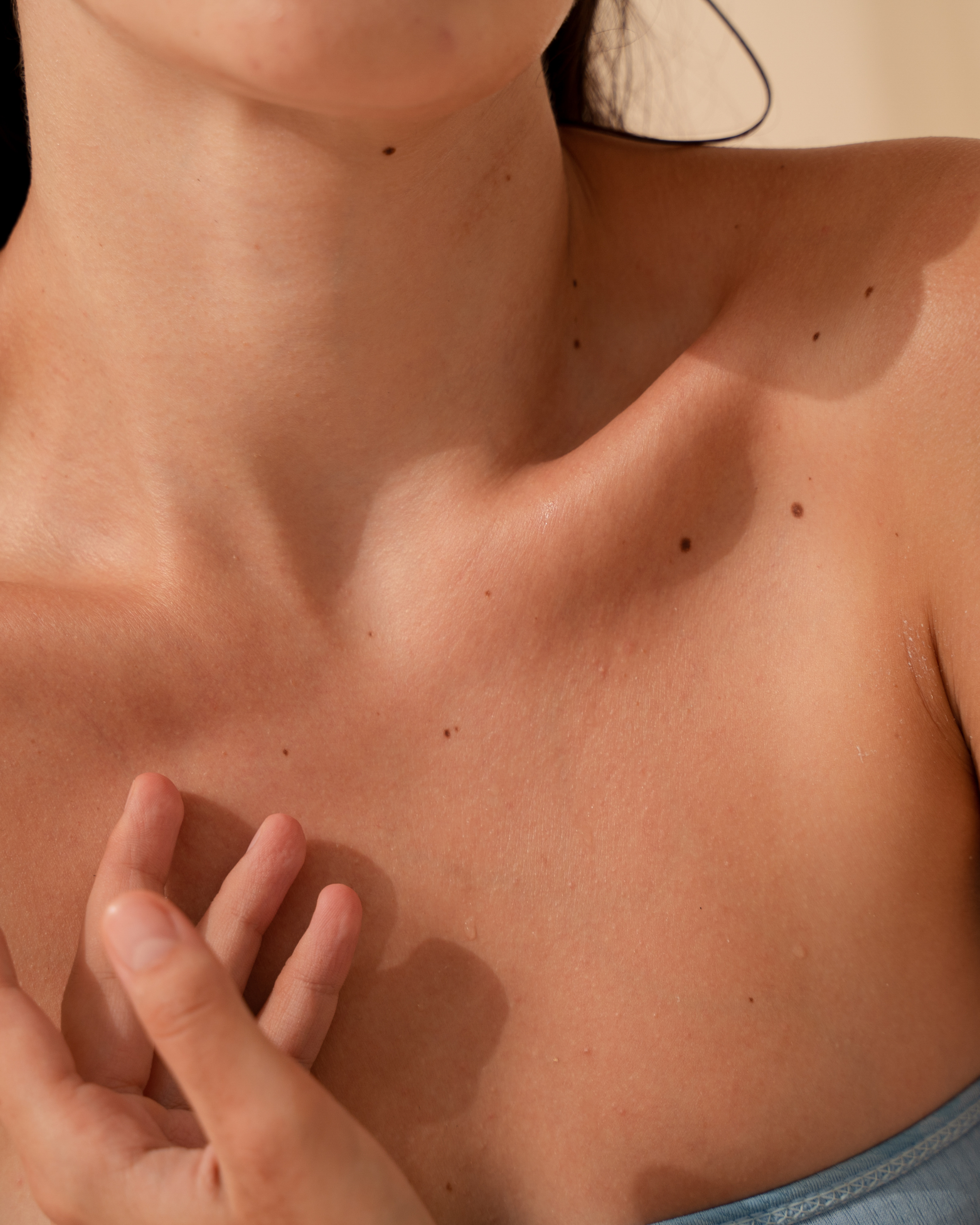
There is one area patients increasingly point to during consultations that has nothing to do with their face.
Their neck.
Sometimes they describe it as crepey. Sometimes the skin simply seems thinner than it was. Others notice fine horizontal lines that were not there a few years ago. And very often it is put like this:
My face still looks quite good, but my neck is giving my age away.
I hear this particularly often from women in their forties and fifties.
The neck is an interesting area because it does not age in the same way as the face, and it is also an area where aesthetic treatments are very easy to overpromise. There are treatments that genuinely improve skin quality, fine wrinkling and mild laxity. But there is an important difference between improving crepey skin and physically removing significant loose skin.
Understanding that distinction is the starting point for choosing the right treatment.
In this article:
- Why neck skin becomes crepey
- Why the neck can change so quickly around menopause
- The five different problems people call "my neck looks old"
- Skincare, microneedling, polynucleotides, hyperdilute Radiesse and Profhilo, one by one
- Every option compared in a single table
- What Botox can and cannot do for the neck
- Whether collagen supplements or HRT make any difference
- When surgery is genuinely the better answer
- Frequently asked questions
Why Does Neck Skin Become Crepey?
Crepey skin describes skin that has become thinner, finely wrinkled and less elastic, with a slightly crumpled, tissue paper appearance that becomes more obvious when the neck moves.
This happens because ageing changes the structure of the skin itself, and several things change at once.
| What changes | What it does to the neck |
|---|---|
| Collagen production declines | The dermis loses its structural scaffold and the skin loses firmness |
| Elastin degrades | Skin no longer recoils, so movement lines start to linger |
| The dermis thins | Light passes differently through the skin, creating that fragile, crumpled look |
| The skin holds less water | Fine lines become more visible and the surface looks dull |
| Cumulative UV damage | Progressive breakdown of the collagen and elastic fibre network |
The neck is particularly vulnerable because the skin here is relatively thin and constantly moving. It is also the area most of us historically neglected. Many women have protected their faces beautifully for twenty years while stopping their sunscreen somewhere around the jawline.
The result is that chronological ageing and photoageing often become visible here at the same time.
Why Can the Neck Change So Quickly Around Menopause?
For many women the change seems to accelerate during their forties and fifties. That is not imagination.
Skin is an oestrogen responsive organ. Declining oestrogen during perimenopause and menopause is associated with changes in dermal collagen, skin thickness, hydration and elasticity, and systematic review evidence supports that relationship (Pivazyan et al.).
That does not mean menopause is solely responsible. Genetics, cumulative sun exposure, smoking, weight changes and ordinary ageing all matter. But for some women, menopause is the point at which previously subtle changes become impossible to ignore.
Patients often describe it as happening overnight. Biologically it has not. But cumulative change can certainly become visible over a short period.
Not All Ageing Necks Are the Same
Before talking about treatment, it helps to separate five quite different concerns that get grouped together as "my neck looks old". They do not have the same cause, and they do not have the same solution.
| What you are seeing | What is actually happening | What it responds to |
|---|---|---|
| Crepey skin | A skin quality problem. Thin, finely wrinkled, less elastic | Collagen stimulation and skin quality treatment |
| Horizontal neck lines | Lines running across the neck. Often appear early and are not a sign of advanced ageing | Biostimulation and skin quality treatment, with realistic expectations |
| Platysmal bands | Vertical bands caused by muscle activity, more visible on clenching | Botulinum toxin. Nothing else addresses muscle |
| Skin laxity | Genuine looseness or descent of tissue | Mild laxity may improve. Advanced laxity is a surgical problem |
| Submental fullness | Fat beneath the chin blurring the neck and jaw angle | Not a skin problem. Treating the skin will not remove fat |
This is why there cannot really be a single best neck treatment. The treatment has to match the problem.
Start With Skincare
This sounds less exciting than an injectable, but it matters more than most people expect. The neck should be treated as an extension of the face.
That means daily broad spectrum SPF. UV exposure is one of the major drivers of collagen breakdown, and there is very little sense in paying to stimulate collagen while repeatedly exposing the newly treated skin to unnecessary ultraviolet damage.
A well formulated topical retinoid is also useful for appropriate patients. A 2024 systematic review in the American Journal of Clinical Dermatology confirmed tretinoin as the established gold standard for photoaged skin, while noting that its poor tolerability often limits how much of it people can actually use, and that retinaldehyde and other retinoid precursors are reasonable second line options where tolerability is the issue (Siddiqui et al.).
That tolerability point is especially relevant here, because the neck is more sensitive than the face. Applying the concentration and frequency you tolerate facially will often produce irritation, dryness and dermatitis. This is an area where more is definitely not better. Retinoids need introducing gradually.
And skincare has limits. A cream can improve skin quality. It cannot reposition loose tissue.
Microneedling: Stimulating the Skin to Remodel
Microneedling produces controlled micro injury within the skin, and that wound healing response drives a signalling cascade involved in collagen remodelling.
For someone with early neck ageing, fine lines or declining skin quality, this can be a useful treatment, and it is attractive for patients who want gradual improvement without adding volume. Over a course we may see improvement in texture, luminosity and fine lines as the skin remodels.
In my clinic I think of microneedling as a skin health treatment rather than a lifting treatment. That distinction matters. What I would not promise is that it will lift significant excess skin back into position. You can read more about medical microneedling at the clinic here.
Microneedling can also be combined with regenerative topical products such as exosomes. The science there is developing rapidly, but it is a newer area than microneedling itself, and I think it is important to be transparent that the evidence base is still evolving rather than settled.
Polynucleotides: Skin Quality Rather Than Volume
Polynucleotides sit in a different category from conventional dermal filler. The aim is not to project or sculpt an area. It is to support tissue quality, which for thin, crepey neck skin makes conceptual sense.
A 2025 systematic review in the Journal of Cosmetic Dermatology found polynucleotide injections improved parameters including skin texture, elasticity and fine wrinkling, while also highlighting the limitations honestly: relatively small studies, differing protocols and a need for better quality randomised trials (Lampridou et al.).
That is broadly how I discuss them with patients. Promising, yes. Magic, no. For the right patient they form part of a skin quality strategy. They will not remove a substantial amount of loose neck skin.
Hyperdilute Radiesse: The Most Interesting Option for Crepey Neck Skin
This is the treatment I most often consider when the primary problem is crepiness, loss of firmness, fine wrinkling, mild laxity and declining dermal quality together.
Radiesse contains calcium hydroxylapatite. Most people know it as a structural injectable used to support the jawline and chin. But when it is diluted, its behaviour changes. Rather than creating shape, it can be spread diffusely through the tissue to stimulate collagen remodelling and improve skin quality, which makes the neck a particularly interesting treatment area.
Does it actually work on the neck?
Yes, and the evidence here is better than for most neck treatments being marketed.
A prospective, evaluator blinded study followed 22 women aged 35 to 55 with mild to moderate neck ageing, treated with two sessions of hyperdiluted calcium hydroxylapatite 45 days apart. At day 120 the results were as follows (Trindade de Almeida et al.).
| Outcome at day 120 | Result |
|---|---|
| Dermal thickness on ultrasound | Increased by 14.9% overall, and by 23.0% at the lateral neck |
| Improvement in horizontal neck lines | 86.4% of participants |
| Improvement in neck laxity | 81.8% of participants |
| Overall aesthetic improvement | 90.9% of participants |
| Reported high satisfaction | 82% of participants |
A broader systematic review of controlled calcium hydroxylapatite trials also supports improvement in skin ageing parameters, while noting frankly that the research is heterogeneous and that many studies lack randomisation and blinding (Amiri et al.). A 2025 review of injectable neck rejuvenation reached a similar conclusion, supporting several approaches while stressing that small studies and limited long term data restrict how confidently we can compare them (Wang et al.).
That nuance matters. The evidence is encouraging. It is not a replacement for surgery.
What is actually happening in the skin?
This is where terminology becomes misleading. When a treatment is described as "tightening", patients understandably picture loose tissue physically moving upwards. That is not what happens.
Calcium hydroxylapatite works through mechanotransduction. The microspheres act as a scaffold that activates fibroblast mechanoreceptors, triggering synthesis of collagen I and III, elastin and proteoglycans, with minimal chronic inflammation (Aguilera et al.). As that collagen remodels, skin gradually becomes firmer, smoother and less crepey. Fine lines soften. The tissue looks better supported.
One honest caveat that the industry rarely mentions: the same review suggests the strongest regenerative response occurs at around a 1:1 dilution, where the microspheres are spaced closely enough for fibroblasts to interact with them. Higher dilutions spread the product further and treat a larger area, but the trade off is real. Choosing the dilution is a clinical decision about what a particular neck needs, not a fixed protocol. Read more about hyperdilute Radiesse at the clinic here.
Is Profhilo Good for the Neck?
Profhilo contains a high concentration of hyaluronic acid and is designed to improve hydration and skin quality rather than to contour. For someone whose neck skin is dehydrated, thin or beginning to lose elasticity, it can improve how the skin looks and feels.
But expectations matter. I think of Profhilo as a skin quality and hydration treatment. I would not choose it because somebody wants significant loose skin lifted. Treatment selection should follow what the tissue actually needs, not which injectable happens to be fashionable.
What About Botox for the Neck?
Botulinum toxin is useful here, but for a completely different reason. It does not treat crepey skin. Its role is in treating platysmal activity.
The platysma is a broad muscle extending through the neck into the lower face, and vertical platysmal bands can become more prominent with age. In selected patients, carefully placed toxin reduces their appearance and may subtly improve jawline definition.
The evidence is now genuinely good. In a randomised, double blinded, placebo controlled phase 3 trial, around 80% of treated participants achieved at least a one grade improvement in platysma prominence at day 14, against roughly 20% on placebo, with no reported cases of dysphagia or neck muscle weakness (Fabi et al.).
But it is treating muscle, not skin. If somebody points to thin, crinkled skin and asks whether Botox will make it thicker, the answer is no.

Every Option Compared in One Table
| Treatment | What it targets | Best for | What it will not do |
|---|---|---|---|
| SPF and topical retinoid | Prevents further photoageing, supports dermal remodelling | Everyone, and the sensible first step in early change | Reposition loose tissue |
| Medical microneedling | Skin texture, fine lines and remodelling | Early neck ageing and declining skin quality | Lift excess skin |
| Polynucleotides | Tissue quality, elasticity and fine wrinkling | Thin, crepey skin where volume is not the issue | Remove loose skin |
| Hyperdilute Radiesse | Collagen and elastin synthesis, dermal thickness | Crepiness with mild laxity and loss of firmness | Replace a surgical neck lift |
| Profhilo | Hydration and skin quality | Dehydrated, thin skin in early decline | Physically lift descended tissue |
| Botulinum toxin | Platysma muscle activity | Visible vertical bands | Improve skin thickness or crepiness |
| Surgery | Physically removes and repositions tissue | Significant excess skin and clear descent | Nothing else reproduces this result |
Can You Combine Treatments?
Often, yes, and combination frequently makes more sense because neck ageing happens at several levels at once. Someone may have mild crepiness, early laxity, horizontal lines and platysmal bands together, and it is unlikely one treatment optimally addresses all four.
A plan might therefore start with skin quality, using hyperdilute Radiesse, microneedling or polynucleotides. Platysmal activity would be considered separately if it is contributing. Good skincare then protects the result.
But this does not mean everyone needs a long list of treatments. Sometimes one is enough to make a worthwhile difference. And sometimes treatment is unnecessary.
What About Collagen Supplements?
Patients ask me about this constantly, and the marketing is persuasive. The evidence is less so.
A 2025 systematic review and meta analysis in the American Journal of Medicine pooled 23 randomised controlled trials involving 1,474 participants. Overall, collagen supplementation appeared to improve hydration, elasticity and wrinkles. But when the authors separated the studies by quality and funding source, the benefit was seen only in industry funded and lower quality trials. Higher quality studies showed no significant effect on any skin parameter (Myung and Park).
The authors concluded that there is currently no clinical evidence to support the use of collagen supplements to prevent or treat skin ageing.
That does not make nutrition irrelevant to skin health. Adequate protein, sensible micronutrient intake, not smoking, moderate alcohol and UV protection all matter. But I would be cautious about expecting a powdered supplement to tighten an ageing neck.
Does HRT Improve Crepey Skin?
This needs a careful answer, and I am answering it as a GP rather than as an aesthetic practitioner.
We know oestrogen influences skin, and systematic review evidence suggests menopausal hormone therapy can improve parameters including skin collagen content, thickness and elasticity in menopausal women (Pivazyan et al.).
However, HRT should not be started as an aesthetic treatment for neck skin. The decision to use menopausal hormone therapy involves a far broader discussion about symptoms, medical history and individual benefits and risks.
If someone is experiencing wider symptoms of perimenopause or menopause, that is absolutely a conversation worth having with their GP or menopause clinician. But I would not prescribe HRT because someone has noticed neck wrinkles.
When Is Surgery the Better Option?
This is the most important part of any honest discussion about the neck.
There is a point at which injectable and skin treatments cannot achieve what a patient wants. If there is significant excess skin, substantial tissue descent or a pronounced loss of the neck and jawline contour, surgery may be the only treatment capable of producing the degree of physical tightening someone is imagining.
That does not mean everybody needs surgery. Many women are bothered by relatively early changes and achieve a worthwhile improvement without it.
But if somebody pulls several centimetres of loose skin backwards with their hands and tells me they want it to look like that, I am not going to suggest a syringe of collagen stimulator will achieve the same thing. It will not.
Knowing when not to inject is just as important as knowing how to inject.
So What Is the Best Treatment for Crepey Neck Skin?
There is no single answer, which is why the consultation matters more than the product list.
| If your main concern is | Where I would usually start |
|---|---|
| Very early photoageing, no laxity | SPF and a carefully introduced topical retinoid |
| Fine textural change and dullness | Medical microneedling, sometimes with exosomes |
| Thin, crepey skin without laxity | Polynucleotides or Profhilo, depending on hydration and texture |
| Crepiness plus mild laxity and lost firmness | Hyperdilute Radiesse |
| Prominent vertical bands | Botulinum toxin to the platysma |
| Significant loose skin and clear descent | A surgical opinion, not an injectable |
The important thing is identifying what you are actually treating. A crepey neck, a muscular neck and a genuinely lax neck are not the same thing.
Frequently Asked Questions
Can crepey neck skin be reversed?
Improved, yes. Reversed entirely, no. Treatments that stimulate collagen can measurably increase dermal thickness and improve firmness and fine wrinkling, but they work on skin quality rather than removing loose skin. The earlier the change, the better the response tends to be.
What is the best treatment for crepey neck skin?
It depends on what is causing it. For crepiness combined with mild laxity, hyperdilute Radiesse currently has the most convincing neck specific evidence. For fine textural change, microneedling. For thin skin without laxity, polynucleotides. For vertical bands, botulinum toxin, which treats muscle rather than skin.
How much does crepey neck treatment cost in Hale and Altrincham?
Hyperdilute Radiesse is £450 per treatment area, with the neck treated as one area, and the protocol is two sessions six to eight weeks apart. Polynucleotides and medical microneedling are £255 per session as a course of three. Consultation is £75 and is redeemable against treatment. Full pricing is on the price list linked below.
How long does hyperdilute Radiesse last on the neck?
Because the effect comes from collagen remodelling rather than from the product itself, improvement develops over roughly three to four months and is typically maintained with an annual session. It is not an immediate result, and it should not be sold as one.
Will Botox help crepey neck skin?
No. Botulinum toxin relaxes the platysma muscle and softens vertical bands. It has no effect on skin thickness, crepiness or texture. If both problems are present they need treating separately.
Do collagen supplements help a crepey neck?
The best current evidence says no. A 2025 meta analysis of 23 randomised trials found benefit only in industry funded and lower quality studies, with no significant effect in higher quality trials.
At what age does the neck start to look crepey?
The underlying changes begin far earlier than most people notice, but crepiness usually becomes visible during the forties and fifties, often accelerating around perimenopause as falling oestrogen affects collagen, skin thickness and elasticity.
Is there any downtime?
Injectable skin quality treatments to the neck typically cause some swelling, small injection points and occasional bruising for a few days. Microneedling causes redness for one to two days. Specific aftercare is given in writing at your appointment.
Neck Rejuvenation in Hale, Altrincham and Cheshire
At Dr Caroline Warden Skin & Aesthetic Clinic in Hale, every consultation and injectable treatment is carried out personally by me, a practising NHS GP and aesthetic doctor. My approach is deliberately conservative and evidence led.
I do not believe ageing skin needs to be fixed, and I do not think every visible change requires treatment. But if your neck has started to feel very different from the rest of your skin, there are now several treatments capable of improving skin quality, texture and early laxity when they are used for the right indication.
At consultation I assess the skin itself, the degree of laxity, neck anatomy, platysmal activity, facial proportions and what you would realistically like to improve. You do not need to arrive knowing whether you need hyperdilute Radiesse, polynucleotides, Profhilo or microneedling. That is what the consultation is for.
Patients travel to the Hale clinic from Altrincham, Bowdon, Hale Barns, Timperley, Sale, Wilmslow, Knutsford, Stockport, South Manchester and across Cheshire. There is no obligation to proceed with treatment after a consultation. Sometimes the most useful starting point is simply understanding why your neck has changed and what can realistically be done about it.
Further Reading
- Why Collagen Declines and the Treatments That Actually Stimulate It
- Why I Combine Polynucleotides With Skin Boosters
- Profhilo vs Skin Boosters: Which Treatment Is Best for You?
- Menopause and Facial Ageing Explained
- Hyperdilute Radiesse at the clinic, if your concern is crepiness with mild laxity
- Polynucleotides at the clinic, if your concern is skin quality alone
Next Steps
Learn more about Dr Caroline Warden Clinic
Learn more about other treatments offered
About the Author
Dr Caroline Warden is an NHS GP with over nineteen years of clinical experience, an independent prescriber, and holds a Level 7 postgraduate diploma in cosmetic injectables. She is the sole practitioner at Dr Caroline Warden Skin & Aesthetic Clinic, 2 Crown Passages, Hale, Altrincham, awarded Best Doctor Led Aesthetic Clinic in Cheshire 2026 by GHP. GMC number 6157708.
This article is for information only and does not constitute individual medical advice. Prices are correct at the time of publication. All treatments require an individual consultation and assessment.
References
- Trindade de Almeida AR, Marques ERMC, Contin LA, Trindade de Almeida C, Muniz M. Efficacy and tolerability of hyperdiluted calcium hydroxylapatite (Radiesse) for neck rejuvenation: clinical and ultrasonographic assessment. Clinical, Cosmetic and Investigational Dermatology. 2023;16:1341-1349. View study
- Aguilera SB, McCarthy A, Khalifian S, Lorenc ZP, Goldie K, Chernoff WG. The role of calcium hydroxylapatite (Radiesse) as a regenerative aesthetic treatment: a narrative review. Aesthetic Surgery Journal. 2023;43(10):1063-1090. View review
- Amiri M, Meçani R, Llanaj E, et al. Calcium hydroxylapatite (CaHA) and aesthetic outcomes: a systematic review of controlled clinical trials. Journal of Clinical Medicine. 2024;13(6):1686. View study
- Wang Z, Zhang Z, Hu J. Progress in neck rejuvenation injection therapy. Aesthetic Plastic Surgery. 2025;49:5266-5274. View review
- Lampridou S, et al. The effectiveness of polynucleotides in esthetic medicine: a systematic review. Journal of Cosmetic Dermatology. 2025. View study
- Fabi S, Humphrey S, Biesman B, et al. Improvement of platysma prominence with onabotulinumtoxinA: safety and efficacy results from a randomized, double-blinded, placebo-controlled phase 3 trial. Journal of the American Academy of Dermatology. 2025;92(2):285-291. View study
- Siddiqui Z, Zufall A, Nash M, Rao D, Hirani R, Russo M. Comparing tretinoin to other topical therapies in the treatment of skin photoaging: a systematic review. American Journal of Clinical Dermatology. 2024;25(6):873-890. View study
- Myung SK, Park Y. Effects of collagen supplements on skin aging: a systematic review and meta-analysis of randomized controlled trials. The American Journal of Medicine. 2025. View study
- Pivazyan L, et al. Skin rejuvenation in women using menopausal hormone therapy: a systematic review and meta-analysis. Journal of Menopausal Medicine. 2023. View study
