Last updated: 30 October 2026
If you have typed "is hydroquinone safe" into Google, you will have found some frightening claims: that it causes cancer, that it is banned, and that it can turn skin permanently blue-black through a condition called exogenous ochronosis. I hear these worries most weeks from patients in Hale, Altrincham, Bowdon and across Cheshire, some of whom have been using the Obagi Nu-Derm System successfully for months and are now wondering whether they should stop.
As an NHS GP and aesthetic doctor, I think you deserve better than either blind reassurance or internet alarm. So I have gone back to the published evidence, including the 2022 systematic review behind most of the headlines, the UK regulatory position, the US figures on how often ochronosis actually occurs, and nearly 40 years of real world use of Obagi Nu-Derm, and set out what it all shows.
The short version: exogenous ochronosis is real, rare, and overwhelmingly linked to strong, unregulated products used for years without supervision. It is not a reason to avoid a properly prescribed and monitored hydroquinone programme. It is a very good reason to insist on one.
In this article:
- Why so many patients are worried about hydroquinone
- What hydroquinone is, and why it is prescription only in the UK
- What exogenous ochronosis is, and how it differs from melasma
- What the 2022 systematic review of 126 cases actually found
- How rare ochronosis is where hydroquinone use is widespread
- Whether any cases have been reported with Obagi Nu-Derm
- Does hydroquinone cause cancer?
- How we prescribe Obagi Nu-Derm in Hale to keep exposure sensible
- Warning signs to watch for
- Frequently asked questions
Why are so many patients worried about using hydroquinone long term?
Three things have collided. First, the United States removed over the counter hydroquinone from shop shelves in September 2020, which many articles reported as a "ban". Second, a 2022 systematic review gathered every published case of hydroquinone ochronosis, and its conclusion that courses longer than three months "may be associated" with the condition has been quoted endlessly without its context. Third, social media is full of images of ochronosis caused by unregulated bleaching creams, presented as though they were the expected outcome of any hydroquinone product.
The result is that a carefully prescribed 4% medicine and a 13% illegal cream seized by Trading Standards are being discussed as if they were the same thing. They are not, and the evidence below explains why.
What is hydroquinone, and why is it prescription only in the UK?
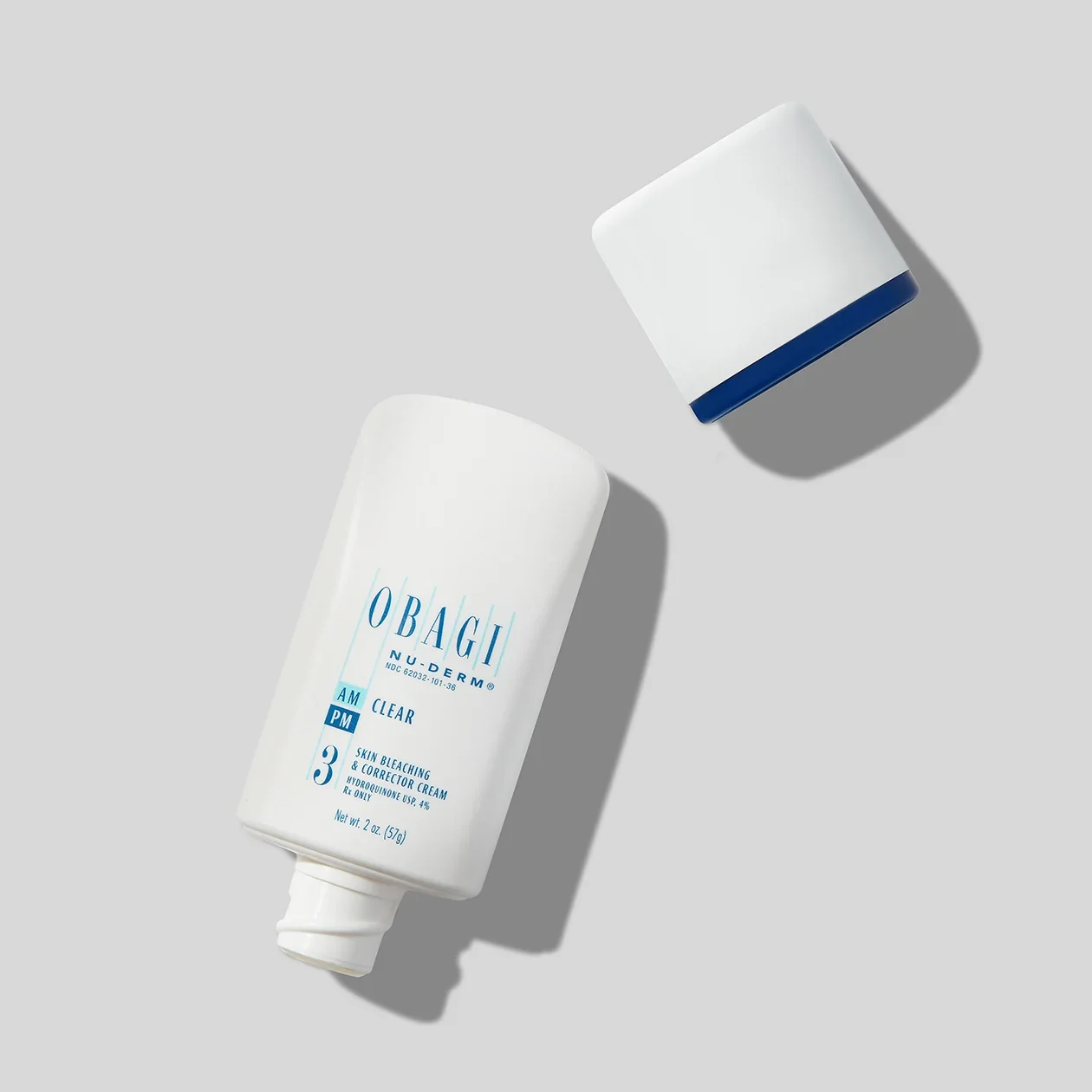
Hydroquinone is a tyrosinase inhibitor: it slows the enzyme that pigment cells use to make melanin. That is why, for more than 60 years, dermatologists have regarded it as the gold standard ingredient for stubborn pigmentation such as sun damage, age spots, the marks left behind after spots, and melasma. The British Association of Dermatologists describes it as a medicine commonly used for melasma that can only be prescribed by doctors.
What is exogenous ochronosis?
Exogenous ochronosis is an uncommon skin reaction in which pigment is deposited in the deeper layer of the skin (the dermis), producing blue-black or grey-blue patches, sometimes with tiny dark "caviar like" bumps, usually on the cheeks, temples and forehead. Under the microscope, pathologists see characteristic banana shaped, yellow brown fibres. It is associated with prolonged exposure to certain phenol chemicals, of which hydroquinone is the best known. It is not the same as endogenous ochronosis, the inherited metabolic condition alkaptonuria, which affects joints and cartilage and has nothing to do with skin creams.
The cruel irony is that a cream applied to lighten pigmentation can, in rare cases, cause a different, darker pigmentation. Because the earliest stage can look like melasma getting worse, some people respond by applying more. That is exactly why knowing the signs matters, and why I cover them further down.
How is exogenous ochronosis different from melasma or sun damage?
Why does ochronosis have such a frightening reputation?
Almost all of the fear traces back to South Africa in the 1970s and 1980s. Dermatologist G.H. Findlay and colleagues first described hydroquinone ochronosis in 1975, in women using strong bleaching creams of around 6 to 8.5% hydroquinone, sold freely as cosmetics and applied over the whole face and body, several times a day, for years and sometimes decades. A 1980 paper described it as a "South African epidemic", and a 1989 survey of two hospital outpatient departments found signs of ochronosis in 15% of Black men and 42% of Black women attending. South Africa limited hydroquinone in skin lighteners to 2% in 1983, and many countries, including the UK, later removed it from cosmetics altogether.
That history is real, and it is the reason hydroquinone is so tightly regulated today. But it describes unsupervised, high strength, cosmetic use in intense sun, which is about as far from a prescribed, monitored 4% programme in Cheshire as it is possible to get.
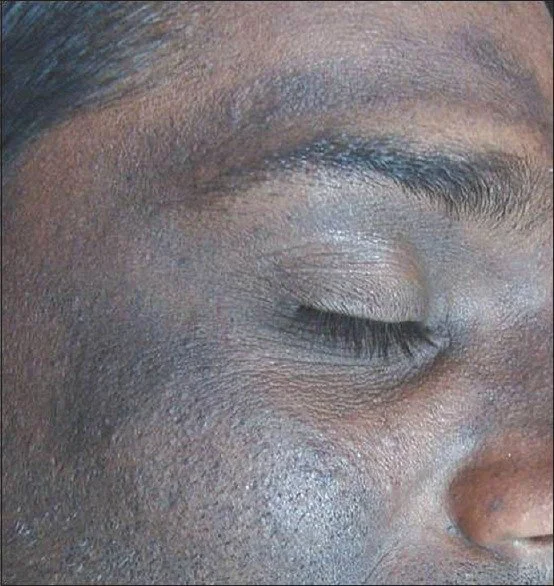
Photo credit: PubMed https://pmc.ncbi.nlm.nih.gov/articles/PMC4681189/
How common is hydroquinone ochronosis? What the 2022 systematic review found
In 2022, Ishack and Lipner published a systematic review in the International Journal of Dermatology. They searched the major medical databases for every published report of hydroquinone associated ochronosis and found 56 articles describing a total of 126 patients. That is the entire global published literature over roughly five decades. Here is what those 126 cases looked like.
Who were the 126 patients in the review?
How long had they been using hydroquinone?
The median duration of use was five years. Fewer than one in ten of the 126 patients had used hydroquinone for a year or less, and only four had used it for three months or less. In the overwhelming majority of reports, ochronosis was the consequence of years of continuous application, not a short, supervised course.
What strength of hydroquinone were they using?
In 35.7% of cases the concentration was above 4%, and in a further 32.5% it was unknown, which usually means an unlabelled or unregulated product. Together that is 68.2%, more than two thirds. Obagi Nu-Derm Clear and Blender contain a known, standardised 4%, made to pharmaceutical standards.
That still leaves roughly a third of cases at 4% or lower, so concentration alone does not remove the risk. Cases have been described with 2% products, including a 2026 US report of a man who developed ochronosis after six months of a 2% cream bought online. Notably, he was an outdoor worker with heavy sun exposure, and UV exposure is recognised as a risk factor for both developing ochronosis and making it worse.
Did the review prove that 4% hydroquinone is safe?
No, and I want to be straight about that. The authors concluded that concentrations above 4% and courses longer than three months "may be associated" with new ochronosis. That cautious phrase was chosen deliberately. A collection of case reports can describe who was affected, but it cannot tell us how many people used hydroquinone without any problem, so it cannot calculate a risk. For that we need to look at countries where hydroquinone use is widespread and well documented.
Takeaway: the 2022 review tells us who has been affected (mostly people using strong or unknown products for years), not how likely any one patient is to be affected. For the denominator, we need other data.
How rare is ochronosis where hydroquinone use is widespread?
The United States is the best natural experiment we have, because hydroquinone was sold there both over the counter at 2% and on prescription at 4% for decades, and American dermatologists publish prolifically.
In other words, tens of millions of exposures set against a case count you could fit on a couple of pages. When Dr Jacob Levitt reviewed the literature in 2007 he found "22 cases in more than 50 years" in the United States. (He declared a commercial interest in a hydroquinone product, which is worth knowing, although later authors with no such interest have reached similar numbers.)
Two further details stand out. A ten year review at a single Boston hospital identified 25 patients, who had used lightening creams for an average of 9.2 years; the shortest exposure was 1.5 years and the longest was 20 years of a 2% product. And US dermatologists reviewing the cases have noted that most involved 2% products, the strength that was sold over the counter without a prescription, which is precisely the situation that cannot legally arise in the UK.
Has ochronosis ever been reported with Obagi Nu-Derm?
The Obagi Nu-Derm System was launched in 1988, so it has now been prescribed by doctors around the world for 38 years. Its two hydroquinone products, Nu-Derm Clear and Nu-Derm Blender, each contain a standardised 4%, and in the UK both are prescription only medicines supplied through clinics such as ours after a consultation.
Because this question matters so much to my patients, I asked it directly. On 29 October 2026, the day before writing this article, I spoke with Mary Kelti, Head of Obagi Clinical UK, about ochronosis and the long term use of Obagi's hydroquinone products. She told me she was not aware of any reported cases of ochronosis with Obagi, and I came away from that conversation reassured. Separately, in preparing this article I have not been able to identify a single published medical case report attributing exogenous ochronosis to the Obagi Nu-Derm System.
I want to be careful about what that does and does not mean. Not every adverse reaction is published, and "not aware of any cases" is not the same as "it has never happened". But a system used for nearly four decades, under medical direction, at a known concentration, with no published ochronosis case that I can find, is meaningful reassurance, and it sits comfortably alongside the US figures above.

Dr Caroline Warden discusses the long term safety of Obagi 4% hydroquinolone
Does hydroquinone cause cancer?
This is the other fear I am asked about, so it deserves a straight answer. The concern comes from rodent studies in which animals were fed large oral doses of hydroquinone for two years and developed kidney and liver tumours and leukaemia. Those findings prompted the US FDA's 2006 review. They do not translate directly to a thin layer of 4% cream on the face. The International Agency for Research on Cancer classifies hydroquinone as Group 3, "not classifiable as to its carcinogenicity to humans", because the human evidence is inadequate and the animal evidence limited.
Writing in the Journal of the European Academy of Dermatology and Venereology in 2006, dermatologists Nordlund, Grimes and Ortonne noted that after 40 to 50 years of medical use there had "not been a single documented case of either a cutaneous or internal malignancy" linked to hydroquinone.
It is also worth knowing that hydroquinone occurs naturally in everyday foods, including coffee and certain fruits and cereals, and Levitt's 2007 review concluded that the amount absorbed from routine topical use is no greater than ordinary dietary exposure.
For balance: in 2022 a US research team analysed a large anonymised patient database and reported that people coded as exposed to hydroquinone had roughly three times the rate of skin cancer. It was presented as a conference poster, could not tell how much hydroquinone anyone actually used or for how long, and the authors and independent experts were clear that it shows an association, not causation. People prescribed hydroquinone tend, by definition, to have sun damaged skin, which is itself the biggest risk factor for skin cancer. It is a reason for ongoing research and for daily SPF, not evidence that the cream causes cancer. I will update this article if better evidence emerges.
Is it safe to use hydroquinone long term? How we prescribe Obagi Nu-Derm in Hale
Here is the distinction that matters most. There is a world of difference between applying hydroquinone twice a day, every day, for years, with nobody checking your skin, and using it within a structured, time limited programme reviewed by a doctor. Every piece of evidence above points to the first scenario, not the second.
I should be honest about the limits of the evidence here too. There are no long term trials specifically testing 4% hydroquinone used two or three times a week for many years, so I cannot promise that intermittent maintenance eliminates the risk. What I can say is that it keeps your exposure far below the pattern seen in reported cases, and that regular review means any early change would be caught quickly.
Takeaway: long term pigmentation control does not mean indefinite daily hydroquinone. It means an initial corrective course, then the least hydroquinone that holds your result, with breaks and reviews built in.
What are the warning signs of ochronosis to watch for while using hydroquinone?
None of these should be ignored, but none should cause panic either. The key message, echoed by every expert source, is stop and get it looked at rather than apply more. And any new or unusual skin change, whether or not you are using hydroquinone, should be checked by your GP.
Why does medical supervision matter so much with hydroquinone?
This is also why I would urge you never to buy hydroquinone products online without a prescription. You cannot verify the concentration, the formulation or even whether the product is genuine, and unregulated products are exactly where ochronosis keeps being reported. I explain how to check that your Obagi is genuine in a separate article.
So should you be worried about Obagi Nu-Derm and ochronosis?
My view as a GP and aesthetic doctor: the risk of ochronosis is real but small, it is concentrated in unsupervised, high strength, long term use, and it is best managed not by avoiding hydroquinone altogether but by prescribing it properly, reviewing it regularly and stopping it when it has done its job.
If you would like to see what a supervised Obagi Nu-Derm programme can achieve, there are examples on our Before and After page.
Frequently asked questions about hydroquinone, Obagi Nu-Derm and ochronosis
Is hydroquinone banned in the UK?
No. Hydroquinone has been banned from cosmetic products in the UK and EU since 2001, which is why it cannot legally appear in creams sold in shops or on online marketplaces, and why products seized by Trading Standards have contained 10% or more. As a medicine it is entirely legal: it is a prescription only medicine that a doctor or other independent prescriber can supply after assessing you. Obagi Nu-Derm Clear and Blender are prescribed on this basis.
Is 4% hydroquinone safe?
4% is the standard prescription strength used by dermatologists worldwide and the strength in the FDA approved prescription products in the United States. In the 2022 review, more than two thirds of ochronosis cases involved concentrations above 4% or unknown products, but cases at 4% and below have been reported, usually after years of use. The honest answer is that 4% hydroquinone is safe for most appropriately selected patients when used for limited periods under review, not that it is risk free.
How long can you use hydroquinone for?
At our clinic in Hale the initial corrective phase is usually 12 to 16 weeks, after which we review and move to maintenance. The product's own prescribing information advises stopping if there is no improvement after three months, and the British Association of Dermatologists recommends time limited courses under medical supervision rather than indefinite use. Most reported ochronosis cases followed a median of five years of continuous application.
Do I need to take breaks from hydroquinone?
In most cases, yes. After the initial phase we either reduce hydroquinone to two or three applications a week or pause it altogether, using hydroquinone free products such as Obagi's arbutin based Fx versions, tretinoin, vitamin C and daily SPF to hold your result. The plan is individual, based on how your skin responded and how much pigmentation remains.
Can hydroquinone make pigmentation worse?
It can, in three different ways. Irritation can trigger post inflammatory pigmentation, especially in deeper skin tones, which is why we adjust frequency rather than pushing through. Pigment can return when hydroquinone stops, particularly without sun protection; this is not ochronosis but is often mistaken for it. And rarely, prolonged use can cause true ochronosis, a grey blue darkening. Any darkening during treatment should prompt a pause and a review, never an increase in application.
Is exogenous ochronosis reversible?
Partially, and with difficulty, which is exactly why early recognition matters. Once hydroquinone stops, the pigment may fade a little but often persists because it sits deep in the dermis. In the Boston series, none of the 25 patients improved with creams alone, although small numbers responded to Q-switched laser treatment and microneedling. Caught at the earliest stage, stopping hydroquinone limits progression.
Is Obagi Nu-Derm safe for darker skin types?
Hydroquinone is used extensively in Black, Asian and mixed heritage skin and is often the most effective option for stubborn pigmentation in these skin types. Because reported ochronosis cases were concentrated in Fitzpatrick types V and VI, we are especially careful about assessment, sun protection and review in deeper skin tones, but skin type alone is not a reason to avoid treatment.
Can I buy Obagi Clear or Blender online without a prescription?
Not legally in the UK, and I would strongly advise against trying. Genuine Obagi hydroquinone products are only supplied against a prescription; anything offered without one is either being sold illegally or is not what it claims to be. Unregulated and online products are exactly where ochronosis keeps being reported, including the 2026 US case after six months of a 2% cream bought online.
What happens when I stop hydroquinone?
Hydroquinone suppresses pigment production while you use it; it does not destroy pigment cells, so when you stop, those cells gradually resume normal activity. In most people the improvement is well maintained with daily SPF and a maintenance routine, but pigmentation can slowly return, especially melasma after sun exposure. That is why we plan maintenance deliberately rather than relying on indefinite hydroquinone.
Is hydroquinone safe in pregnancy or breastfeeding?
No. The British Association of Dermatologists advises avoiding hydroquinone and retinoid creams in pregnancy, and the product information advises caution while breastfeeding. We do not prescribe Obagi Nu-Derm during pregnancy or breastfeeding, but we can plan a safe routine for that period and return to the system afterwards.
What are the alternatives to hydroquinone for pigmentation?
Options include tretinoin, azelaic acid, arbutin, vitamin C, kojic acid, cysteamine, thiamidol and tranexamic acid, as well as professional treatments such as the Obagi Blue Peel Radiance, and always strict daily SPF. Most are gentler and less potent than hydroquinone for stubborn pigmentation, but they are valuable for maintenance and for anyone who prefers to avoid hydroquinone. If you are unsure whether your pigmentation is melasma or sun damage, my guide to melasma versus sun spots explains the difference.
Next steps
If you are worried about hydroquinone, have been using Obagi Nu-Derm for some time, or would like to find out whether a supervised pigmentation programme is right for your skin, I would be happy to talk it through at a consultation at our clinic in Hale.
Learn more about Dr Caroline Warden Clinic
Learn more about other treatments offered
Further reading
- The Real Reason Your Tretinoin Is Not Working
- Why Obagi Is One of the Best Medical Grade Skincare Brands for Pigmentation and Post Inflammatory Marks
- Why You Should Not Buy Obagi Online: Why Authorised Stockists Matter
- Melasma vs Sun Spots in Perimenopause
- Medical Grade Skincare and Obagi in Hale, Altrincham and Cheshire
- Obagi Blue Peel Radiance
Dr Caroline Warden (GMC 6157708) is an NHS GP with over 19 years of clinical experience, an independent prescriber, and holds a Level 7 postgraduate diploma in cosmetic injectables. She has practised aesthetic medicine since 2017 and runs Dr Caroline Warden Skin & Aesthetic Clinic at 2 Crown Passages, Hale, Cheshire, WA15 9GN, serving patients from Hale, Altrincham, Bowdon, Alderley Edge, Wilmslow and across Cheshire. The clinic is an official Obagi Ambassador clinic and stocks Obagi products. This article provides general educational information and does not replace an individual assessment. Clinical information correct as of October 2026.
References
- Ishack S, Lipner SR. Exogenous ochronosis associated with hydroquinone: a systematic review. International Journal of Dermatology 2022;61(6): pages 675 to 684. https://doi.org/10.1111/ijd.15878
- Qorbani A, Mubasher A, Sarantopoulos GP, et al. Exogenous ochronosis (EO): skin lightening cream causing rare caviar-like lesion with banana-like pigments; review of literature and histological comparison with endogenous counterpart. Autopsy and Case Reports 2020;10(4):e2020197. https://doi.org/10.4322/acr.2020.197
- Mihailescu ML, Gonzalez A, Shivakumar V. Black malar papules following use of hydroquinone cream 2% purchased online. Cutis 2026;118(1): pages 13 to 15. Read the article
- Levitt J. The safety of hydroquinone: a dermatologist's response to the 2006 Federal Register. Journal of the American Academy of Dermatology 2007;57(5): pages 854 to 872. Read the abstract
- Lazar M, De La Garza H, Vashi NA. Exogenous ochronosis: characterizing a rare disorder in skin of color. Journal of Clinical Medicine 2023;12(13):4341. https://doi.org/10.3390/jcm12134341
- Nordlund JJ, Grimes PE, Ortonne JP. The safety of hydroquinone. Journal of the European Academy of Dermatology and Venereology 2006;20(7): pages 781 to 787. https://doi.org/10.1111/j.1468-3083.2006.01670.x
- Kooyers TJ, Westerhof W. Toxicology and health risks of hydroquinone in skin lightening formulations. Journal of the European Academy of Dermatology and Venereology 2006;20(7). Read the abstract
- International Agency for Research on Cancer. Hydroquinone. IARC Monographs Volume 71, 1999. Read the summary
- Miles B, Wilkerson M. Hydroquinone exposure and skin cancer risk, TriNetX database analysis presented at the Society for Investigative Dermatology annual meeting, 2022, reported by MDedge Dermatology. Read the report
- British Association of Dermatologists. Melasma: patient information leaflet, updated June 2024. Read the leaflet
- Local Government Association. Toxic skin creams still rife in cosmetics market, councils warn. Read the warning
- Southwark Council Trading Standards. Illegal skin lighteners. Read the guidance
- Findlay GH, Morrison JG, Simson IW. Exogenous ochronosis and pigmented colloid milium from hydroquinone bleaching creams. British Journal of Dermatology 1975;93(6): pages 613 to 622. Read the abstract
- Hardwick N, Van Gelder LW, Van der Merwe CA, Van der Merwe MP. Exogenous ochronosis: an epidemiological study. British Journal of Dermatology 1989;120(2): pages 229 to 238. https://doi.org/10.1111/j.1365-2133.1989.tb07787.x
- Bhattar PA, Zawar VP, Godse KV, et al. Exogenous ochronosis. Indian Journal of Dermatology 2015;60(6): pages 537 to 543. Read the review
- Dermatology News (MDedge). Hydroquinone: complications and controversies. Read the column
- Obagi Nu-Derm Clear and Blender: US prescribing information (hydroquinone USP 4%). Read the prescribing information
- Obagi Medical. Nu-Derm Clear product page and important safety information. Visit the Obagi page
- Happi. Treat and protect: Obagi Medical Products (company history confirming the 1988 launch of the Nu-Derm System). Read the article
- NBC News. FDA wants skin lightening cream restrictions (2006), including South Africa's 1983 limit on hydroquinone in skin lighteners. Read the report
