Heavy Brows, Brow Drop and Brow Lifts: A Doctor's Guide to Forehead Treatment

One of the most common things patients tell me is:
I want to look fresher, but I don't want to look frozen.
When I ask what "frozen" actually means to them, the answer is usually more specific than the word suggests. It is rarely a smooth forehead they are afraid of. It is heavy brows, hooded eyes and a face that looks tired in a new way.
That is a reasonable thing to be worried about, because it does happen, and it is almost always avoidable. It comes down to one muscle and one assessment most people never receive.
In this article:
- Why the forehead is the one area that can make you look worse
- The compensation most people do not know they are doing
- Why brows drop, and who is most at risk
- What a proper forehead assessment involves
- Whether a brow lift effect is real
- Whether using less is the answer
- What to do if it has already happened
- Frequently asked questions
The Forehead Is the One Muscle Holding Your Brows Up
This is the fact everything else follows from.
The frontalis is the only muscle that lifts your eyebrows. Everything else acting on the brow, the frown complex in the glabella and the muscles around the eye, pulls it down.
Your brow position at any moment is the result of that tug of war. Relax the only muscle pulling upwards, and the balance shifts downwards.
This is why the forehead is the one area where treatment can genuinely make somebody look worse, and why it deserves more assessment than any other part of the upper face.
A 2022 paper in Aesthetic Surgery Journal puts it plainly: the frontalis "has a critical role in aesthetic outcomes" and "should always be included in the assessment", even when the area being treated is the frown rather than the forehead itself (Bertucci et al.).
The Compensation Most People Do Not Know They Are Doing
Here is the part that rarely gets explained, and it is the reason two people with identical foreheads can have completely different outcomes.
Some people are unconsciously using their forehead muscle all day to hold up an eyelid that is already slightly heavy. The clinical term is involuntary frontalis activity compensating for levator insufficiency. In plain terms, the lid has lost a little lifting power with age, and the forehead has quietly taken over the job.
You would not know you were doing it. What you would notice is a horizontal line across the forehead that never fully goes away, because the muscle beneath it never fully switches off.
Now relax that muscle. You do not simply lower the brow. You remove the compensation and unmask an eyelid heaviness that was being hidden, which the same authors note is particularly a risk in older patients (Bertucci et al.).
That is how somebody ends up saying their eyes feel heavy after treatment, when the eyelid was never the area treated.
Why Brows Drop, and Who Is Most at Risk
| What causes it | What actually happens |
|---|---|
| Treating a frontalis that is doing compensatory work | The compensation is removed and previously hidden lid heaviness appears |
| Treating too low on the forehead | The lower fibres are the ones suspending the brow. Weakening them drops it directly |
| Treating the forehead without addressing the depressors | The downward pull is left unopposed |
| Spread of effect to neighbouring muscle | Placement and depth matter as much as amount |
| A brow that already sits low at rest | There was less margin to begin with |
| Higher risk if | Lower risk if |
|---|---|
| Your brows already sit low | Your brows sit high and your forehead is relaxed at rest |
| You have visible hooding of the upper lid | The lid is not hooded |
| You have a forehead line that never fully disappears | Your forehead is smooth when you consciously relax it |
| You are older, where lid changes are more common | You are younger with good lid position |
| You raise your brows constantly in conversation | You do not |
None of these are reasons not to treat. They are reasons to be assessed properly first, and in some cases to treat the frown and leave the forehead entirely.
What a Proper Forehead Assessment Involves
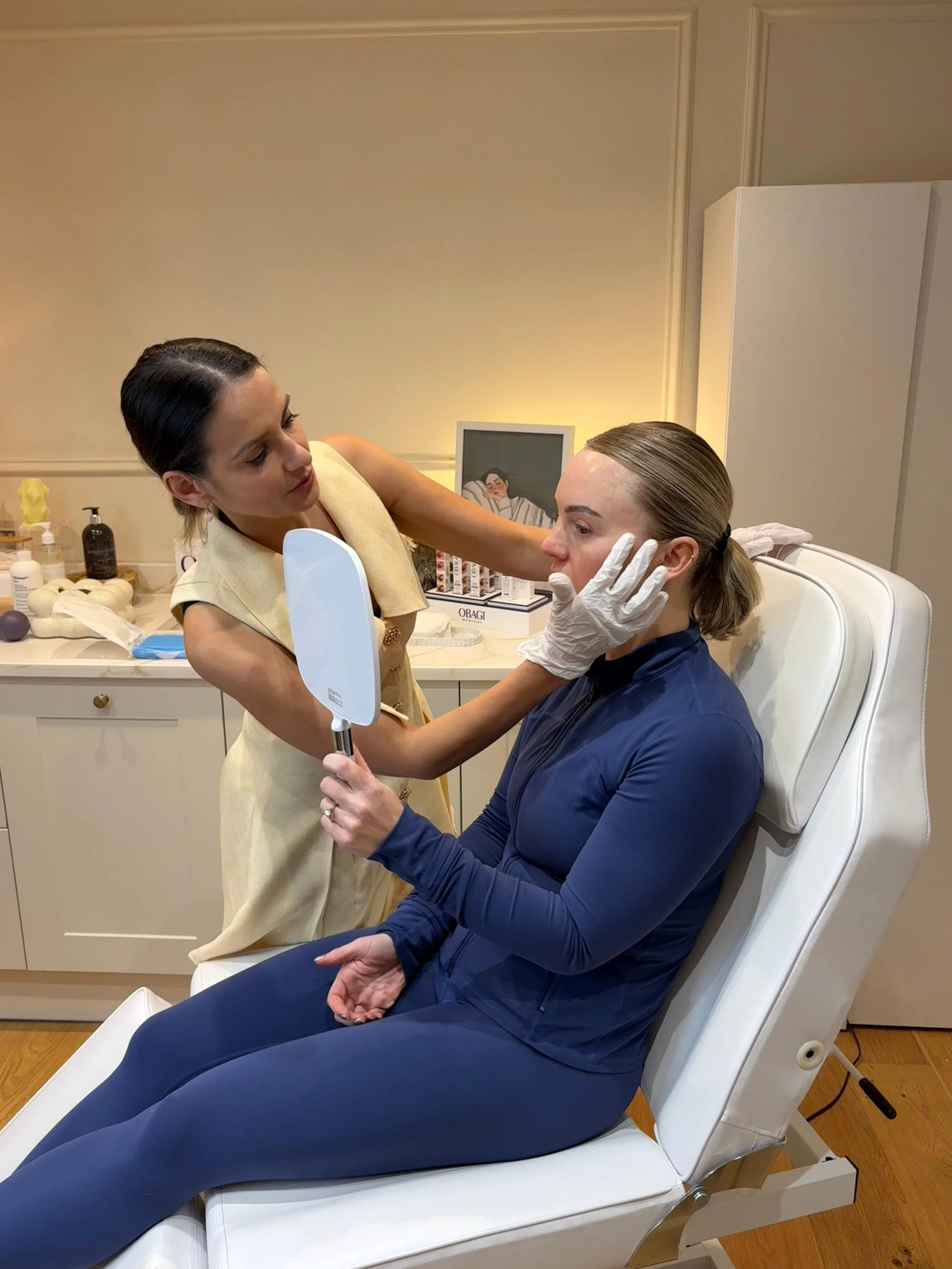
A photograph of a forehead tells me very little. I need to watch the face work.
| Step | What it tells me |
|---|---|
| You relaxed, upright, looking straight ahead | True resting brow position, and whether any forehead line persists at rest |
| You raising your brows to maximum | Strength and pattern of the frontalis, and where lines actually form |
| You frowning hard | Strength of the depressors, which decides how much the brow will fall if I treat above |
| Manually holding the forehead still | Whether the brow and lid hold position without it, which is how compensation is revealed |
| Palpating the muscle | Bulk and tone, which vary considerably between people |
| Comparing both sides | Natural asymmetry, which should be respected rather than erased |
That fourth step is the one that matters most and the one most often skipped. Holding the forehead still for a moment shows you what treating it will actually look like, before anything is injected.
Is a "Brow Lift" Real?
Partly, and the phrase needs using carefully.
Because brow position is a balance, reducing the downward pull of the depressors while leaving the frontalis alone can raise the brow slightly in some people. That effect is real. It is also modest, highly variable between individuals, and cannot be promised.
What it is not is an equivalent to surgery. A surgical brow lift repositions tissue. This adjusts a muscular balance temporarily, and it works best in people who have the anatomy for it in the first place.
If somebody guarantees you a brow lift from an injection, they are describing a mechanism as though it were an outcome.
Is Using Less the Answer?
This is the intuitive conclusion and it is not quite right.
In dose escalation studies across the main preparations, eyelid ptosis was low and not dose dependent, and no new safety signals emerged at substantially higher doses (Kaufman-Janette et al.). The problem is generally not how much. It is where, and whether the assessment was done.
Meanwhile, under treating a strong forehead tends to produce a patchy, uneven result that wears off quickly, so you get the inconvenience without the benefit.
The answer is not less. It is placed higher, balanced against the depressors, and sometimes not at all.
Dynamic Lines and Static Lines, Briefly
Worth a mention here because it changes what treating the forehead can achieve.
A dynamic line appears only on movement. A static line is visible when the face is completely relaxed, which means there is already structural change within the skin. Reducing movement stops further folding, but it does not rebuild collagen or reverse sun damage.
If a forehead line remains at rest, skin quality is usually doing at least half the work, and treating only the muscle will underwhelm. I have covered this in more depth in my guide to forehead lines, frown lines and crow's feet.
What If It Has Already Happened?
If you are reading this because your brows feel heavy after treatment somewhere else, the most useful thing I can tell you is that it is temporary.
| What to expect | Detail |
|---|---|
| It resolves | The effect wears off as the muscle recovers, typically over weeks to a few months depending on when you were treated |
| It often improves before it fully wears off | Partial recovery of the frontalis usually restores enough lift to feel normal sooner than the full duration |
| Some asymmetry can sometimes be balanced | Occasionally a small adjustment elsewhere helps. This needs assessing, not guessing |
| It should change what happens next time | Whoever treats you next should know it happened, where you were treated and at what dose |
Go back to whoever treated you first. A practitioner who will not see you when something has not gone to plan is the actual problem, and it is worth knowing that before you book anywhere.
Refreshed, Not Frozen: What That Actually Means
Faces are supposed to move. Expression communicates warmth, surprise and interest, and removing it does not make somebody look younger. It makes them look absent.
For me a natural result means that when you talk and smile, your face still feels like your face. It means respecting natural asymmetry rather than promising perfect symmetry. And it means knowing when treatment is unlikely to improve the thing that is actually bothering you.
Which is why I think "frozen or not frozen" is too crude a question. A better one is:
How much movement would you like to keep?
That gives us something meaningful to work with, and it is a decision for you rather than a default for me.
Frequently Asked Questions
Why do my eyebrows feel heavy after forehead treatment?
The forehead muscle is the only one that lifts your brows. If it is relaxed, the muscles pulling downwards are less opposed and the brow sits lower. In some people the forehead was also quietly compensating for a slightly heavy eyelid, so treating it reveals heaviness that was previously hidden.
Is brow drop permanent?
No. It resolves as the effect wears off, usually over weeks to a few months, and often feels normal again before it has fully worn off.
Why do my eyes look hooded when I did not have my eyes treated?
Because the forehead was doing work you did not know about. Involuntary frontalis activity can compensate for reduced lid lifting power, so relaxing the forehead unmasks it. This is more common with age.
Can it be fixed?
Sometimes an adjustment elsewhere improves the balance, but it needs proper assessment rather than more product added hopefully. Otherwise it is a matter of waiting, and it does resolve.
Does a lower dose prevent it?
Not reliably. Ptosis rates in dose escalation studies were low and not dose dependent. Placement, height on the forehead and whether the depressors were addressed matter more than total amount.
Can injections lift my brows?
In some people, yes, by reducing the downward pull rather than by lifting directly. The effect is modest, varies a lot between individuals and cannot be guaranteed. It is not comparable to surgery.
Should I avoid forehead treatment altogether?
Not necessarily. But for some people the right plan is to treat the frown and leave the forehead alone, and that should be decided at assessment rather than discovered afterwards.
How do I know if I am at risk?
Relax your face completely in a mirror. If your brows already sit low, your upper lids look hooded, or there is a forehead line that never quite disappears, say so at your consultation. Those are the things worth flagging.
Consultations in Hale, Altrincham and Cheshire
At Dr Caroline Warden Skin & Aesthetic Clinic in Hale, every consultation, treatment and review is carried out personally by me. There is one injector and nothing is delegated.
I assess every forehead at rest and in movement before anything is agreed, including the manual test above, because it is the single best predictor of whether treatment will suit you. Sometimes that assessment leads me to recommend treating less than expected, or not treating the forehead at all.
Patients travel to us from Hale, Altrincham, Bowdon, Hale Barns, Timperley, Wilmslow, Sale, Stockport, South Manchester and across Cheshire. You are welcome to book a consultation for lines and wrinkles, and there is no obligation to proceed.
Further Reading
- Forehead Lines, Frown Lines and Crow's Feet: A Doctor's Guide
- Why Less Is Not Automatically More Natural
- The Most Common Mistakes Patients Notice
- Why Some Aesthetic Treatments Look Unnatural
- Anti wrinkle injections at the clinic, if movement is the dominant problem
- What Actually Works for Under Eye Ageing
Next Steps
Learn more about Dr Caroline Warden Clinic
Learn more about other treatments offered
About the Author
Dr Caroline Warden is a practising NHS GP and aesthetic doctor with nearly twenty years of clinical experience, an independent prescriber, and holder of a Level 7 postgraduate diploma in cosmetic injectables. She is Medical Director and sole practitioner at Dr Caroline Warden Skin & Aesthetic Clinic, 2 Crown Passages, Hale, Altrincham. GMC number 6157708.
This article is for information only and does not constitute individual medical advice. It describes treatments that may be appropriate following an individual consultation and assessment.
References
- Bertucci V, Carruthers JD, Sherman DD, Gallagher CJ, Brown J. Integrative assessment for optimizing aesthetic outcomes when treating glabellar lines with botulinum toxin type A: an appreciation of the role of the frontalis. Aesthetic Surgery Journal. 2022;43(Suppl 1):S19-S31. View paper
- Kaufman-Janette J, Cox SE, Dayan S, Joseph J. Botulinum toxin type A for glabellar frown lines: what impact of higher doses on outcomes? Toxins. 2021;13(7):494. View review
- Padda IS, Tadi P. Botulinum toxin. In: StatPearls. Treasure Island (FL): StatPearls Publishing; updated 2023. View chapter