Lines and Wrinkles Treatment in Hale, Altrincham and Cheshire

Last updated: 30 September 2026
Doctor-led treatment for fine lines, expression lines and ageing skin
Lines and wrinkles are a normal part of ageing, but not all wrinkles form for the same reason, and they should not all be treated the same way. Some lines appear only when you move your face. Others are there when your face is completely still. Some are not really wrinkles at all, but shadows and folds caused by the face losing support underneath the skin. Fine crepey lines are usually a sign that the skin itself has thinned.
At my clinic in Hale, near Altrincham, I take a whole-face, skin-first approach. Rather than treating each line where you can see it, I look first at why it has developed and which layer of the face is responsible. The aim is not to remove every line or leave you expressionless. It is to help you look fresher and rested while still looking entirely like yourself.
In this article:
- Why do we get lines and wrinkles?
- What type of wrinkles do I have?
- Which areas of the face are most affected?
- Which treatments actually improve wrinkles?
- Do I need more than one treatment?
- What does wrinkle treatment cost in Hale and Altrincham?
- Your consultation
- Frequently asked questions
Why do we get lines and wrinkles?
Skin ageing is driven by two sets of forces. The first is intrinsic: genetics, hormones and the natural slowing of collagen and elastin production that begins in our mid-twenties and accelerates around the menopause. The second is extrinsic: sun exposure above all, but also smoking, pollution and repeated facial movement. A widely cited review in the journal Dermato-Endocrinology describes skin ageing as a process
"influenced by a combination of endogenous or intrinsic and exogenous or extrinsic factors."
Ganceviciene R et al., Dermato-Endocrinology, 2012
This is why two people of the same age from the same street in Bowdon or Wilmslow can have completely different faces, and why there is no single "best wrinkle treatment" for everyone.
What type of wrinkles do I have?
Knowing the type of line is far more useful than knowing where it sits. Four patterns cover almost everyone who walks into my clinic.
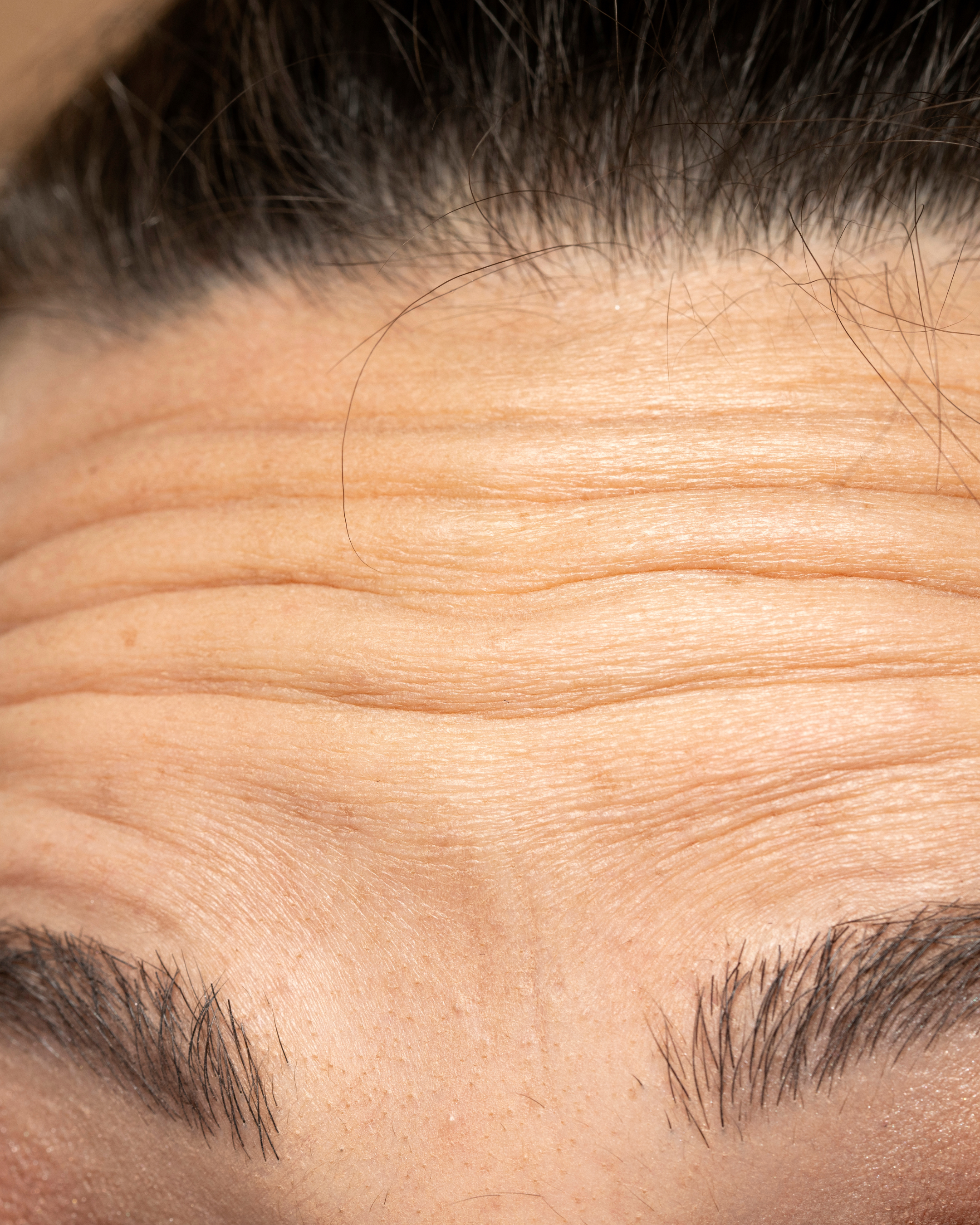
Dynamic or expression lines
These form because the muscle underneath contracts and folds the skin. In suitable patients they respond best to anti-wrinkle injections, because the treatment addresses the movement creating the crease. Read the detailed guide to forehead lines, frown lines and crow's feet.
Static or etched lines
Once a line is etched in, relaxing the muscle stops it deepening and softens it, but rarely removes it. At that point the skin itself needs treating, with retinoids, microneedling, polynucleotides or skin boosters. I explain this in why your wrinkles are still there after anti-wrinkle injections.
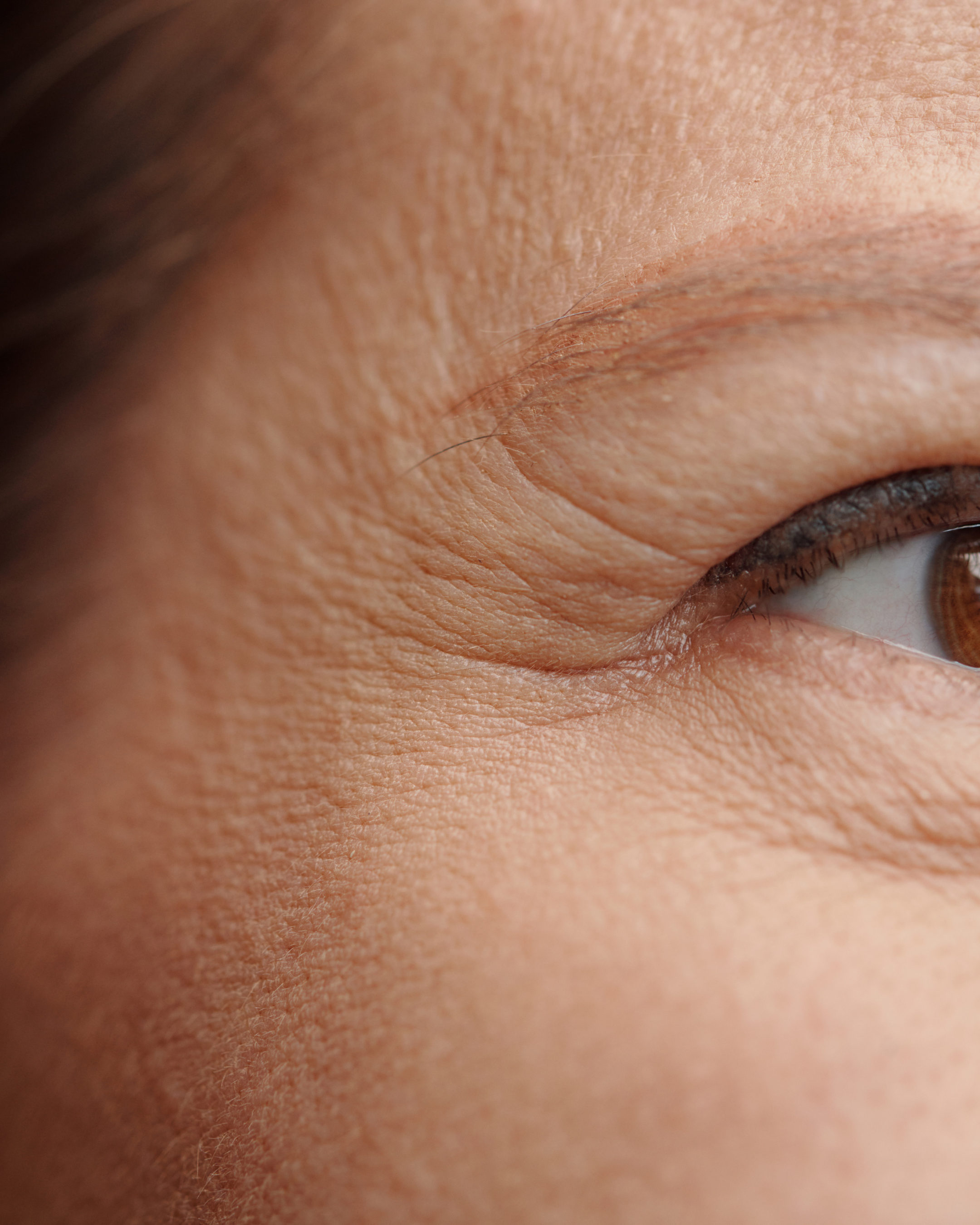
Fine and crepey lines
Here the problem is thin, dry, under-supported skin, not movement. Adding volume is rarely the answer. Treatment focuses on hydration, collagen and elasticity. See my guides to the crepey neck and ageing hands.
Folds caused by loss of facial support
Not every fold is a wrinkle. As fat, ligaments and bone change with age, the surface of the face drapes differently. Filling the fold itself often looks heavy. Restoring support elsewhere, with Sculptra, Radiesse or carefully placed filler, usually looks far more natural. I explain the anatomy in the Triangle of Youth, and the lower face specifically in what actually works for jowls.
The layer causing the line decides the treatment. Muscle, skin, or support underneath. Get that wrong and the result is either disappointing or overdone.
Which areas of the face are most affected?
Which treatments actually improve wrinkles?
No single treatment addresses every layer of facial ageing. At consultation I work out which layer is causing the problem and match the treatment to it.
A note on anti-wrinkle injections
Anti-wrinkle injections use a prescription-only medicine, most commonly botulinum toxin (Botox is one brand), so whether it is a suitable option for you can only be decided at a face-to-face consultation with a prescriber. As with any prescription treatment there are risks, including bruising, headache, a temporary heavy brow or eyelid droop, and asymmetry, and it is not suitable in pregnancy, breastfeeding or with certain neuromuscular conditions. At my clinic every consultation and every treatment is carried out by me personally.
Do I need more than one treatment?
Sometimes, but not always. Because facial ageing happens at several layers at once, a single treatment cannot always address every concern, and the honest answer at consultation is often fewer treatments than you expected.
The aim is not to accumulate treatments. It is to find the smallest number that will make a meaningful, natural difference, and sometimes that number is zero.
What does wrinkle treatment cost in Hale and Altrincham?
A new-patient consultation is £75, redeemable against treatment. Because the right treatment depends on the type of line, prices vary from a skincare programme to a course of collagen stimulation. Current prices for every treatment are on the price list, and I explain what sits behind the anti-wrinkle and Sculptra prices in what you are actually paying for and what a full Sculptra course involves.
Natural-looking results, not a frozen face
The most common thing patients say to me is some version of "I don't want to look different, I just want to look fresher." That is my philosophy too. Good aesthetic treatment should not erase every sign that you have lived, laughed or frowned. Some movement and some lines are part of what makes a face look human. I wrote about why the best results are usually the ones nobody notices in this post, and about what goes wrong when treatment is overdone in frozen foreheads, heavy brows and Spock arches.
Your consultation
Every new patient starts with a consultation with me. I look at your facial anatomy and movement, skin quality, how much support has been lost, any previous treatments, your medical history and medications, and what actually bothers you. Sometimes the recommendation is an injectable. Sometimes it is skincare. Sometimes it is a combination, and sometimes it is to do nothing for now. You do not need to decide what you want before you arrive; working that out is the point of the appointment. If anything I see looks like it needs medical attention rather than cosmetic treatment, I will tell you and suggest you see your own GP.
The clinic is in Hale, near Altrincham, and welcomes patients from across Cheshire and south Manchester, including Bowdon, Hale Barns, Wilmslow, Alderley Edge, Knutsford, Sale, Didsbury and Stockport.
Book a consultation for lines and wrinkles
Frequently asked questions
What is the best treatment for wrinkles?
There isn't one. Expression lines respond to anti-wrinkle injections, fine etched lines to skin-quality treatments, and deep folds to restoring support. The consultation works out which you have.
What is the difference between fine lines and wrinkles?
Fine lines are shallow surface changes from thinning, dry skin. Wrinkles are deeper creases, usually from repeated movement or lost support. They often coexist and need different approaches.
Can wrinkles be removed completely?
Rarely. The realistic goal is to soften them and stop them deepening. Etched lines improve but usually do not vanish.
Can anti-wrinkle injections remove deep wrinkles?
They stop the movement that made the wrinkle, which softens it. A line that is deeply etched at rest usually also needs skin treatment.
Do I need injections at all?
Not necessarily. Many wrinkles are caused by skin quality, sun damage or lost support rather than muscle, and for those, injections into the muscle are the wrong tool.
At what age should I start wrinkle treatment?
There is no correct age. Treatment is based on what your face is doing, not your birthday. See my guide to treatments by decade.
Can skincare really improve wrinkles?
Yes, for fine lines and skin quality, particularly prescription retinoids and daily SPF used consistently. It will not replicate injectable treatment where strong movement or structural loss is the cause.
Will treatment make me look frozen?
That is never the aim. I use a conservative, anatomy-led approach that softens unwanted movement while keeping natural expression.
Why do I have wrinkles at 35 when my friends don't?
Genetics, sun exposure, smoking and how expressive your face is all matter more than age alone.
Are wrinkle treatments safe?
In a doctor-led clinic with full assessment, yes, though every treatment carries risks, which I explain at consultation. If you want to know what to look for when choosing a clinic, read how to choose an aesthetic clinic safely.
Related reading
- Forehead lines, frown lines and crow's feet: a doctor's guide
- Why your wrinkles are still there after anti-wrinkle injections
- Why collagen declines and the treatments that actually stimulate it
- Menopause and facial ageing explained
- What happens if you stop having anti-wrinkle injections?
- Retinol vs prescription retinoids: what the evidence shows
Next steps
Learn more about Dr Caroline Warden Clinic
Learn more about other treatments offered
References
Written by Dr Caroline Warden, NHS GP with over 19 years of clinical experience, independent prescriber and Level 7 qualified aesthetic doctor. GMC 6157708. Dr Caroline Warden Skin & Aesthetic Clinic, 2 Crown Passages, Hale, Altrincham, Cheshire WA15 9GN.