Keratosis Pilaris: The “Chicken Skin” Condition That Isn’t Just Dry Skin
Written by Dr Caroline Warden, NHS GP and Level 7 trained Aesthetic Doctor, Dr Caroline Warden Skin & Aesthetic Clinic, Hale, Cheshire. Last reviewed: September 2026.
Keratosis pilaris is usually dismissed as dry skin or blocked pores. In reality it is a disorder of keratinisation, it behaves nothing like acne, and the thing most people do to fix it is the thing making it worse.
What I hear most often:
I exfoliate constantly and nothing changes. My arms look spotty whatever I do. I have had this since my teens, will it ever go?
If that sounds familiar, you are in very large company. It affects around 40% of adults and between 50 and 80% of adolescents, and the true figure is probably higher because most people never mention it to anybody (Pennycook and McCready).
In this article:
- What is actually happening in the skin
- Where it appears, and why the face is different
- Why it happens, and what it is not caused by
- The two patterns, and why it matters which you have
- Why exfoliating harder makes it worse
- What actually works, and at what strength
- How to build a routine that holds
- What does not work, and what to stop spending money on
- Whether it improves with age
- Frequently asked questions
What Keratosis Pilaris Actually Is
It is a disorder of keratinisation, meaning the skin sheds keratin unevenly.
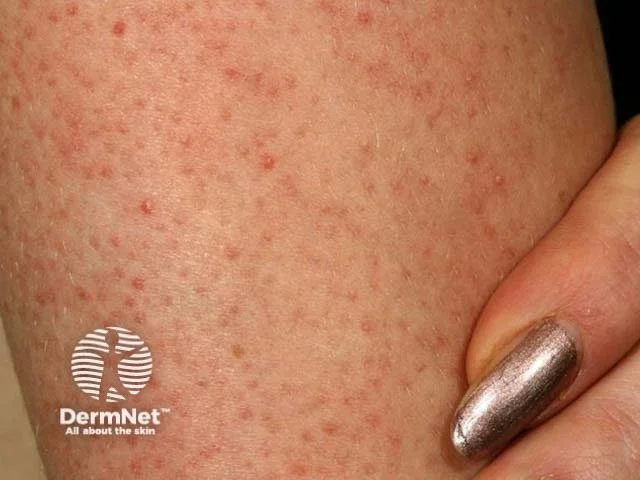
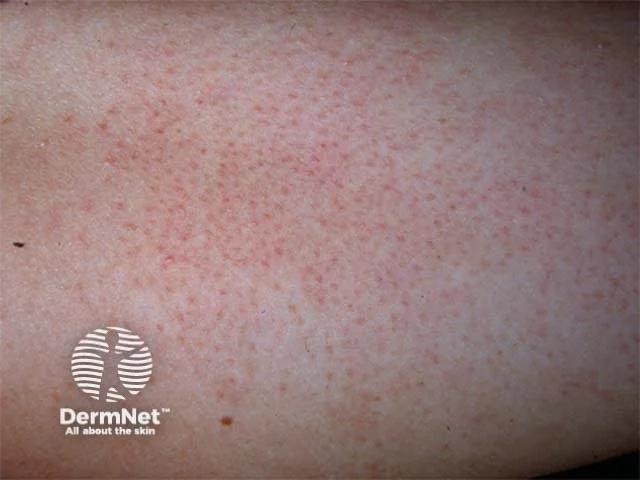
Instead of shedding smoothly, keratin builds up inside the hair follicle and forms a small plug. That plug is what you feel as a rough, raised bump. Coiled hairs are often trapped within the lesions, and the plug causes redness and scaling around the follicle opening (Pennycook and McCready).
The bumps can be skin coloured, pink or red, or brown, which is more common in deeper skin tones. The overall feel is often described as sandpaper, or permanent goosebumps.
It is not an infection, it is not acne, and it has nothing whatsoever to do with hygiene.
Where It Appears
| Common sites | Less common sites |
|---|---|
| Upper arms | Forearms |
| Thighs | Lower legs |
| Buttocks | Jawline |
| Cheeks, especially in children and young adults |
Facial keratosis pilaris is increasingly common and is frequently mistaken for acne, rosacea or folliculitis, which leads to treatments that actively make it worse. If you have been treating cheek bumps as adult acne without improvement, this is worth considering.
Why It Happens
It is largely genetically determined, and there is usually a family history even if nobody has ever named it.
| Contributing factor | Detail |
|---|---|
| Inherited barrier differences | The underlying tendency, and the reason it runs in families |
| Dry or eczema prone skin | Strongly associated. So is ichthyosis vulgaris |
| Atopic conditions | Eczema, asthma and hay fever all travel with it |
| Hormonal change | Often noticed in adolescence and around pregnancy |
| Cold, dry weather | Which is why it reliably worsens over a British winter |
It is not caused by dirt, blocked pores, poor diet or insufficient exfoliation. That is worth saying clearly, because a great many people carry a quiet sense that their skin looks unclean.
The Two Patterns
Most people have a mix, but one usually dominates, and it changes what to reach for.
| Textural | Inflammatory | |
|---|---|---|
| What you see | Rough, bumpy texture with minimal redness | Red or pink bumps with background redness, sometimes called keratosis pilaris rubra |
| Where | Most often arms and thighs | Most often arms and face |
| Mistaken for | Dry skin | Acne |
| What to prioritise | Keratolytics and moisturisation | Calming ingredients first, acids second and cautiously |
Why Exfoliating Harder Makes It Worse
This is where most people go wrong, and it is completely understandable. The bumps feel like something that should scrub off.
Because the problem starts inside the follicle, scrubbing the surface cannot reach it. What aggressive exfoliation does instead is irritate already fragile skin, increase redness and inflammation, damage the barrier, and make the whole thing look worse.
Scrubs, loofahs, harsh acids and daily exfoliation reliably exaggerate it, particularly in sensitive or eczema prone skin, which is exactly the skin most likely to have it in the first place.
If you have been exfoliating for years and it has not improved, that is not because you have not tried hard enough. It is because harder was never the answer.
What Actually Works, and at What Strength
This is the part almost nobody publishes, so here are the actual figures from the published evidence.
| Ingredient | Strength and use studied | What it achieved |
|---|---|---|
| Urea | 20% cream, once daily | Significant texture improvement within one week, sustained at four weeks, with no adverse events |
| Lactic acid | 10%, twice daily for 12 weeks | 66% mean improvement in roughness and appearance |
| Salicylic acid | 5%, twice daily for 12 weeks | 52% mean reduction in lesions |
| Glycolic acid | High concentration, 50 to 70%, in clinic | Improved redness and papules, but no significant difference by five year follow up |
| Polyhydroxy acids | Gentler alternative | Less irritating option where lactic or salicylic acid stings, though less directly studied |
Figures from a 2025 review in Cureus (Dampa), and from StatPearls, which notes that texture improves with either 6% salicylic acid lotion or 20% urea cream while most other treatments lack controlled trials (Pennycook and McCready).
Two things to take from that table. Urea at 20% works fastest and is the best tolerated, which makes it the sensible starting point for most people. And every one of these is cosmetic improvement requiring ongoing maintenance. None of them alters the underlying tendency.
How to Build a Routine That Holds
Order of operations matters more than any single product.
| Step | What to do | Why |
|---|---|---|
| 1. Barrier first | Gentle, non foaming wash. Stop anything stripping | Keratosis pilaris skin is usually barrier impaired. Actives fail on a damaged barrier |
| 2. Moisturise properly | A rich cream, applied to damp skin after washing | Moisturisation matters more than exfoliation here, which surprises people |
| 3. Add one keratolytic | Start with 20% urea, or 10% lactic acid | One at a time, so you know what is doing what |
| 4. Build slowly | Two or three times a week, not daily | More is not better. Irritation undoes the benefit |
| 5. Calm if inflamed | Niacinamide, azelaic acid, ceramides | Where redness dominates, calming beats acids |
| 6. Reduce friction | Looser clothing, avoid heat and tight fabrics | Friction and heat reliably worsen the inflammatory pattern |
Consistency matters far more than intensity. A gentle routine used four times a week for three months beats an aggressive one abandoned after a fortnight, every time.
What Does Not Work
Worth knowing before you spend anything.
| Commonly tried | The honest position |
|---|---|
| Body scrubs and exfoliating mitts | Cannot reach the plug and worsen inflammation |
| Dry brushing | Same problem, plus friction |
| Changing your diet | No strong evidence that diet causes it or resolves it |
| Antibacterial washes | It is not an infection and there is nothing to kill |
| Acne treatments | Common mistake with facial keratosis pilaris. Usually makes it redder |
| Expecting a cure | There is not one. There is good management |
Lasers and light based treatments are sometimes offered for the redness component. The evidence is limited, it addresses appearance rather than the underlying tendency, and it is not something offered at this clinic, so I have no interest either way in whether you try it.
Does It Improve With Age?
Often, though not always.
Many people find it softens through their thirties and forties, becomes less inflamed over time, and shifts with hormonal change. Others find it persists, particularly on the arms and thighs, which is why maintenance rather than cure is the realistic framing.
Keratosis Pilaris and Sensitive Skin
It overlaps heavily with eczema prone skin, rosacea tendencies and allergic conditions. It is also associated with ichthyosis vulgaris.
That overlap is precisely why trend led or aggressive routines backfire so reliably on this particular group. The skin that most commonly has keratosis pilaris is also the skin least able to tolerate what the internet recommends for it.
The Bit Nobody Mentions
It is medically harmless and emotionally significant, and those two things are not in conflict.
People avoid sleeveless clothing. They feel self conscious every summer. Many carry a quiet worry that their skin looks unclean, which is both untrue and very common. And most have spent years cycling through products that were never going to work.
Dismissing this as "just cosmetic" ignores what it actually costs people. The goal is not poreless perfection. It is that it stops being the first thing you notice about yourself.

What I Can and Cannot Help With
Worth being clear, so nobody books the wrong appointment.
| What this clinic does | What belongs with your GP |
|---|---|
| Guidance on barrier repair and medical grade skincare | Diagnosing a skin condition |
| Helping you build a routine that is actually tolerable | Prescription treatment for a skin condition |
| Telling you honestly what is not worth buying | Anything patchy, painful, infected or rapidly changing |
| Skin quality treatments where appropriate | Associated conditions such as eczema |
Keratosis pilaris is not something I treat as a medical condition here, and there is no clinic treatment that cures it. What there is, is sensible skincare guidance from somebody who will tell you when a product is not going to help.
If your skin is painful, infected, rapidly changing, or you are not certain what you are dealing with, see your own GP.
Frequently Asked Questions
What is the best treatment for keratosis pilaris?
Twenty percent urea cream has the best combination of speed, tolerability and evidence, with significant texture improvement reported within a week. Ten percent lactic acid twice daily achieved 66% mean improvement over twelve weeks. Both need continuing to maintain the result.
Is keratosis pilaris acne?
No. It is a keratinisation problem, not bacteria or blocked pores, which is why acne treatments often make it redder rather than better.
Can it be cured?
No, but it can be significantly improved. It is a long term skin tendency rather than a disease to eliminate, and all effective treatments are maintenance rather than cure.
Can it be scrubbed away?
No, and trying is the most common reason people make it worse. The plug sits inside the follicle where a scrub cannot reach, and the friction increases inflammation.
What strength urea should I use?
Twenty percent is the concentration with published evidence for keratosis pilaris. Lower strengths are moisturising but less keratolytic.
Does it worsen in winter?
Yes. Cold weather and low humidity reliably worsen it, which is why many people find it settles over summer and returns each autumn.
Is it caused by diet?
There is no strong evidence that diet causes it. General skin health influences inflammation, but no dietary change resolves it.
Is it linked to eczema?
Yes. It is considerably more common in people with atopic, eczema prone skin, and is also associated with ichthyosis vulgaris.
Why is it on my face?
Facial keratosis pilaris is increasingly recognised and is often mistaken for acne, rosacea or folliculitis. If cheek bumps have not responded to acne treatment, this is worth considering.
How long before I see a difference?
With 20% urea, texture can improve within a week. With acids, allow twelve weeks of consistent use before judging it. Stopping returns you to baseline over a few months.
Skin Consultations in Hale, Altrincham and Cheshire
A great many people arrive having been told for years that nothing can be done about this, which is not quite true. It cannot be cured, but the difference between a well managed and a badly managed routine is substantial.
What I can do is look at what you are using, tell you what is likely helping and what is almost certainly irritating it, and build something simple enough that you will actually keep doing it. Often that means fewer products than you arrived with.
Patients travel to us from Hale, Altrincham, Bowdon, Hale Barns, Timperley, Wilmslow, Knutsford, Sale, Stockport and across Cheshire. You are welcome to book a skin consultation, with no obligation to buy anything afterwards.
Further Reading
- Understanding the Skin Barrier
- Why Is My Skin Suddenly Sensitive?
- Five Skincare Ingredients I Would Be Careful With
- Rescuing Dry Skin in Winter
- Medical grade skincare in Hale, Altrincham and Cheshire
Next Steps
Learn more about Dr Caroline Warden Clinic
Learn more about other treatments offered
About the Author
Dr Caroline Warden is a practising NHS GP and aesthetic doctor with nearly twenty years of clinical experience, an independent prescriber, and holder of a Level 7 postgraduate diploma in cosmetic injectables. She is Medical Director and sole practitioner at Dr Caroline Warden Skin & Aesthetic Clinic, 2 Crown Passages, Hale, Altrincham. GMC number 6157708.
This article is for information only and does not constitute individual medical advice or a diagnosis. Skin conditions should be assessed by your own GP.
References
- Pennycook KB, McCready TA. Keratosis pilaris. In: StatPearls. Treasure Island (FL): StatPearls Publishing; updated 2023. View chapter
- Dampa E. The effectiveness of topical keratolytics (alpha hydroxy acids, beta hydroxy acids, urea) in treating keratosis pilaris: a review of the literature. Cureus. 2025;17(12):e100507. View review
- NHS. Keratosis pilaris. Read more
- DermNet. Keratosis pilaris. Read more